Aurora Nealand is a multi-instrumentalist (clarinet/ sax/ accordion/ voice/ unsuspecting everyday objects) who’s difficult to summarize in the allotted 2–3 sentences, not least of all because she ranks in this particular editor’s musical pantheon alongside the likes of Bob Dylan. Nealand’s “trad” jazz band, the Royal Roses, was a longtime weekly fixture on Frenchmen Street. Her other projects, to name just a few, include the Monocle (original compositions), redrawblak (experimental jazz), and Rory Danger & the Danger Dangers (rockabilly + mosh pit, whaling, reincarnation, etc.)
***Thank you to the Threadhead Foundation for supporting our editorial work in 2026!***

[Photo: Jason Steger.]
DISCOVERING FRENCHMEN
[Café Brasil, Z’otz, & other spots]
Aurora Nealand, 12/11/2022: I came to New Orleans in November of 2004, and the first time I hung out on Frenchmen was probably a week after. I was living way uptown on State Street and Magazine–I had just answered an ad on Craigslist–and I remember biking downtown once I discovered Frenchmen Street, which for me was an incredible little haven and paradise. Still quite small [in those days], but worth biking all the way across town for.
My original Frenchmen Street interactions as a player were mostly centered around The Spotted Cat. As a listener, I would go to Café Brasil a lot. And I would go to the Dragon’s Den, [with the old] Z’otz coffee shop, after I finished playing a gig.
Café Brasil was kind of the centerpiece. There was a flamenco group with Jonathan Lawrence that performed every week–a troupe of dancers and guitarists, and singers–and string quartets every week. I think it was Matt Rhody maybe leading those string quartets? That [scene] was the most impressionable thing – I immediately was like, “What is happening here?” … I do remember there was more diversity of music on Frenchmen Street pre- and [immediately] post-Katrina in terms of style.
The Dragon’s Den also, at that time, when the old Z’otz coffee shop was downstairs: upstairs was music, performance, and improvisation, and then downstairs was this wild, feral coffee shop crowd. They stayed open until two in the morning, so a lot of the younger weirdos and punks that you were meeting would hang out there at midnight and play chess and drink tea.
Laura DeFazio: Sort of like Flora’s a little bit?
Aurora: A little bit like Flora’s, yeah. I’d go there after gigs. I remember seeing my friend AK– AK had a child who was two years old, maybe. Little punk kid–a child of punks–would just be curled up in the corner at two in the morning [underneath] anarchist zines. People playing chess in the corner, people drunk on whiskey over there… I don’t think they could sell alcohol, but Dragon’s Den was upstairs. It was super chill vibes.
There was something really sweet about playing live music in these tiny clubs and then going to a coffee shop at one in the morning. It was just a different scene, you know? Z’otz later moved around the corner, to where Kava was. [Kava Coffee & Laundromat had been located at 435 Esplanade in the ‘90s and into the ‘00s.] Then it moved Uptown to Oak Street.
[…] What else? The Dream Palace was there for a minute–I remember seeing Kufaru play. I didn’t know him super well because he passed away soon after [6/12/2006], but a lot of older musicians would talk about him. Satsuma used to be a place called Coffea [closed in 2009], and they had a mural of Kufaru on the wall.
Also, I think Apple Barrel is such a special, weird little place. The fact that you can fit twenty people at the maximum in that club, and that such incredible blues and roots musicians were playing there– I’m sure still are. Apple Barrel was the other pillar of that side of the street, because [the Dat Dog corner was] still the empty lot. You would bounce between Spotted Cat and Apple Barrel, then maybe there would be a brass band on the corner.
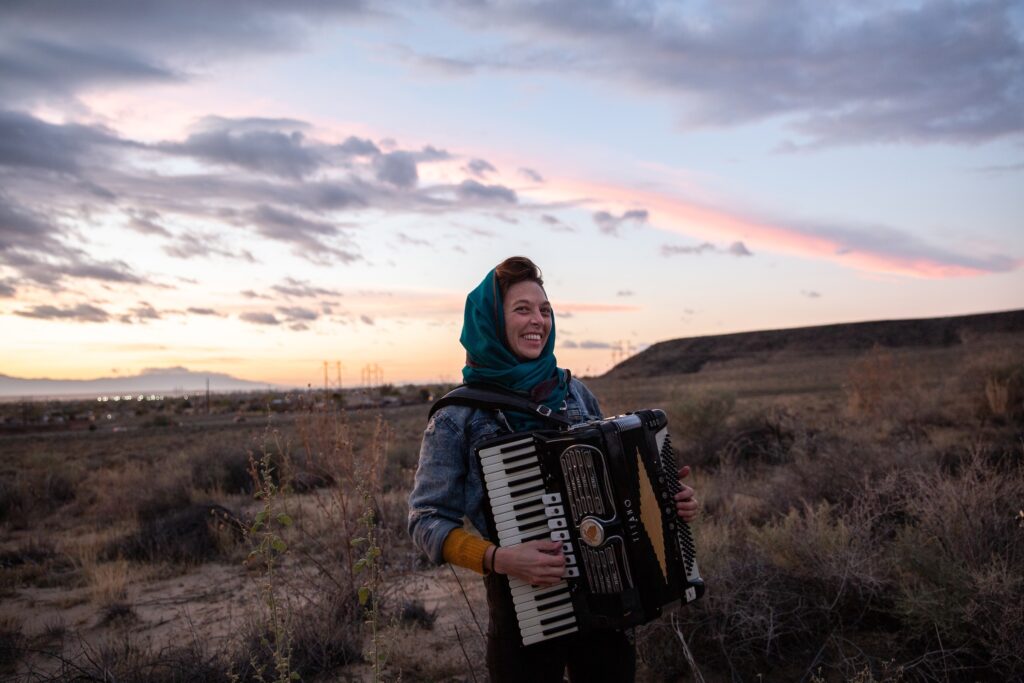
[Photo by Alexia Webster.]
STARTING TO PLAY ON FRENCHMEN
[Spotted Cat / Aside about acoustics / Jazz Vipers / Katrina / Early gigs]
Aurora: The Spotted Cat was one of the first places I went regularly– that probably was [happening by] December 2004, January of 2005. I’m sure lots of people have said this, but the stage was in a different place so the acoustics were different. And there was, like, wicker furniture and a coffee table…. which is kind of unimaginable now.
Laura: Such a different aesthetic…
Aurora: Yeah! [They] had the stage on the other side, so the room was shorter. The sound was smaller and warmer, a little homier because it was was bouncing back to you sooner.
Laura: Is that what people mean when they say sound sounds warmer? It actually means that it’s bouncing back–
Aurora: Yeah– it could mean the way it’s refracting in the space. You’re hearing more of the mid tones come out.
[… DBA] also used to be different: the stage used to be lower to the ground, and a little deeper, I think? It was a foot off the ground and not carpeted, so the music–especially acoustic music–really resonated in the wood. The vibe was so warm. It felt like walking into a time capsule, in a different way than it did at the Spotted Cat. They had to [make changes] because it was becoming a bigger club, they were having rock bands… Everything needs to evolve.
[Back to early days at the Cat:]
Aurora: I was not “local” at that time at all, but I could tell it was a scene for local people. The same characters were coming out every week. I mean for sure, some were visiting also, but it was a lot of people that were living here. Which was really beautiful.
The original New Orleans Jazz Vipers were the first band that I saw that I was really blown away by.** I think they were playing twice a week [at the Cat] at that time, and I started going to listen to them a lot. [**Sidenote from editor: The first band that I saw that I was really blown away by, upon moving to New Orleans in 2014, was Aurora Nealand & the Royal Roses.]
At that time, [the Vipers lineup] was Joe Braun, Rob Snow, Neti Vaan, Charlie Fardella, Bruce Brackman, John Rodli, and Tom Saunders. I think those were the main staples. Those guys were lovely, and so friendly once they saw that you came a lot.
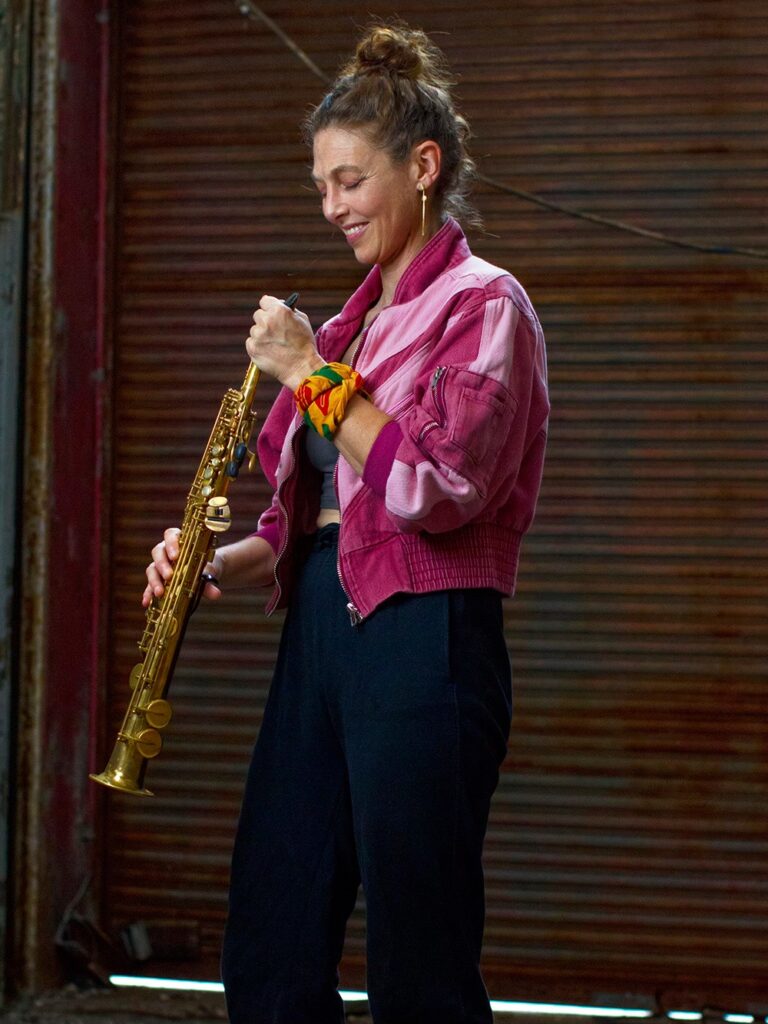
[Photo courtesy of AN.]
Aurora: […] I will say that [Bruce Brackman] is incredible. Doesn’t get talked about enough in the New Orleans clarinet lineage but is such an incredible traditional player who plays in one of the most innovative ways I’ve ever heard. …I actually don’t think Bruce would admit to that.
Laura: [Chuckling] Admit to the traditionalist part or the innovative part?
Aurora: No, the modern. He always says, “Ohh, you’re playing all mod-ren [sic] over there,” and you’re like, “I’m not playing– You’re–” [chuckling] … you know. He and his family are from Louisiana, from the New Orleans area. [Seeing him] felt like you were watching Cannonball Adderley play traditional New Orleans jazz. Still very rooted in tradition; just so innovative. He was really kind and supportive, even though I’m sure I pretty much sucked at that time. [Laughter]
Laura: How old were you then?
Aurora: 24 to 25?
[…] Through the Jazz Vipers, I met Sid Snow, who’s Rob Snow’s father. Sid Snow gave me my first gig in New Orleans. It was not on Frenchmen Street; it was at the Market Cafe, which is an outdoor cafe on Decatur. [Check out our interview with Sid Snow, here!] That was pre-Katrina. That was a five-hours-long gig, and I didn’t know any of the songs. I had a book, which… people in New Orleans didn’t really learn the songs from books, you know. [Laughter]
I started playing [on Frenchmen]… It’s all a little fuzzy. I don’t remember if it was pre-Katrina or post-Katrina. […] Well, I met Panorama at DBA, and I guess I did play with them a couple times in the spring of 2005.
After Katrina, I was gone, like many people, for three or four months. And then Mardi Gras of 2006 was such a wild Mardi Gras– it was so beautiful and so visceral and intense. I don’t even know the half of it, because I had only been here for ten months before.
Spring of 2006 probably was the time that I started playing [on Frenchmen] regularly– I played at the Spotted Cat with this band called Vavavoom. That was twice a week.
TIP JAR SHENANIGANS
I.
Aurora: I have one story–it’s actually just hearsay, because I was there right after this happened. So you should ask someone that’s part of it.
The Washboard Chaz Blues Trio used to play [at the Spotted Cat] before one of the bands that I was playing with. I got there early to listen to them, and I was talking to St. Louis Slim afterwards, and he was like, “Man, this crazy thing happened–”–where the trio was playing on the stage and somebody came in and made like he was going to tip the band… but instead he just grabbed the tip jar and ran. Ran out with the tip jar! And it was the end of their four-hour set, so that’s everything they’re making.
Laura: Ohhhh….
Aurora: And then Washboard Chaz started running after him–with his washboard–down Frenchmen Street [uproarious laughter in background], and then–because there used to be police on horseback on Frenchmen Street–
Laura: [*Dying*]
Aurora: So it was like: this tip jar thief was running down Frenchmen Street, then Washboard Chaz was running after him, and then–come barreling down–was a policeman on a horse, comes running after the guy with the tip jar. Then the guy’s just, like, throwing the tips out of the tip jar behind him–I think to put them off the trail–and then eventually, eventually they got the tip jar back. The imagery is wonderful… You should ask one of them. I do think there’s grains of truth in this.
[Indeed! Read Chaz’s account of it here: https://frenchmennotes.com/?p=2013.]
[P.S. Also, I ran into him at Markey’s in August ‘26, told him I was editing this interview with this anecdote, and he added a new detail: apparently a couple of Japanese tourists collected all the scattered money off the street and returned it to him <3]
[P.P.S. But then I just saw on facebook today {9/1/26} that apparently he got his tip jar stolen again from BJs last night?! Wtf.]
II.
Aurora: There’s also a great period where I was younger, with this band we had for a short time called The Moonshiners. It was younger people, mostly transplants, starting their own little traditional jazz band, playing at The Spotted Cat. This was probably 2008.
And Glen David Andrews would come in and sit in with us, and blow us all out of the water. Because he grew up playing on Jackson Square, and because of his family–you know, he is deeply of New Orleans. He’d come sit in with us for one song or two songs, get the crowd super hyped up, be like, “Tip the band!” Then after [the] one or two songs, he would walk around with his own tip jar, being like, “Tip the band!” And then leave– with his tip jar. [Laughter]
And we were so young. Like, “Are we supposed to– should we say something?” “No. No one say anything here.” [Laughter] It was amazing. A good lesson in ‘hustlerhood’ — but mad respect for that kind of hustle, you know?

[Aurora Nealand as her alter ego, Rory Danger. Photo courtesy of AN.]
FORMATIVE BANDS ON FRENCHMEN → WOMEN & JAZZ SCENE
Aurora: All the regular cast of characters that you’d see, like Washboard Chaz and St Louis Slim–for me those were pretty formative. The Tin Men, Liquidrone–Clint Maedgen’s band, and Rob Wagner’s Trio at DBA…
DBA was the first place I saw Linnzi Zaorski. Linnzi has a whole presentation. Linnzi’s voice is so unique, and Linnzi was dressing vintage before it was the super mainstream, popular thing to do [on Frenchmen].
Linnzi Zaorski, Sophie [Lee], Ingrid [Lucia]–those were the women that I was seeing a lot. Then, of course, Charmaine [Neville], Germaine Bazzle. Rebecca Barry [jazz saxophonist] moved away around the time when I was arriving, but for sure it was nice to hear about another female instrumentalist. I didn’t see any other female instrumentalists when I first moved to town.
Laura: That’s wild. […] Do you have any comments on breaking into that scene as woman? Was it a challenge at all?
Aurora: [chuckling] I’m always like, “I could write a book about the shitty things that have happened.” I mean, in general, New Orleans is a welcoming community, and I’m really grateful for that. Of course… being a woman breaking into a field that, especially at that time, was male-dominated… The culture of jazz and live music is a very heteronormative, masculine culture: that is built into the culture of jazz music, even. Not necessarily by the people that created the music but by the culture that surrounded it eventually. There is a real “bro” culture.
[…And] you’re more sensitive when you’re younger. You’re looking for approval– from your peers and from your elders. You’re navigating the territory where you want to get paid, [and the] band leader says, “Well, meet me for lunch and you’ll get paid.” And you’re like, “I don’t want to meet you for lunch. I just want to get paid!” There’s a lot of human interactions that I do think, being a woman, are more complicated in a field that has a culture of being kind of sexist. So there was a lot of… not-great experiences, which maybe I’ll write about someday.
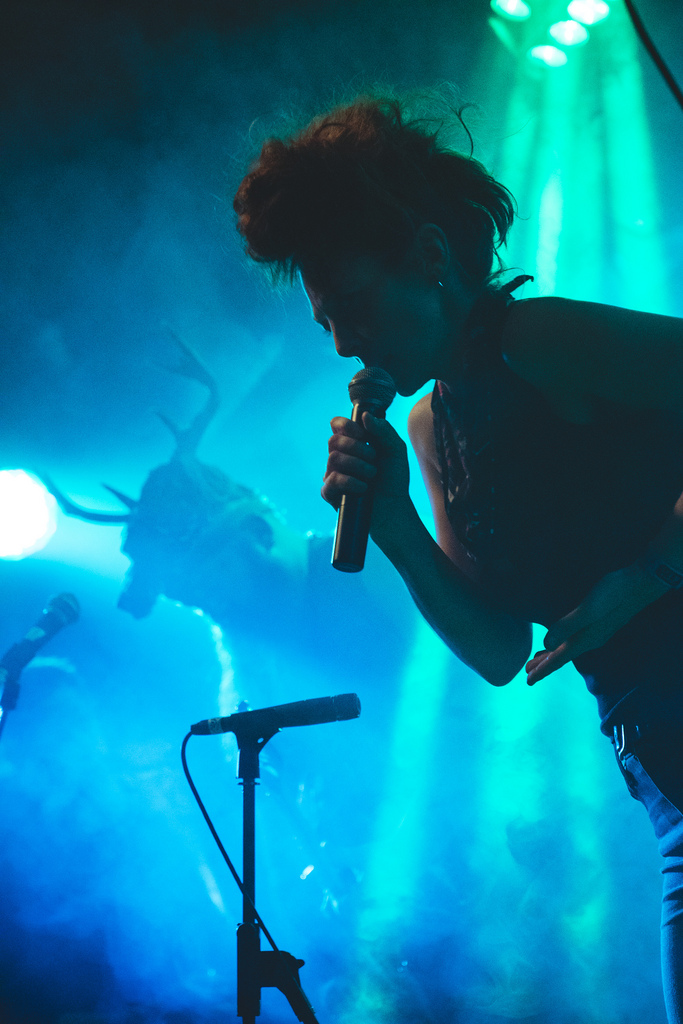
[“Rory & deer head” – photo courtesy of AN.]
FRENCHMEN TURNING POINTS & COFFIN NAILS
[Katrina, Café Brasil closure, goodbye Empty Lot, other closures & openings]
Aurora: To me, post-Katrina, it seemed like there was this feeling of New Orleans needing and wanting to come back at whatever it took. So there became a little bit of this… commodification of the culture. I think that in some ways, clubs followed what they thought tourists wanted to see, which is no one’s fault: [they were] trying to bring people back.
It’s not really my place to speak because I’m not from here, but in my opinion, [it turned into] a little bit of this Disneyfication of New Orleans– including with the music and what got booked. Like I said, before Katrina as a young person on Frenchmen Street, it was wild to see a string quartet playing over there [gestures] at six in the evening, and then you walk down the street and over there’s a septet of acoustic musicians wonderfully playing jazz of the 1920s and ’30s, then you walk across the street and you’d see Rob Wagner and his modern jazz trio playing pretty out-there original compositions. Then you could walk ten feet to Snug Harbor where, bless their hearts, if you become local enough, they let you sneak in. Or if they know you’re a musician, they let you in. So you could see Charmaine Neville–New Orleans legend, more rooted in the New Orleans R&B sound; she’s incredible. Then you would have the New Orleans Klezmer Allstars playing later that night.
You could see all of that. All of that was pretty normal to see on Frenchmen Street. These local bands playing their own original music, which doesn’t necessarily happen as much now.
Laura: Were there any other turning points that you’ve noticed, besides Katrina?
Aurora: Yeah… With certain clubs opening and closing, certainly. To me, Frenchmen Street still felt very local-centric through, I don’t know, 2012–13. I think for a lot of us, Café Brasil not reopening [was a turning point]. And staying closed, which is incredible testament to Adé just being like–
Laura: “Fuck it”?
Aurora: Yeah– he wants to do what he wants to do. [*This exchange refers to the fact that after he closed Café Brasil, owner Adé Salgado let the building sit empty for a decade and a half before finally renting the space to the owners of Favela Chic.]
Laura: Right. Did Café Brasil reopen after Katrina, again, briefly?
Aurora: It did, yeah, because I remember seeing Bread and Puppet Theatre there, a double bill with Why Are We Building Such A Big Ship. I think the Klezmer Allstars played after us. I have a hard time seeing that happen on Frenchmen Street now: a radical puppet show, and then a band of weirdo Bywater punks who barely know their instruments–I can say this because I was in the band!–playing some original music for other weirdo traveling punks in their community? And then New Orleans Klezmer Allstars, who were pretty big at that time. Jonathan Freilich would actually be a good person to interview. [We did! Check it out here.]
Yeah, I would say Café Brasil closing. And the Dream Palace–again, I didn’t get to experience it much, but I know for a lot of people that was like, “Ugh.” Then I think, slowly, new clubs that opened had a bit more focus on specifically catering to tourists as opposed to just being music clubs. It was a shift. You can point to the obvious, like Willie’s Chicken Shack opening. To me that felt like a turning point.
Laura: Yeah [Willie’s is] actually why I started doing this project…
Aurora: The Dat Dog! The two-story hotdog emporium. They’re successful at what they do, but that was definitely a turning point. Just [in terms of] the landscape of the street and what was there before, which was this empty lot… There were always young brass bands [playing in the empty lot], or street performers. We [Why Are We Building…] did some DIY shows there.
The book fair–if you can picture that: the book fair–was on Frenchmen Street at nighttime. Tables were out and the authors were there with their books. I remember playing in that empty lot with Why Are We Building Such A Big Ship while the book fair was going on.
So when Dat Dog, the two-story hotdog emporium went up [in 2014], even though it’s historical architecture, it still changed very much the landscape of the street. Just the stature of it.
And that it was just, like… hot dogs.
Laura: [Laughing] Right!
Aurora: Which is not bad! ….… I mean, I’m vegetarian, so I don’t know.
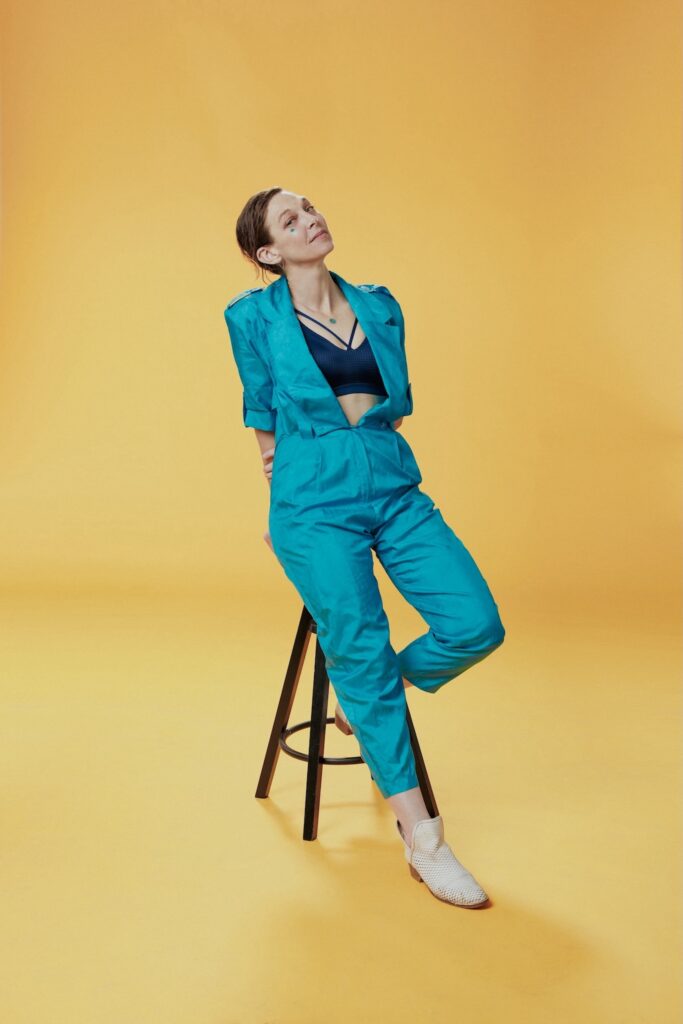
[Photo by Noé Cugny.]
TREME, TECHNOLOGY, AND BRUTE VOLUME
Laura: Do you have any thoughts on technology?
Aurora: Oh, I have a lot of thoughts about technology!
Laura: Technology, society, the musical landscape, community, how they all relate…
Aurora: How long do you have? [Laughter]
For sure, well, I will say this! When HBO’s Treme came in and started filming, [it] was a boon for many people in New Orleans: I think they did a great job of honoring and respecting and really trying to tell local stories. And also employ local people. So big props to them. On the other hand, it created a television show of the local scene, then the local scene became more of something to look at rather than participate in. I remember the first time going to a second line after Treme first started premiering: that was the first time I saw cell phones, saw people standing there, being in the second line space but not participating. They were spectating.
Laura: And filming…
Aurora: And filming with iPhones. Which, you know– it’s beautiful that there’s documentation of second lines. Photographers, I think, have a separate place. Documentarians have a separate place. But I do think there is something that happened with the broad commercialization of the New Orleans local scene that lets people be a little less participatory. Just like with the broad pandemic of insta-technology culture– you’re there at a live music event, but you’re also on your phone, texting.
So, it’s a different kind of engagement that the crowd has with the live music. It reflects in the culture, in the way music is consumed. In the way the audience gives their attention– or maybe more times doesn’t give their attention, and talks over the music because they’re there— [dopey bro voice] “I’m here, I’m in this awesome thing, but really I’m talking and I’m making a video!”
Which is– okay. I was going to say “fine,” but it’s not actually fine! Which is “okay.”
Laura: It would be okay in moderation, but no one has that…
Aurora: Right, no one has the moderation. But I also think that, again, the commodification, or glamorization, of the local heritage and culture paved the way for people wanting to come and see this as an attraction. So then: “Oh yeah! Of course we can have a hot dog place here,” and eventually, “Of course Willie’s Chicken Shack, with extreme brightly lit neon lights and techno music playing from the inside, of course we can have that!” Because….
Laura: They need to eat while they’re looking at their spectacle!
Aurora: Right. They need to eat while they’re looking at their spectacle–and their phone.
[…] I mean, culture changes. There are things that are not bad about it changing. But just the sheer fact that the noise level on Frenchmen is so much higher now than it ever used to be–it makes it less pleasant to work there, as someone that makes sound for a job.
Laura: Do you mean specifically inside the venues?
Aurora: Everywhere. Just the baseline. Certain clubs now have speakers outside… Snug has had that for a little bit, but it’s very modest because it’s very localized: you can really only hear it if you stand right outside, and they’re only broadcasting a little bit of what you could hear inside. But there’s a number of other clubs that have I think adopted the Bourbon Street model of “pump out the music that’s going on inside in order to bring people in.” And then it becomes like a sound competition– it’s hard to know how to fight that.
But also, yeah: inside the venues, the expectation is just “turn it up,” generally.
Laura: I can’t go in some of them anymore. I hate it. I love music but I also don’t want someone to, like, stick my favorite perfume up my nose and push the button, you know?
Aurora: Yeah, yeah! [Laughing]... I wear earplugs anytime I play at the Spotted Cat and most places on the street. Even if I’m playing without a drummer, I still wear them because the general level of crowd noise is usually quite high. It’s more of a party atmosphere. And it’s the technology thing that we’re talking about, where people are there to see the music, not to hear the music. I get pretty snarky and say things on the microphone, and sometimes you can turn it into a listening space– sometimes. It’s not always in your control. Really, you’re selling alcohol. That’s the club piece of your job.
[…] People are coming there to see the music, to drink their alcohol, and to see themselves seeing the music–but the hearing part is less.
[Note from Luddite editor: the corrosive nature of smartphone culture is one of my personal favorite topics to get into. See this interview with Jonathan Freilich for more.]

[Photo courtesy of AN.]
ONCE AND FUTURE FRENCHMENS
Laura: Is there a “next” Frenchmen Street, do you think?
Aurora: Well, not in the same way, because as you said, the [physical] landscape is different. Obviously, everyone talks about St. Claude Corridor [but] it’s different because you don’t have the foot traffic there, and it’s not a contiguous set of clubs. The energy is quite different. But, it still is nice to see clubs that are… for instance, Siberia: that’s really inwardly-focused, and I mean that in a good way–it’s interested in fostering the music that is here, and the musicians that are here, and catering to the people that are here. If tourists from outside want to come in and hear it and participate, then wonderful, but they’re not trying to cater to it.
On O.C. Haley, that corridor up there, there’s now the Rabbit Hole, which is a cool little new venue that’s opening. But I think there’s nothing like “Frenchmen Street,” however long Frenchmen Street was that thing. I don’t see that happening there.
Laura: Is there anywhere in the city now where you see at least aspects of [the old Frenchmen]?
Aurora: I was out in Arabi last night for a friend’s art show near the Zeitgeist [at the St. Claude Arts Park, opened October 2022]. There were three little happenings… happening: Sunpie Barnes and the Sunspots were playing in the Zeitgeist–people were dancing, a lot of people hanging out outside. There was a weird art installation and… [chuckling] AstroTurf? … happening twenty feet away. And then an art gallery down the street, where local artists work, which was nice.
I don’t know, it was nice to see folks hanging out in that way: local people hanging out late at night.
Laura: Is there any way we can nurture Frenchmen-like places like that going forward? At the policy level, or the community level, or whatever?
Aurora: If you want it to be a somewhat similar corridor scene like Frenchmen, it would take… I don’t knooow, [chuckles] Harry Connick Jr. ‘s foundation? Or someone who has a lot more money even, buying the corridor. Buying real estate. And, then policy– like, the city not getting greedy and giving the permit to Willie’s Chicken Shack. Sorry, Willie’s! [Laughter] Praline Connection, when that was there, that was such an old school New Orleans staple. You really couldn’t feel like you were somewhere else.
Laura: That’s a really good point.
Aurora: It was just the food that they sold, the layout of what it was…
Laura: It wasn’t relentlessly trendy at all…
Aurora: No! It was just a place people went. So the fact that that flipped to Willie’s Chicken Shack, which is a chain… The city could have not allowed that. We have an HDLC, which–I don’t always agree with historic district policies, but you could have that for an arts corridor: “What is allowed here?” There’s a lot of dicey gray area in there, but there’s still some pretty gross things that you can [protect against] at a policy level. And then have a panel that’s involved in that local art scene.
[But] I don’t know the answer. Until then, I think there are, especially post pandemic, a lot of DIY house concerts. I see a lot of New Orleans musicians deciding, “We want to play music in this way.” There’s more, in my opinion, house concerts, and more of a scene that’s happening now with local neighborhood bars, like BJ’s and Vaughan’s. Redux Bar. I’m talking about all Bywater bars, because that’s what I know best, but in Arabi also– that is really heartwarming to see. All these [individual neighborhood places], like it was in New Orleans even before I moved here, [when] there were more clubs uptown– it wasn’t just Maple Leaf on Oak Street, and the Bon Temps, and then [in downtown/mid-city] Frenchmen Street, Sweet Lorraine’s, and Prime Example. If you talk to the older guys, there were all sorts of neighborhood music clubs.

[“Aurora Nealand as The Monocle – Gasa Gasa.” Photo courtesy of AN.]
HOME
Laura:. Do you still play regularly on Frenchmen?
Aurora: I don’t have a regular there. I was just thinking about that. I miss having a regular on the old Frenchmen Street–because of that feeling of being away from New Orleans for two months, or three months, and then coming home. The most incredible feeling during a certain number of years was to go to Frenchmen Street and see the people that you loved. To go there, the first night after being away? I specifically remember that overwhelming feeling of, “Oh, this is amazing, all these people that know me, and they know my name…” You know? It feels– I feel like I’m at home.
Also, it’s a little like a corridor in high school–
Laura: [laughing] Yeah!
Aurora: Which I didn’t even have! I went to a high school that had outdoor– Whatever, but [Laughter] like, those movies that you see where people are walking down the hallway, and their lockers are outside, and they’re saying hello to everyone– it felt a little bit like that. You walk down the corridor at Frenchmen, and you see the original Jazz Vipers, and you know the doorman at DBA, and you talk to this person… And when friends would come to visit–
Laura: [Laughing] You feel famous!
Aurora: –they would be like, “What is this?” [Laughter] Yeah, you feel famous! I miss that. I don’t have that feeling as much when I’m away for a while and I go back down there. You know, there’s still people I love that I’m so excited to see… But there was a minute where it was incredible. Frenchmen would be the place that would make me feel most at home and most overwhelmingly thankful and joyous to be in New Orleans.
–Ed. Laura DeFazio
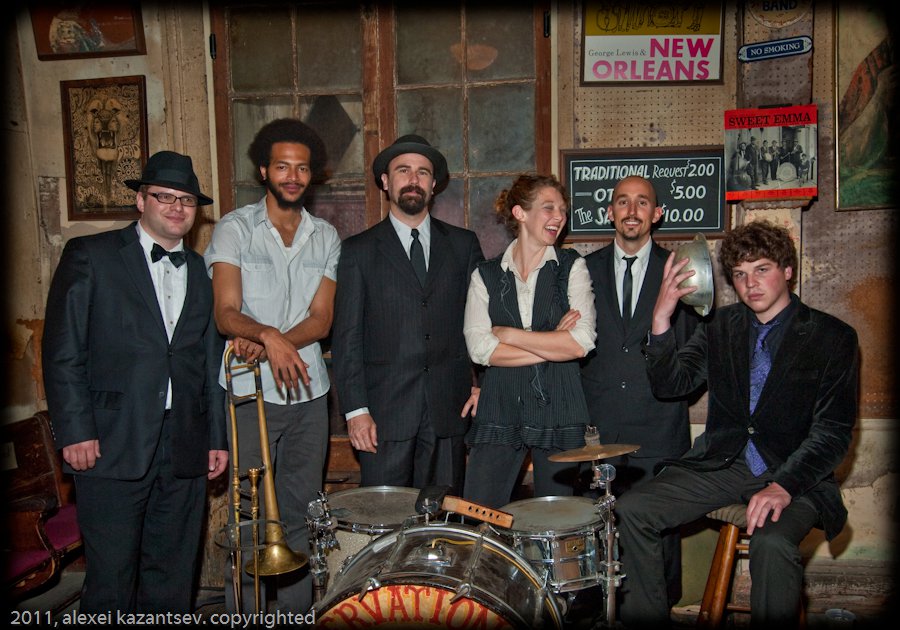
[Aurora Nealand & the Royal Roses at Preservation Hall, 2011.]
Interviewed by Laura DeFazio on 12/11/2022
Transcribed by (a human at) GoTranscipt.com
Transcript corrected by Meredith Foster
Edited for clarity & concision by Laura DeFazio
Posted to Frenchmen Notes on 11/8/2026
