Frenchmen Street is a small but vital New Orleans music corridor just outside the historic French Quarter. Frenchmen Notes is an oral history/data collection project documenting this pivotal scene for the benefit of music fans, community members, and researchers alike. We have a long list of folks we still plan to interview, and we want your stories, too! Submit anecdotes, pictures, etc. via our Community Portal, or by emailing research@maccno.com.
What is Frenchmen? Why Document Frenchmen? Scroll down for more.
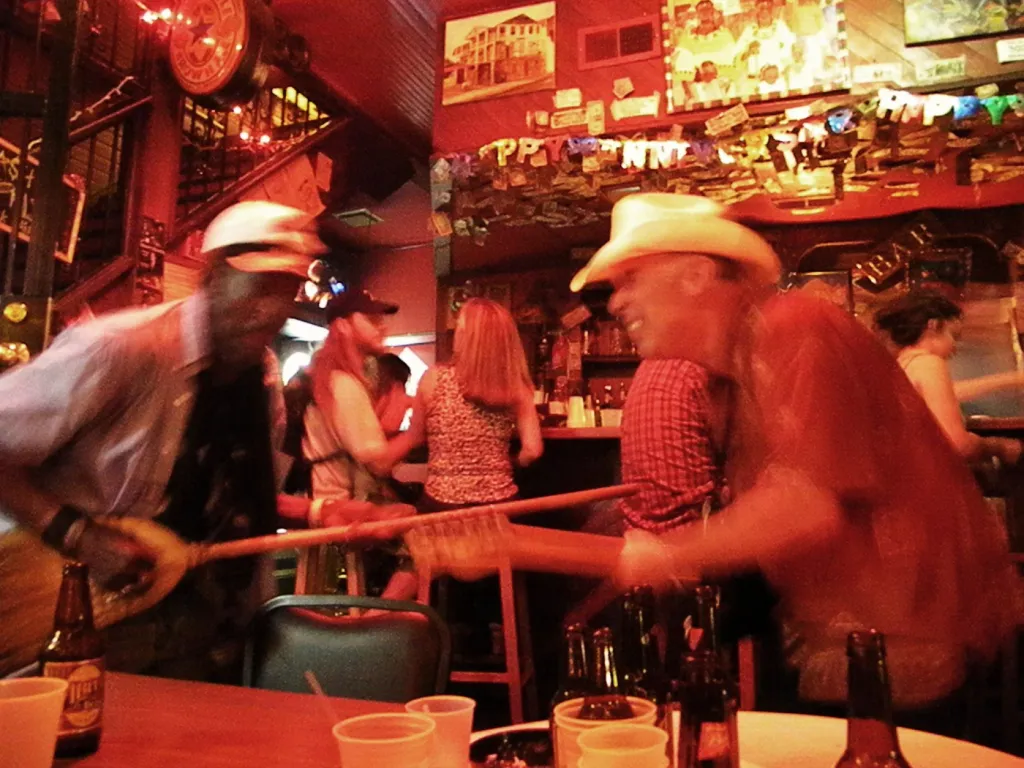
[Dr. Love (L) and Michael Sklar. Broom/guitar duel at the Apple Barrel circa 2010-ish. Photo by K. Hanrahan.]
What is Frenchmen?
Despite being only two-and-a-half blocks long, the strip referred to as “Frenchmen” (a fraction of the entire named street) is its own tiny ecosystem, both culturally and economically. According to our interviewees, Frenchmen is or was “an arts incubator,” “where the locals go,” “an array of clubhouses”, “the best place to learn,” “the best place to play,” “bohemian,” “local,” “international,” and the “Wild West.” Once a “best-kept secret,” Frenchmen has become “a different world” to many of the community members who frequented or played the clubs in its heyday.
The music scene on Frenchmen began developing in the late ’70s and grew—slowly, organically, with a handful of venues—throughout the ’80s and ’90s. From the start, its bohemian character—thanks in large part to the area’s affordable housing at the time—encouraged artistic experimentation and innovation. With strange and wonderful fusions, innumerable attempts and failures, Frenchmen became an incubator for musicians, bands, and local micro-genres. Its cultural vitality was fairly unexpected—the strip had no great musical history, nor was it zoned for music, and the surrounding neighborhood was struggling out of an economic depression.
In the early 2000s, several new venues sprung up at once, creating a “snowball effect” for foot traffic, commerce, and gigs. Musicians could now make their entire livings on Frenchmen and do so playing original music for predominantly local crowds peppered with highly music-literate visitors. Clubs had their own distinct vibes and specialized in different genres. Most, for better or worse, didn’t charge a cover, and this variety and density gave pedestrians the ability to encounter several bands and artists in one evening. Musicians could easily meet new collaborators; friends and neighbors could enjoy an affordable night out.
Now a distinct tourist destination, Frenchmen has changed and continues to change. Dive into the anecdotes and interviews, articles and tables, timeline and storymaps, and more here at Frenchmen Notes to explore this cultural landmark.
Why Document Frenchmen?
All who’ve experienced Frenchmen—visitors, locals, musicians and non-musicians alike—hold treasured memories of the area. These memories span decades, and it’s important to document them since many key figures of Frenchmen’s early scene are now community elders. Frenchmen Notes is neither a purely nostalgic exercise nor a purely academic one. This ongoing project aims to explore the many facets of Frenchmen that made the scene so special while serving as a resource for researchers of music, history, and urban planning.
The world at large is changing, and it’s becoming harder for these kinds of environments to find fertile ground in which to grow. It is the hope of Frenchmen Notes’ creators that these stories and data can teach us about how we as cities, communities, and individuals can nurture organically-forming cultural incubators like Frenchmen Street—affordable, bohemian corners of the world that value originality and mutual support.