Saxophonist/bandleader Dominick Grillo has been a fixture on Frenchmen Street for over twenty years. He and his band, the Frenchmen Street All-Stars, play a funky mix of R&B, rock, and soul– they’re known for packing the dance floor on Monday nights at the Spotted Cat.
***Thank you to the Threadhead Foundation for supporting our editorial work in 2026!***
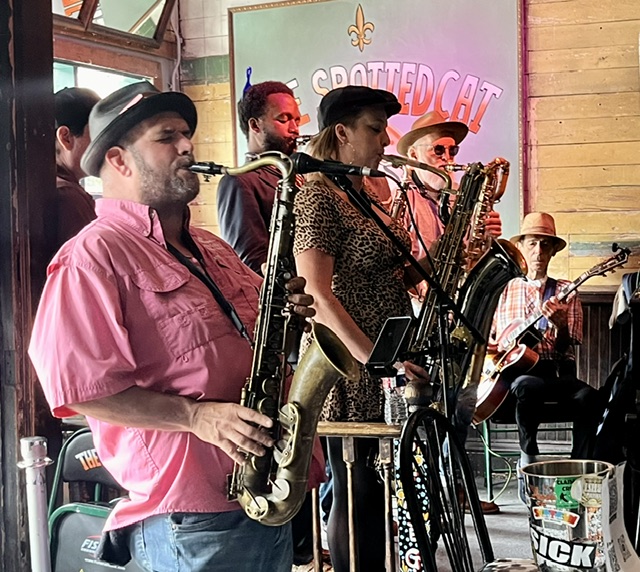
[Photo courtesy of Dominick Grillo, foreground.]
FINDING FRENCHMEN / HURRICANE EFFECTS
Hannah Kreiger-Benson, 7/16/21: So when you first came to town [in 2000], what did you hear about Frenchmen?
Dominick Grillo: Nothing, absolutely nothing. And then I stumbled onto it after looking around for a little while. Just driving around, figuring it out. I used to drive around to get lost in the city because I was new here. The best way to figure out where you are is to get lost and find your way back.
It took me about a year to find Frenchmen St, and when I did, I was there almost every day. Listening, sitting in, smoking lots of weed, drinking a lot of whiskey… [laughter]
Laura DeFazio: Did you have a favorite band to go see?
Dominick: My favorite band after the storm, during the storm, and before the storm was the Palmetto Bug Stompers, with Will Smith as the vocal lead. They still are around, but they have Kevin leading them now. I always liked the Vipers before the split, now it’s the Vipers and the Cottonmouth Kings. I like both of them, but I like the Cottonmouth Kings a little bit better. A little bit more raw, more of the people I hang with.
Hannah: And what were the places you went to? Tell us a little more about the scene.
Dominick: The bulk of the places I went to were Snug Harbor, the Apple Barrel, Spotted Cat, DBA— the 500 block. There was [also] Café Brasil and the Blue Nile. That was pretty much it.
Back then, when I first got here, it was a lot of OTRA, Latin bands at Café Brasil, the Blue Nile had a Kermit show that I’d always go to… The 500 block was always just a mixture of all the people we hang out with. Like Mike Hood, Bruce Brackman, Mike Sklar. Who else? There’s just so many people that you try and remember. Sam Price–all the people who are seen less frequently now, but still there in the capacity of trying to get some stuff done. Trying to relive the golden days.
Hannah: Why are they seen less frequently now?
Dominick: Because they’re busy, they’re doing projects that are, if not national, international acts. And statewide acts.
Hannah: OK, so [Frenchmen] was like a launching pad.
Dominick: At one point, yeah– if you were playing the D.B.A. eventually you were going to be a national act.
Hannah: When was that?
Dominick: It was early 2000s, before the storm.
Hannah: Did the storm change that?
Dominick: Yeah, the storm gave it a resurgence– everybody was coming back to play already, but then [Frenchmen] became the Hollywood South hang out. Hollywood came in after the storm, after Katrina. And you’d have, like, Laurence Fishburne hanging out the Spotted Cat, listening to like a bunch of UNO guys playing music all night long.
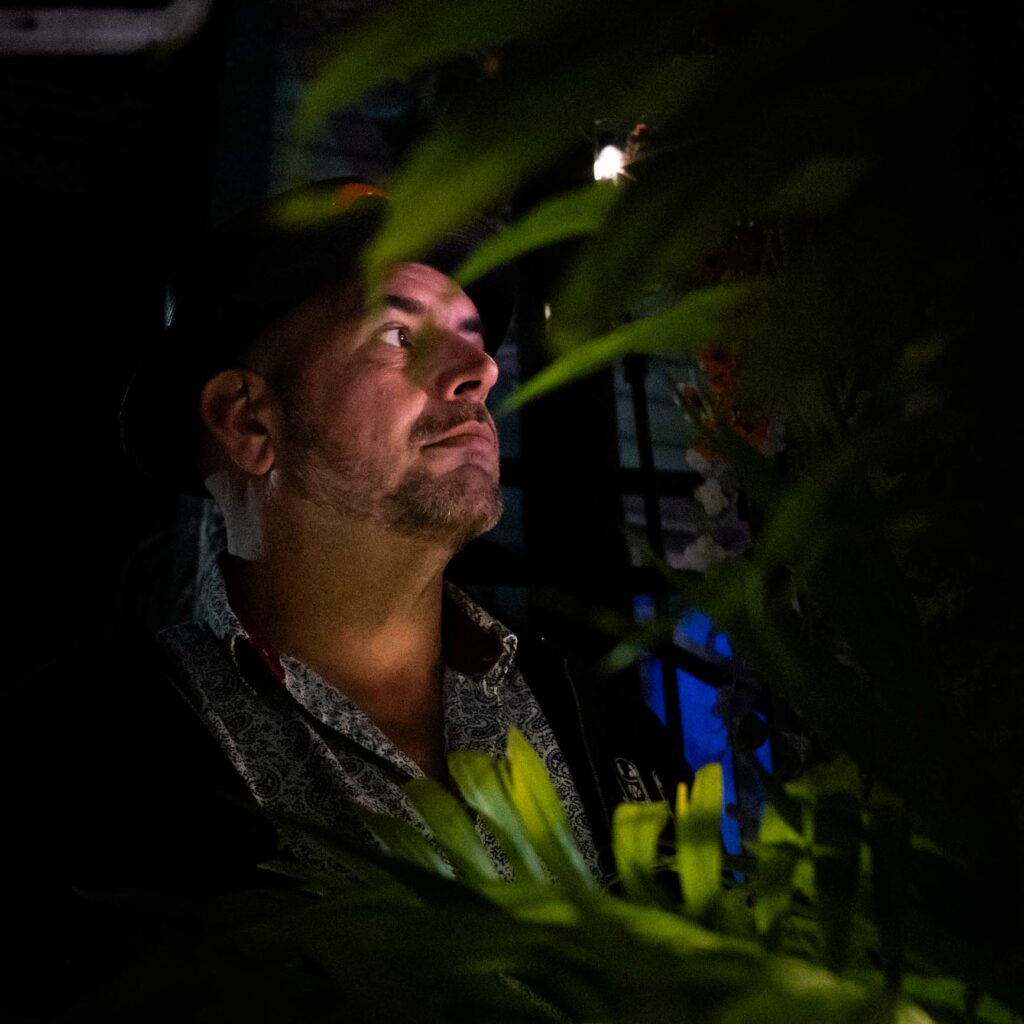
[Grillo at the Frenchmen Art Market, December 2025. Photo by Camilo León Quijano.]
Dominick: Before the storm, I worked as a door guy on Bourbon Street at Big Daddy’s, which was probably the worst strip club on Bourbon Street at the time. Other than Sex Acts, and Love Acts, and… something. I forget the name, but they were all owned by the same guy, so it was just like the same bad club just three times over.
And when the storm hit I vowed not to ever to work as a door guy anymore, only to work in music. At that point I was just like, “I’m gonna to sink or swim.” So, every night after the storm I was down there. [That is,] right after I did three months in Austin– that was just not an ideal place for me being an aspiring New Orleans musician. But, wonderfully kind people.
I was using UNO as a means to live, which is really expensive for me. Meaning, I had student loans paying my bills and paying from my college, but I never did any core requirements; all I did were the music credits. So I didn’t get a degree from there, but it allowed me to pay for an apartment and not worry too much about… where I’m making my money right away. Like, I’d be able to pay like four or five months, and then I’d just have to worry about paying two or three months after that. Tom Chute got me an apartment in Gentilly for like 400 bucks, 500 bucks, so it wasn’t impossible.
At some point I wound up getting a job at the Italian Pie on Elysian Fields. Delivery, so I was done by like 9, and I was able to go out– you’d never go out before 10:00 o’clock.
EARLY GIGS TO BAND-LEADING / SPOTTED CAT BECOMES HOME BASE
Dominick: The first clubs I played at were Checkpoint Charlie’s and the Apple Barrel. Back then, I would be the saxophone player for a blues band with Mike Hood, Al Arthur, Tom Chute. Or Coco, Michael Sklar, Dave Easley… Usually about five people. I would be the fifth piece, standing by the door taking up as little space as possible. Not really an official member of the band, but I’d still get paid every now and then.
When they first started doing the Satchmo Club Strut, that was when I first really started doing band leading.The Satchmo Club Strut– it’s now turned into the Satchmo Fest. It used to be just a ticketed event where you would be able to go into the clubs and listen to the music that they were featuring.It would be like the five clubs on Frenchmen St, all organized by Jason Patterson pretty much. And George Brumat. They’d try and showcase what was going on Frenchmen.
[Read our previously published short-form interview with Dominick, HERE, for more on Dominick’s bond with George, Jason, and the rest of the Snug Harbor folks.]
Dominick: The Satchmo Club Strut lasted like three or four years, and each year it paid a little bit less trying to hold on to the idea, until it became something bigger than itself.
Hannah: And you started band leading then, you said.
Dominick: I’d been a band leader the whole time, but I started getting paid for it then. You know, actually finding gigs and putting bands together.
I was working at the Spotted Cat on Saturdays and Sundays doing the early shows for like six years. On Sundays, it would be Jesse Morrow and myself, and we’d be just doing duos. We’d be just drinking Irish car bombs and playing music for all the people at the Christopher Inn, so it’d be like Charlie [?], Eura [Jones]was always there; she was the porter at the Spotted Cat before it changed owners. She was a trip. That was pretty much my weekends for like six years.
Hannah: So the Spotted Cat was kind of a home base?
Dominick: Yeah– still. Right after the storm, Eura was the porter-slash-booker-slash-let’s-call- her-manager at the Spotted Cat. She put me in wherever she had–like somebody missing, or somebody not making it. She looked out for me a lot and got me a lot of gigs.
I used to do Tuesday nights with Mike Hood, Saturdays with St. Louis Slim. The only bands I never really played with at the Spotted Cat were the trad bands. I’d sit in with ’em, but trad really wasn’t my thing. It’s like, I consider myself a blues player who plays jazz as well. It’s probably all in my head, but I never really thought I fit in so much with that scene, or fit in with the musicians in that style. I always feel like I’m in between the genres, so therefore I have my own weird thing. But oh well.
Laura: There’s advantages to that.
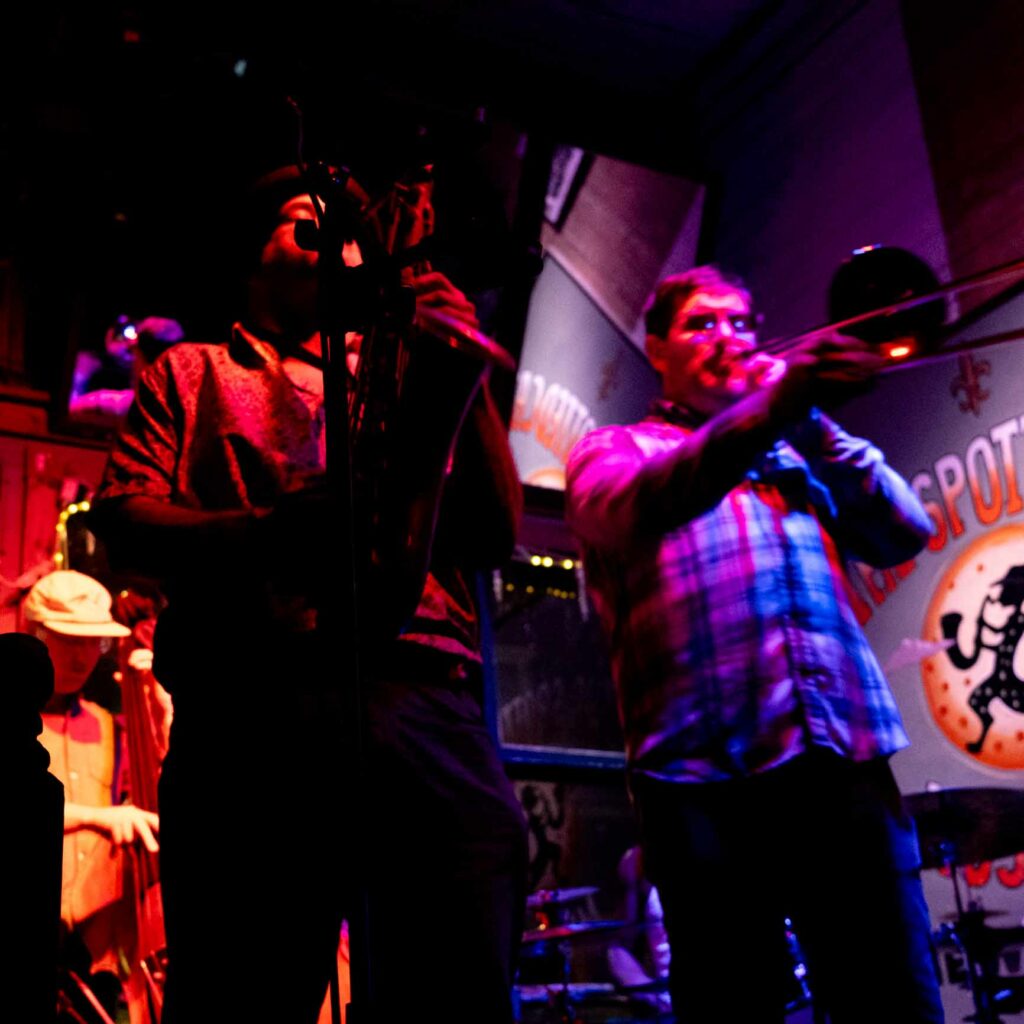
[Dominick Grillo & the Frenchmen Street All-Stars on a Monday night at the Spotted Cat, December 2025. Photo by Camilo León Quijano.]
THE BENCH: PICKING ARRANGEMENTS OUT OF THIN AIR
Hannah: When was Frenchmen Street the best?
Dominick: When it most felt like home? Definitely right before and right after the storm. Mike Sklar and I would sit on the bench in front of the Apple Barrel, and just listen to all the different types of music going on at once, and you could come up with, like, an arrangement, just listening to the funk song at DBA and then the jazz at the Spotted Cat and the blues going on at the Apple Barrel and the reggae going on at the Café Negril.
It’s definitely a mashup, and I came up with a couple of different arrangements from doing that. I still play them. The way I play “Black Cat Bone” is a mixture of like me listening to Galactic at D.B.A one night, and [simultaneously] listening to Mike Hood playing “Black Cat Bone” at the Apple Barrel. Just like, “It fits, let’s do it.”
GIG ECONOMICS
Hannah: [Tell us about] the rate of pay on Frenchmen compared to whatever else, what was common?
Dominick: New Orleans– and I’m going to generalize this into a whole thing, ’cause it’s not just on Frenchmen St.–but New Orleans has been stuck in 1970s pay up until about 10 years ago.
And then some clubs started paying a little bit more, or giving less hours for the same amount of pay, stuff like that. When I first started working on Bourbon Street, it was $15 a set plus tips, and at that time it was, working at the Apple barrel for 100 bucks, and you get tips on top of that. So, the band would have to split 100 bucks and tips. Usually you’d make like 60-70 bucks, and that’s mostly tips.
Laura: For how many hours?
Dominick: All night long… 10pm till whenever.
Hannah: Yeah, so what’s in your experience a decent level of pay for a Frenchmen gig?
Dominick: The decent levels of pay back in the day were… when D.B.A. would give you a guarantee, and they’d have a certain amount, depending on what band it is, they’d do a pretty big guarantee from what I understood about the club.
Hannah: In terms of like what you take home, where is the level, back then and now?
Dominick: Then it was like, 50 bucks was… acceptable. Now, around 150 is a decent average.
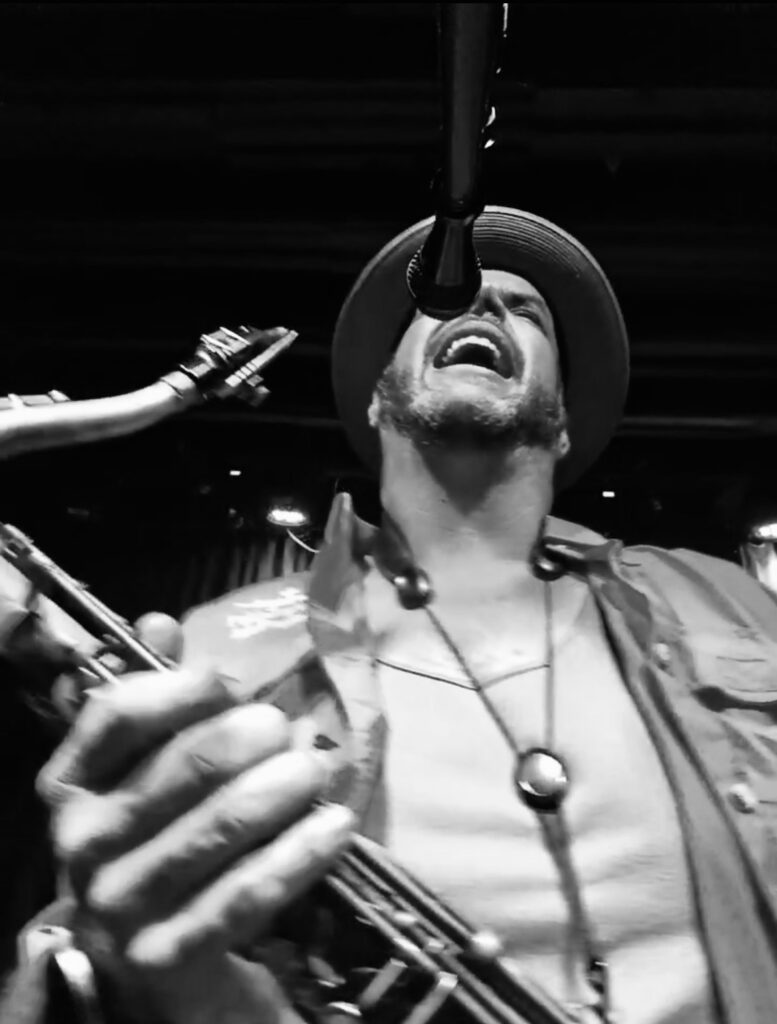
[Photo courtesy of Dominick Grillo.]
ROLLING WITH THE CHANGES / NEIGHBORHOOD BARS
Hannah: Does Frenchmen feel different than other parts of the city?
Dominick: Well, yeah, it totally does. And Frenchmen feels different from itself. Right now, it’s taking this natural evolution, I think. Everybody is getting pissed that it’s turning into Bourbon Street: it’ll be like Bourbon Street; it will never be Bourbon Street. But you know, success rears its head in many forms, and people get their feathers tousled by many different things.
Hannah: Well, like you said, it felt more like home just before and just after the storm. How did it evolve to feel less like home?
Dominick: It’s not that it feels less like home– it feels like there’s more strangers in your house.
[Laughter]
Dominick: And the strangers are turning out to be people you’re working for, and tourists, and… The people that don’t get what it was about. The bachelorette parties, you know? All that stuff was there before, but it just wasn’t so prevalent, it wasn’t so focused upon.
Hannah: Since those changes, has anywhere else, either an area or venue, felt like home? Has that Frenchmen spirit gone anywhere else?
Dominick: Yeah, there’s some neighborhood bars and stuff like that, like BJ’s and Vaughan’s, couple others, but just sort of… you know. It’s not going to last, so you don’t really get too comfortable.
Hannah: What’s not gonna last? The gig or the venue or…?
Dominick: All the above. Like, what’s Carnaval now on Saint Claude– it was two different things before it got to that.* And all those places were fine and dandy, and you’d have fun doing this thing, but you just knew it wasn’t going to be what it was at the moment for too long.
[*Note: The venue changed from Siberia to Carnaval in 2019. This interview took place in 2021. In 2022, it went back to being Siberia.]
Laura: Right, new owner, new booker, you know.
Dominick: ‘Cause the owners are your peers, and you have a view into what’s going on there. You just gotta be positive with whatever you see; you can’t just shit on any establishment just because they do something you don’t like. It’s not their fault that you don’t like what they’re doing.
… But yeah, the neighborhood spots are the only spots other than Frenchmen Street that I’ve ever really felt comfortable.
Laura: Neighborhood spots like BJ’s and Vaughan’s…
Dominick: Yeah. Those two, they did a little bar crawl where they had like BJ’s, Vaughan’s, and– What used to be the Joint but is Bar Redux now, but what was it before that? Things change names so many times I forget what the names are.
Hannah: I mean, that was one of those [first] things that started me looking at Frenchmen. Just, what buildings were what business in what years, collecting that information…
Dominick: Well, the Dream Palace before Blue Nile; Laborde Printing before Bamboula’s; an empty lot before 30/90; Café Brasil before Favela Chic, and there was a long spot with nothing in between, ’cause Adé was really mad at the city and was like, “Screw you guys, I’m not paying my taxes so therefore I’m not gonna to open my bar.”
Hannah: For 15 years after the storm right?
Dominick: Yes.
Laura: He was still open for a few years after the storm though, right?
Dominick: Yeah, a couple years, but they wanted him to renew city licenses and stuff. He said, “I got plenty of money. I’m gonna retire.” It was just, you know, his way of living.
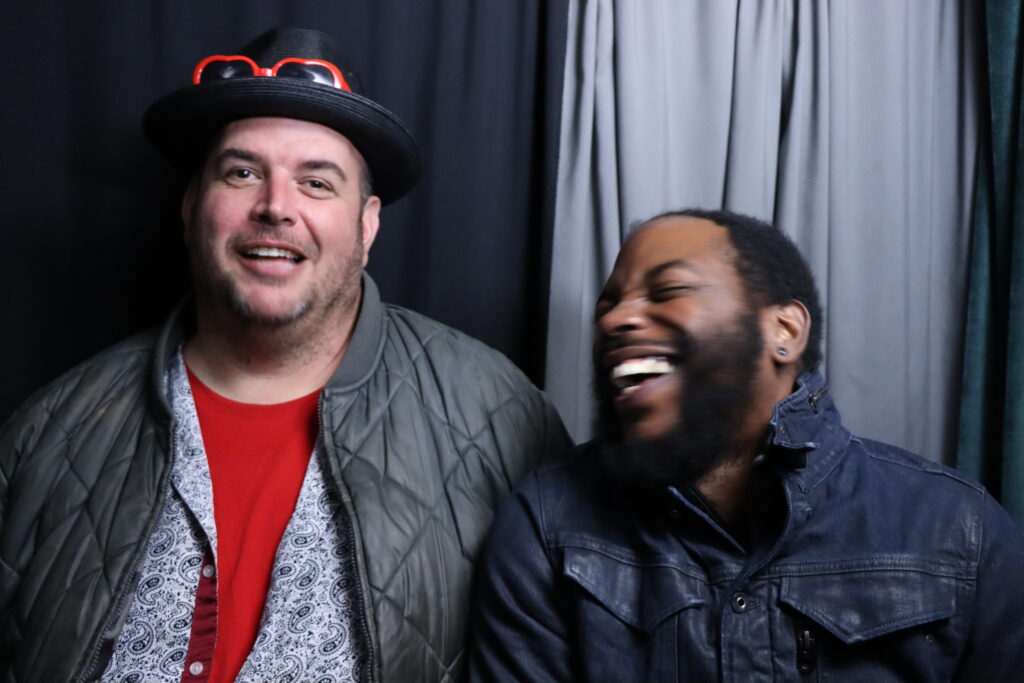
[Grillo, L, with drummer Julian Addison. Photo courtesy of Dominick Grillo.]
GRATITUDE
Hannah: Yeah, so one question that we’ve been asking: What can we learn from Frenchmen, in terms of how to nurture future musicians and music spaces? What can we do?
Dominick: In my opinion, musicians are never going to be happy.
[Laughter]
Hannah: So what follows from that?
Dominick: The fact that we as musicians are actually making a living doing what we wanna do is far above anywhere else in the country, you know. There’s what we do, and then there’s what international and national acts do, and it’s a big gap in between.
And that gap is seen everywhere, in Kansas City, in Chicago…. Like, you can make money, but every [other] place considers it a hobby.
Laura: Yeah, it’s not like a work-a-day job like it is here.
Dominick: But musicians not being happy, always going to want more… I mean, I guess it’s the human condition, always wanting more, wanting to do better and to be better. But at some point, you need to be grateful for what you are able to do and capable of doing and what you’re getting from it.
Laura: And there is something here that doesn’t exist anywhere else.
Dominick: Yeah. The ability to play for people and watch them dance. I like to play music that makes people dance; I don’t like to play sit down music and watch people stare at you while you play some jazz or something like that. [Laughter]
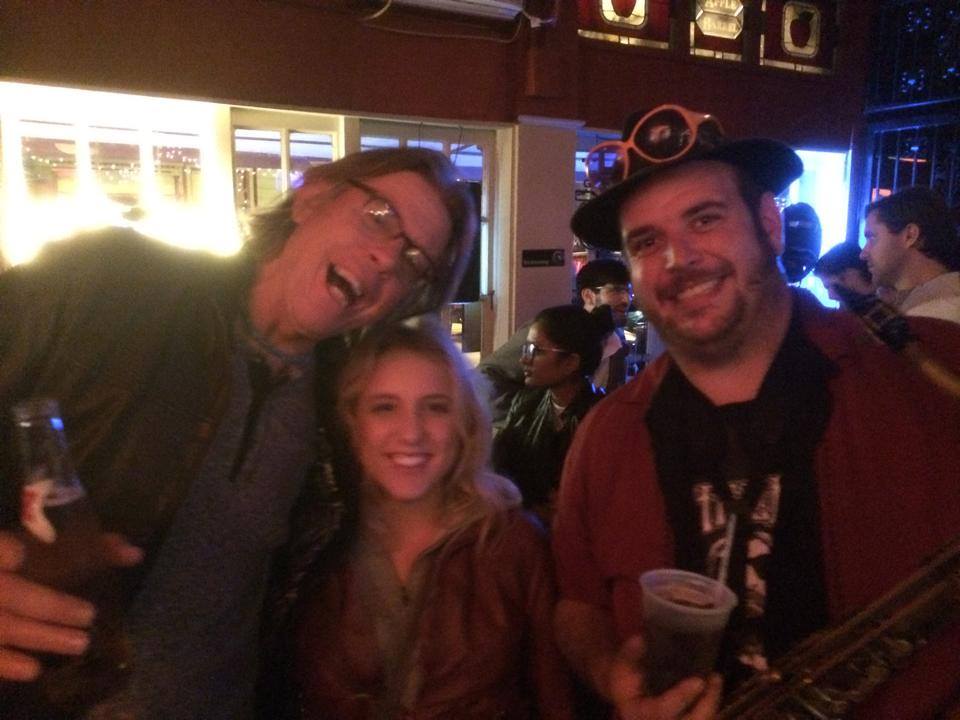
[Grillo, R, with Richard “Dick Deluxe” Egner, L, and Laura DeFazio. 2015.]
THE BEST OF TIMES, THE WORST OF TIMES
Laura: Do you have any other favorite memories of playing on Frenchmen? Any moments that stand out?
Dominick: There’s too many to count, or to regale about. Every single night has its own ability to have the most unique moment possible. It could be–you know, if your concerns are money–that one guy comes in, tips a band $1000. That happens. Or if you just want the party that doesn’t end until 4:00 in the morning and everybody dances, and then you got a full house, that happens too. There’s just so many different ways to answer that question.
I’ll definitely be able to state one of the worst moments down there. It revolves around three to five people passing away, all within a couple months from each other. Which was Jimmy May, who was a bartender at the Apple Barrel, Coco, Jimmy from the Christopher Inn, Uncle Lionel, and there’s a couple other people that nobody really knows. There’s another Jimmy, I forget his last name, and then there was just like a couple personal friends, stuff like that. But, that was the point at which doing second lines became hard.
When Uncle Lionel passed away [in 2011], it rained for two weeks straight. Two weeks straight, not a day without a couple hours of rain each day. His second line had two and a half feet of water in the street.
You know, and Coco passed away at the same time, and that was just like… losing a bunch of friends, peers, mentors, you know, that rocked me pretty hard. I think I got depressed after that moment for a while. That was rough, yeah– it took a while to get out of that funk. But playing music helps.
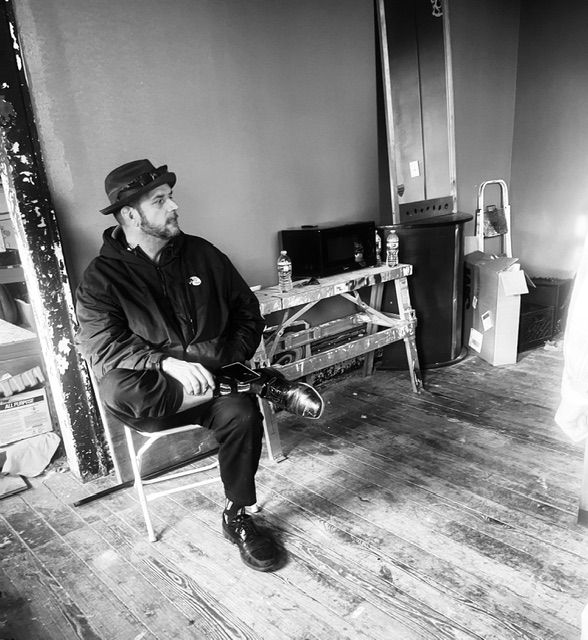
[Photo courtesy of Dominick Grillo.]
***
Interviewed by Laura DeFazio & Hannah Kreiger-Benson 7/16/2021
Transcribed by Carmen (Jazz Museum intern)
Transcript corrected by Hannah Kreiger-Benson
Interview edited for clarity & concision by Laura DeFazio
Posted to Frenchmen Notes 5/13/26
