Monica da Silva – artist, jewelry maker, much-decorated local bartender – grew up in Chicago and arrived in New Orleans via San Francisco in 1996. Jazz/swing/R&B pianist Monty Banks, a native of Seattle, traveled the country and high seas plying his trade before landing on Frenchmen Street just after Katrina. They met at the Apple Barrel, and the rest is history…
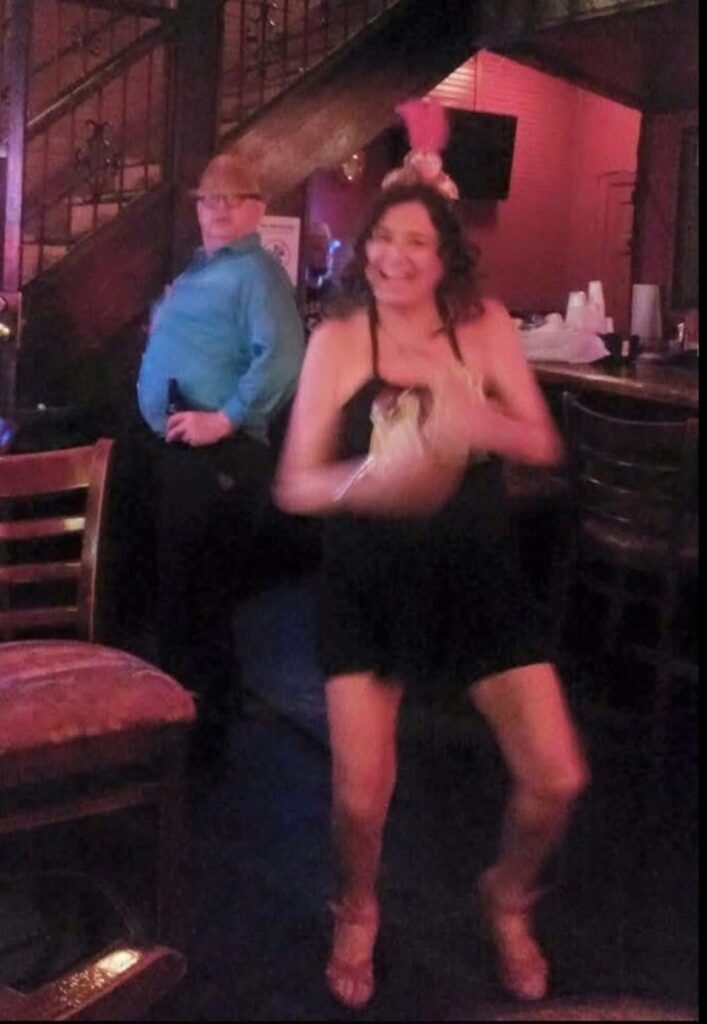
This conversation took place in 2021 at M & M’s home in the Marigny. Read on for good fun and fond memories with Coco, Adolfo, Dave Gregg, Jack Fine, Al “Carnival Time” Johnson, Jean Knight, and all the other char-AC-tas who’ve populated Monty & Monica’s life together on Frenchmen Street. (Also, this just in, in the time since this interview took place back in 2021, they’ve gotten engaged!)
***Thank you to the Threadhead Foundation for supporting our editorial work in 2026!***
PT I: Monica, Monty, & the Apple Barrel
MONTY’S ARRIVAL / DAVE GREGG
MONTY BANKS, 3/12/2021: I moved here just after Katrina. So it was like January, early February of 2006. Before that I had been working on cruise ships, and then I ended up getting a job in an Indian casino in Arizona. It was a high-paying job, but I didn’t enjoy desert life too much, you know?
One of my cruise ship friends had moved here to New Orleans, and when Katrina happened, I called him and said, “Hey, are you okay? Need a place to stay? I’m making tons of money, you can just come stay here for a while until you get your feet on the ground.” He tells me, “Nah, nah, I’m fine, I’m up in Canada, but, when I move back, we could use a guy like you in our band. Why don’t you come out to New Orleans? You could stay on my couch for a while.”
I said, “Yeah, sure. I’ll give it a try.”
MONTY: My friend’s [Adam Coolsaet’s] band was a busking band, but it was… I don’t know how to explain it. Do you remember Dave Gregg? This guy would play electric bass guitar with his feet. He’s an amazing guy. You know, a lot of people can’t sing and play at the same time. To try to play bassline and chords and sing can be quite perplexing. But this guy would play the bassline with his feet. Then he’d have a guitar on his back and he’d play the chords, then he could play melody lines on another guitar–one-handed–and sing!
MONICA DA SILVA: And play harmonica!
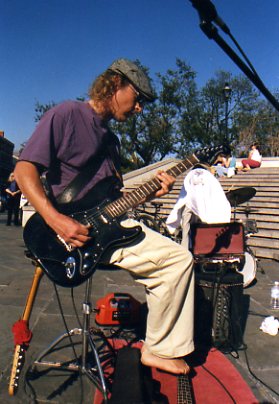
[Dave Gregg. Photo courtesy of Monica & Monty.]
MONTY: He was virtuosic. He was an interesting character. Socially, he was really awkward. You probably have to be a bit on the spectrum to be able to do all that stuff at the same time. But yeah, that would be our trio. I would actually play alto sax, and then my other buddy Adam was the drummer.
That’s how I got to know Monica. We’d play at the Apple Barrel; she was bartending there.
MONICA: Can I interrupt to tell my first story about meeting you?
…MONICA’S FIRST STORY ABOUT MEETING HIM:
MONICA: So, this guy keeps coming in, he’s got a saxophone backpack, and he wears these green sunglasses. He thought he was so cool!
This is when you could smoke in bars; the green glasses thing wasn’t because he was so cool, I found out later. It was because it hurt his eyes being in smoky bars. But I didn’t know that. I was just like, ‘Who is this guy who doesn’t talk to me? Just another one of the newcomers… Everybody else knows me, but he just comes in, orders his Heineken and talks to everybody else. I’m getting kinda tired of that.”
Eventually we got to know each other, and we started hanging out as friends. We did that for like six months. I’d never been friends with a boyfriend before; it was really nice. It was really cool. We didn’t even go on “dates”–we didn’t know we were dating! We were courting, I guess, but we didn’t know it. …Or, I didn’t know it.
Eventually I was like, “He hasn’t kissed me, what’s up with that?’
So I kissed him, and it was all over.
MONTY: It’s been like thirteen, fourteen years [at time of interview]. I think it was about a year, from the time I got here to the time we got together.
[Monica, Oct. ‘26: “It’s been twenty years now, and we’re getting married in December 2027!”]
MONICA: Yeah. James Brown died on Christmas Eve, I don’t know the year [2006], but it was after that we started to move forward in our relationship.
MONTY: Thank you, James Brown.
MONICA: I was juggling a bunch of boyfriends at that time.
MONTY: Yeah, a lot of people said… interesting things to me after we connected.
Int: Like what?
MONTY: Just different things, different admirers… Like, Shaggy–do you know Shaggy? He’s the crawfish guy. He’s like [gruff, indignant voice], “How’d you do it? How’d you do it?!?! I’ve been trying for years! And you better not mess this up, or I’ll be lookin’ for ya!” I’m like, “Oh, god…” [Laughter]
“BEST BARTENDER: MONICA DA SILVA”
[Note: Due to mysteriously vanishing audio files, a few small bits like the following had to be reconstructed in third person from Laura’s notes.]
Monica moved to New Orleans from San Francisco in 1996. On Frenchmen, Monica has tended bar at the Apple Barrel, Café Negril, the Spotted Cat, the original Café Istanbul, the Dream Palace, and most recently–for about a year leading up to the pandemic–the Royal Frenchmen Hotel. (She’d spent the decade before her Royal Frenchmen job focusing primarily on her visual art.) Off Frenchmen, she’s bartended at Benny’s blues bar, the Milan, and Tipitina’s.
MONICA: I worked at the Apple Barrel straight for nine years. I started the same year as 9/11, which was before they had music.
Monica started out at the Apple Barrel as a fill-in. She remembers one of her early shifts, which took place while a show was going on down the street at Café Brasil. Everyone loved Café Brasil, she said, but it could be hard to get a good drink in there when it was packed.
MONICA: I walked past [Café Brasil] and saw a bunch of people I knew in there. I mentioned I was bartending at Apple Barrel and they all came over. I had the highest ring in the history of the Apple Barrel!
After that, the owners made room for her on the schedule.
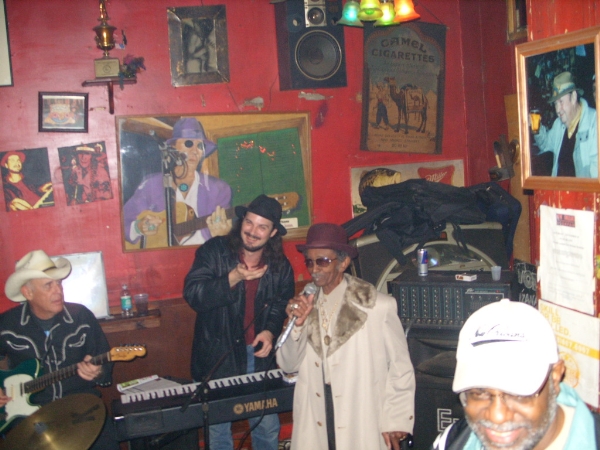
[Music at the Apple Barrel. Mike Sklar, seated, Uncle Lionel, with mic.]
MONICA: For the last couple of those nine years at the Barrel, I worked Café Negril as well. Then I quit the Barrel and did Negril and the Spotted Cat.
DBA asked her to work there too, but she said no– “[DBA] was my special place,” she recalls, and there were “too many people.”
MONICA: The Apple Barrel is a small place. Everybody knows everybody. I make sure people are okay. You know, take care of single women with guys hitting on them, match people up to talk to each other…
MONTY: Monica is so famous! I can’t believe how big-time Monica is. One of those newspapers–I think it’s The Gambit–comes out with awards. One year, I’m reading it and they have all the fest bands, and then I see, “Best Bartender: Monica da Silva.”
I’m like, “Wow!” I come into the bar with this newspaper in hand, and Monica’s holding court and everything, and I go, “Monica, look! It says you’re the best bartender in New Orleans!”
She goes, “…Agaaain?” [Laughter]
MONTY: Turns out it’s like the fifth time! She’s in all these different newspapers. That smart-ass attitude, it works perfect, you know?
MONICA: I was being serious! I was just like, “Again?”
MONTY: She was like, “Oh, brother. They’re always saying that.” [Laughter]
According to Monty, the story of how Monica got her gig at the Royal Frenchmen was not dissimilar to her start at the Apple Barrel: he recalls having bartend his own gig there after the staff walked out one day. It was pouring rain outside and “a total shitshow.” Monty enlisted a friend to help him out, but neither of them knew how to run the till or keep tabs. Luckily, Monica stepped in.
LAGNIAPPE: A SNAPSHOT OF ADOLFO
MONICA: … Adolfo was the cook upstairs. When I’m just first meeting him, him he’s got a cigarette, and he’s chopping food, and the cigarette’s got an ash this long… [pantomimes an ash that defies physics, to general laughter]
[Adolfo Perez Palavicini, a native of Sevilla, Spain, was the longtime owner and chef of creole/Italian restaurant Adolfo’s, above the Apple Barrel. Before opening his restaurant in 1997, Adolfo cooked at Alberto’s, which was above the Dream Palace across the street. Sadly, Adolfo passed away in on 8/12/2022, the year after this interview took place. His restaurant is currently owned and operated by his wife, Kim Perez, and their kids.]
LAGNIAPPE: HOW COCO CHOSE THE APPLE BARREL
MONTY: This might be an apocryphal story, but I heard that Coco and his buddies all listed different factors [that they were looking for in clubhouse] on a map, and they triangulated right there on Frenchmen Street.
So he ended up approaching Liz [Elizabeth Montoya, former Apple Barrel owner], and asking, “Why don’t we start doing music here?” Liz tells it totally different… it was her idea. [Laughter] Liz might be somebody to interview. She’s a wild card. She’s a char-AC-ta’.
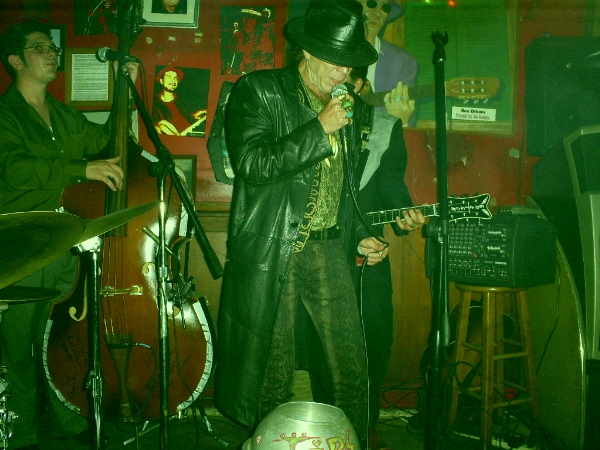
[Coco at the Apple Barrel. Photo courtesy of Monica & Monty]
PT II: Kindness & Community
THE ROYAL BENCHMEN OF FRENCHMEN
MONTY: I was always just struck by the amazingness of what a nice cultural community was there on Frenchmen Street. How everybody knew each other, and was so music-positive. And particularly, that bench that was in front of the Apple Barrel. You’ve already heard many people mention that, you’ve sat on it yourself, and that was–
MONICA: “The Royal Benchmen of Frenchmen–” I believe Coco coined that.
MONTY: I believe so, yeah.
Int: So who were the other Benchmen? Or who were a few of the main ones.
MONICA: Coco, Mike Sklar, Kenny Holladay, who passed–
Int: Mike Sklar passed too, right?
MONICA: Yeah. His daughter lives here. She’s got a really interesting story, about Nazis and stuff like that. Interview her about it–she’s finding more about her lineage and history. And there’s something about Frida Kahlo in there too? I did a memorial for Coco for gravestone placing, to raise funds, and we got in touch: I wanted her to be part of it. She told me some stuff. I don’t remember a lot of it, but you should ask her.
So, what was I saying? Oh yeah, the Royal Benchmen. Then there was the broom guy, Doc Love, who was a street guy and then he started saying he was a performer–with his broom, or a pool stick, or whatever he had that day. He was a Benchman.
MONTY: And also Uncle Lionel.
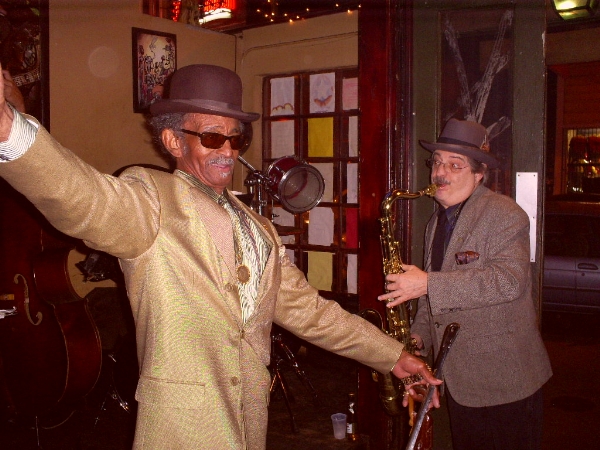
[Uncle Lionel, L, and Jerry Jumonville. Photo courtesy of M & M.]
Int: So they’ve really all passed…
MONICA: I don’t if Doc Love is still around or not.
MONTY: He passed away, sadly.
MONICA: Oh.
MONTY: Jack Fine. He’s still alive.
MONICA: He was in a nursing home, and he ran out of money. But then some musicians–a regular brass band, or a jazz band; I don’t know exactly who they were–
MONTY: James Williams.
MONICA: James Williams! Got him a place to live in a back house or something.
MONTY: I don’t even think Jack ran out of money: he kept sneaking out! [Of the nursing home : ) ] Trumpet player. He’s pretty small, probably about 5’2”, probably weighs 90 pounds. He was a New York musician, but he’s been here twenty, twenty-five years…
His thing was, he would just invite himself to sit in. Wherever he would go, he would be sitting in the audience and he’d just pull out his trumpet–when he felt like it–and just start doing a big loud trumpet solo. But he could get away with it because that was what he’s known for.
MONICA: That’s something I noticed about Frenchmen Street, was how kind everybody was to people. I came from San Francisco, and Chicago before that. You didn’t put up with shit, because there was a lot of shit. But here, everyone got to know each other, and you welcomed them in.
Up until they acted up so much you had to tell them to leave… But they were welcome, whereas in other bars I worked across the country, we didn’t have those types of people at the bar.
Int: Yeah, tell me more about what your regulars were like at the Apple Barrel compared to other bars you’ve worked at across the country, or even in other parts of town….
MONICA: Annoying. All regulars are annoying. Don’t put that in! [Laughter]
I had the Christopher Inn shift. There was a dayshift, then I started like at 7. Or 6pm? I forget what it was, but there was happy hour [going on] for one more hour [after I arrived].
So those guys were already blasted because they’d been sitting there daydrinking since 2pm. Out on the sidewalk, or inside the bar, or whatever. And they loved to get you in trouble, or make shit up, like telling Liz [the owner], “Liz, she’s late! And she’s already drunk!” [laughing, shakes her head] And she’s like, “You might not have a job tomorrow if you’re gonna come in late again.” [laughing, shakes her head] I’m like, “Come on, it’s not like that clock’s ten minutes fast!”
They were a handful, the regulars, but I really did love them. They were from Christopher House, mostly. And working people getting off work—construction guys, stuff like that. And neighborhood musicians and artists. Lots of artists.
We had no tourists, then little by little, people came during Jazz Fest. They were great tippers, they knew the music, they loved the scene; they wanted to eat the scene up with a spoon, in bucketfuls. They were dream customers. People would complain, “The tourists are coming!” … I’d say, “These aren’t tourists: they’re travelers!”
Travelers from all over the world, that really loved the music. As opposed to what we got now… I mean, I have to get drunk to go to Frenchmen Street on a Saturday night!
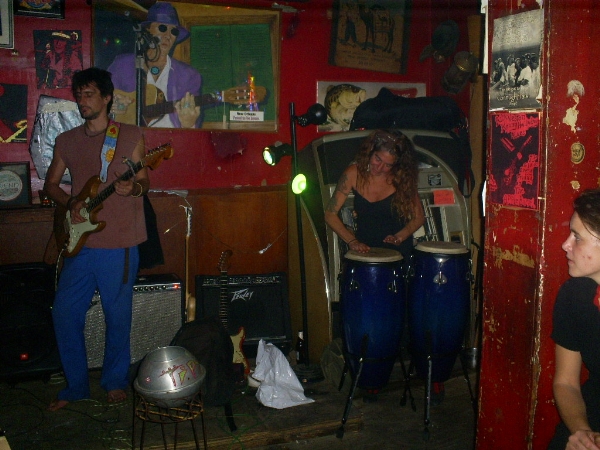
[Roberto Luti, L, and “Washboard” Lissa Driscoll, R. Photo courtesy of M & M.]
MONTY BANKS’ GOLDEN ERA
(& more on “The Bench”)
MONTY: I just want to talk about what a cultural, anthropological institution that [bench] really was. It was really the only chance I’d ever seen where I could hang for long times in a comfortable social environment and just hear stories and ask questions about New Orleans music, music in general.
It was really the best place to learn about music. The best place to learn that I’d ever seen. Really, really experienced people would be up there, but you felt like everybody was kind of on an even playing field. It was comfortable. And since there were tons of different musicians there, people would [always look around and] say stuff like, ‘Wow, music is incredible, because it can cut through different cultural bla-blas.”
Although he came up in Seattle of the ‘90s, where people generally thought of jazz as “this old-timey stuff,” Monty grew up feeling like he was somehow destined to be a jazz musician. He listened to bands like the Zoot Suit Riot, Big Bad Voodoo Daddy, and the Cherry Popping Daddies (Ingrid Lucia, he notes, had a band in that style as well) and imagined what it would be like to live in an “environment of jazz.” He and his friends formed a jazz band when they were young, but “their chops were really for ‘80s music–pop music.”
MONTY: I’d felt like all these golden eras were all in the past. I figured, “I’m never gonna see what it was like in New York when Charlie Parker came out, I’m never gonna see what it was like to be in World War Two and the big swing bands, my life is just crap because I’m never gonna see a golden era.”
But then, when I was out there [by the bench], I’d look around and be like, “You know, this is my golden era.”
And it really was, talking to Coco and Uncle Lionel and learning that stuff.
PT III: Admirable Musicians
MONTY: [Outside New Orleans] if you meet someone, you know, where they ask, “What do you do for a job?” and you tell them, “Well, I’m a musician,” …. They’re like, “…What?”
Int: Same with bartending–it translates differently here, you know?
MONTY: But here they’re like, “Oh, where do you play? I wanna come see you.”
MONICA: I really admire musicians like Monty, the ones who came to town from elsewhere to really learn music, not just get drunk.
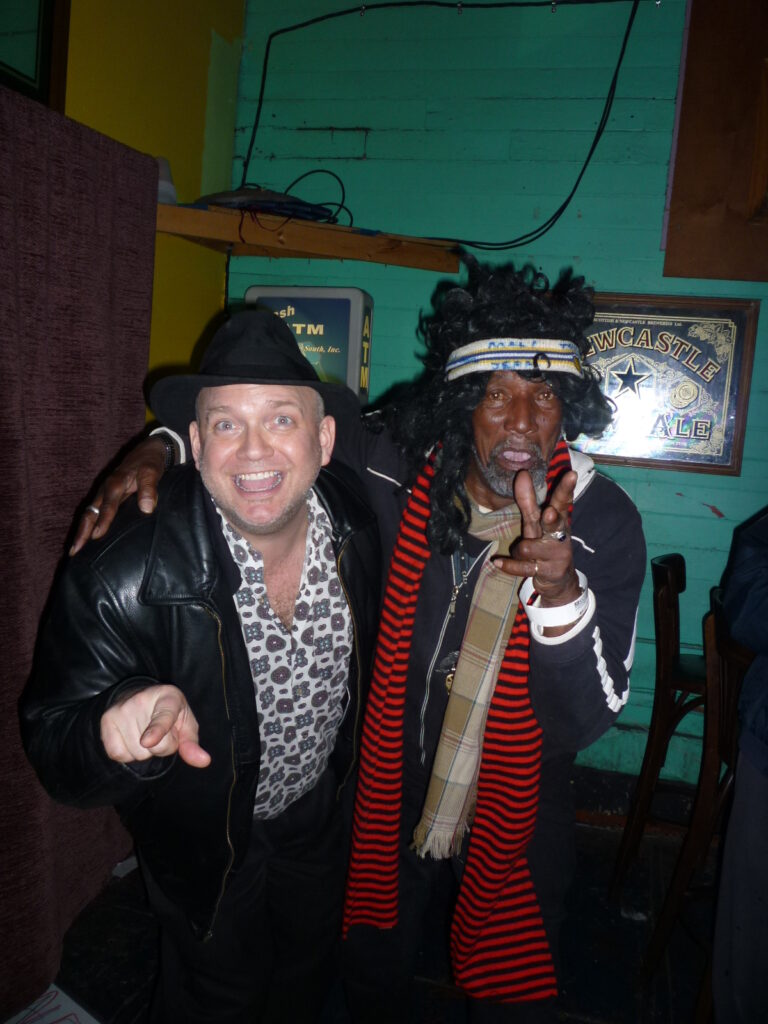
Int: Who are some other musicians in that category?
MONICA: Charlie Harrohan, Meschiya Lake, Lynn Drury, Margie Perez, Pat Casey–oh my God, just the Pat Casey scene. I mean, that kind of jazz was not really being done at the bars [in Frenchmen’s earlier days]. [Pat Casey moved to New Orleans around 2008].
And then I got sad, because everyone latched onto the moneymaker, which was the trad jazz thing. Which I think is great, but I think it got oversaturated. All the bars are doing that except DBA, except Apple Barrel. And Negril didn’t do it so much either. I think they did more of a rock thing, and a reggae thing.
Some other musicians I admire [this list includes non-transplants as well] are Walter Wolfman, Junkyard Dog, Kufaro, the brass bands [that play or have played] by DBA and Café Brasil. Fredy Omar–the Latin scene was really big. But Walter Wolfman especially. He’s a good friend of mine. He’s amazing.
Int: We definitely want to interview him. [He was at the top of our list but sadly passed away on 12/20/2022, before we were able to speak to him.]
MONICA: Michelle now runs things. His new lady. [Michelle Bushey Washington and Walter Wolfman married onstage at Tipitina’s in June 2021, just a few months after this interview was conducted.] I have other friends that know her, so I could probably….
MONTY: Al Johnson, I’m sure you have him on your list. He lived in Christopher House [The Christopher Inn on Frenchmen] at the time when I moved [to New Orleans] because his house got destroyed [in Katrina], but he now has a house in the Musicians’ Village. I’d have these little bitty gigs at the Spotted Cat in the afternoon, and he would come over… God, he was so nice. He said, “You’re my new favorite piano player; let’s get together,” and we would give each other piano lessons at his house.
MONICA: [chuckling] Yeah, because you didn’t know who Jean Knight was….
MONTY: Oh! Well, yes… When I first visited Al, we was talking to someone on the phone. He had asked me if I knew who sang “…Mr. Big Stuff, who do you think you are?” I was so embarrassed that I didn’t, and she was on the other end of the phone line!
I had to learn a lot about music when I moved to New Orleans… It was awesome, and I loved it.
MONICA: […] New Orleans musicians can just get up and play with each other. Other people can’t. That New Orleans mambo is its own thing.
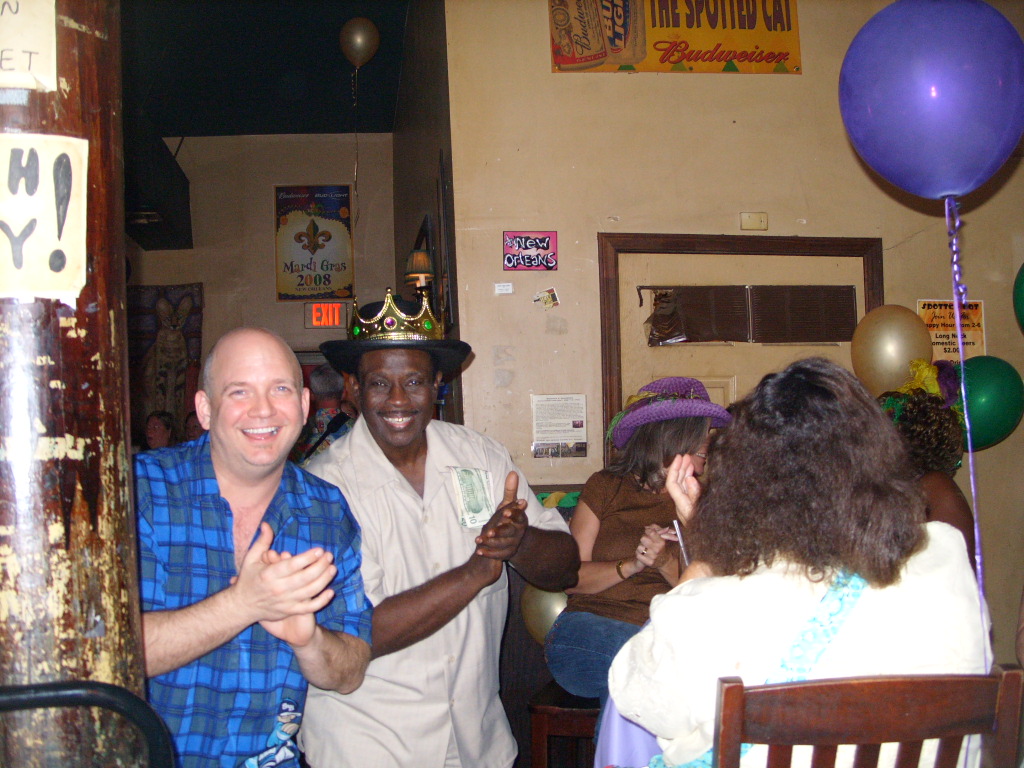
[Monty, L, with Al “Carnival Time” Johnson at the Spotted Cat. Photo courtesy of M&M.]
PT IV: Memorable Shows
STEVIE WONDER
MONICA: I was bartending at [?]…. Everybody emptied out because Stevie Wonder was playing–this happened twice [in two different years]. I actually locked the bar, [went over to where he was playing, and] watched through the window. I was so nervous– I was like, “You dumbass, who the fuck cares, nobody was in your bar, you could’ve gone and sat down in there….” But I was dutiful…
But I got to see Stevie Wonder play.
TOM JONES AT APPLE BARREL
MONICA: And then there’s the night Tom Jones played…
MONTY: I got to see Tom Jones!
MONICA: André Bouvier was there that night. He’s another one I love too. The Royal Bohemians….
MONTY: Hannah, you [as a piano player] will really appreciate this. It was freezing, and raining like crazy, so it was just a really quiet night. A few random people had wandered into the tiny bar. The streets were absolutely empty. When I popped in, I saw about 35 people, and there was Tom Jones up on the bandstand, singing his heart out! He had a night off in New Orleans, and decided to sit in with the band. He gave a free show for about 2 hours! (He was hammered too!)
He actually kept singing the same song over and over again. “Poke Salad Annie.” He later told me he fell in love with that song when he was working in Las Vegas.
There was a little group of people in the back–these smug-asses–and they had the nerve to yell, [whinily] “Freeeebird!”
Int: Oh god.
MONTY: To Tom Jones! And I thought to myself, you are watching Tom Jones in the most intimate venue possible, for free! And you still have the nerve to say, “Freebird” to Tom Jones? I have no hope. I will never be mad ever again when people crack jokes like “Freebird” [at me]. I still can’t believe that!
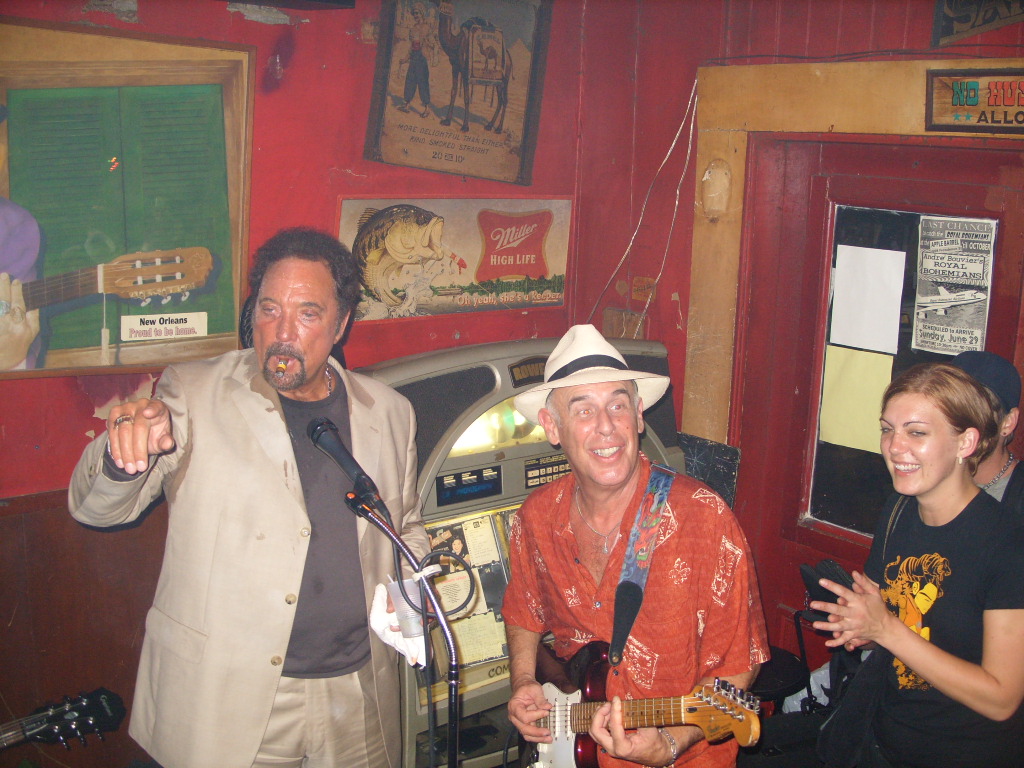
[Tom Jones, L, and Mike Sklar, center, at the Apple Barrel. Photo courtesy of M & M.]
SEEING THE RADIATORS AT THE DREAM PALACE
MONICA: It was Jazz Fest, and I’d just gotten off work seeing Randy Newman at the CAC– I was a bartender there. It was an amazing show. The Radiators were playing at the Dream Palace and I was supposed to go, but I had no cool clothes because I’d been working like crazy–again, it was Jazz Fest. I had these black polyester bell-bottoms on, and a white shirt, and I was like, “I don’t want to go in!” But I had the cab take me by anyways and I decided I was going in.
Immediately someone gives me something [ecstacy]. You’re not supposed to sit on the bar, but Jared let me sit on the bar, and that’s where I saw Ed Volker, and then the Radiators, who we called Lower Decatiators. And then we all went upstairs and partied. There was this big fish on the wall, and my friend Jonny “Smiley” Liss had a little ball with a smiley face on it, and we were batting it with the fish… I mean, we were just outta fucking control.
Then we all went out on the town, and then it just gets torrid… We ended up at Snake and Jakes, walking out at 10am.
Interviewed by Laura DeFazio & Hannah Kreiger-Benson 3/12/2021
Transcribed by Brooke (2021 Jazz Museum intern)
Edited for clarity & concision by Laura DeFazio
Published to Frenchmen Notes 10/20/26
