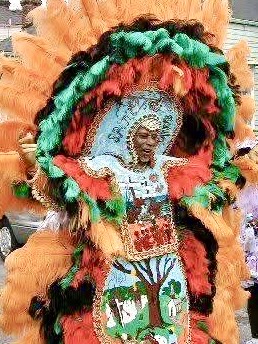
Alfred Doucette of the Flaming Arrows has been inducted twice into the Mardi Gras Indian Hall of Fame (once as Big Chief, once as Chief Council). A real Renaissance man, the master suit-maker and performing artist has also enjoyed long careers in carpentry, thoroughbred horse racing, night club ownership, and race car building/driving.
***Thank you to the Threadhead Foundation for supporting our editorial work in 2026!***
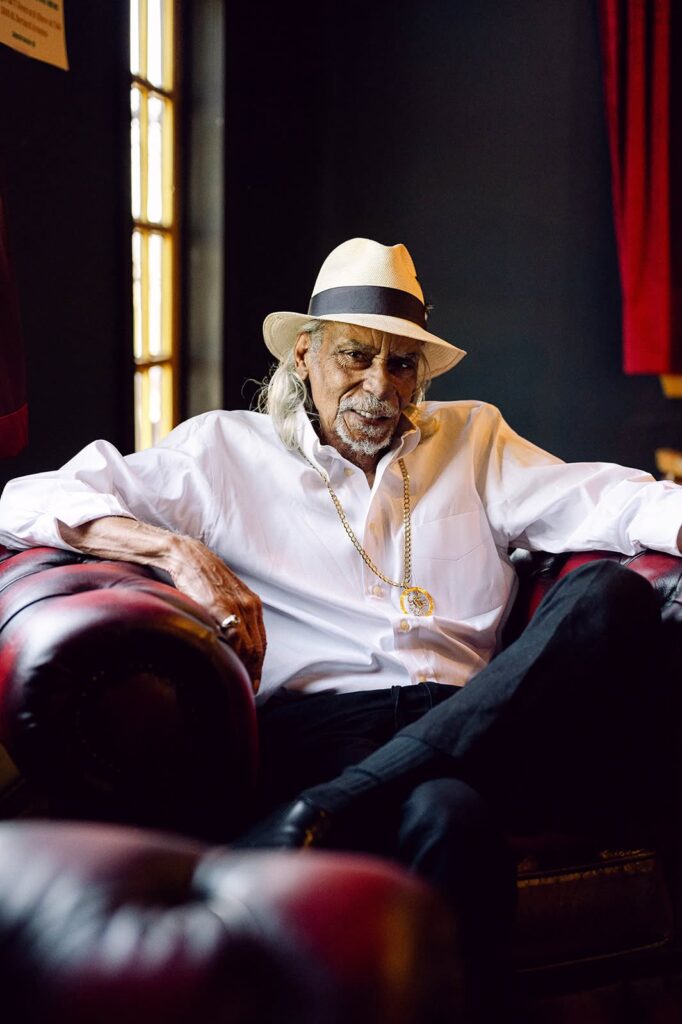
[All photos courtesy of Big Chief Alfred & his partner, Emily.]
INTRO
Big Chief Alfred Doucette, 8/25/2022: I’m a Mardi Gras Big Chief, and I’m a carpenter. I’ve worked all over this city. I helped build New Orleans.
When me and my brother opened the Nite Cap on Louisiana Avenue in the ’70s, we used to have all kinds of musicians from New Orleans work the club. I had fifteen bands under my supervision; I had an international band that I was paying $15,000 to $25,000 a week. […] In the ‘70s, everybody had money. Money was flowing.
I knew something about entertainment, but I didn’t sing. I was in the club business for twelve years and never sang. Cars was mainly my thing– I was into racing cars. I never did get involved with singing until… 1992, I think. “Marie Laveau” woke me up. [“Marie Laveau” is the lead track on Doucette’s 2007 album, Rollin’ Wit Da Legends & Marie Laveau.]
I woke up singing that song. Brian Lewis used to play drums in my club; I saw him coming out of Lowe’s, and I told him about my song. He said, “Let me hear,” and I played the tape. He said, “Man, come up to the house”–he had a studio–and I got on his microphone and sang the song. He called his wife, and his wife was a record promoter, and she said, “Oh, Alfred, ” she said, “Man, I love that song.” And I recorded that song.
I’ve been singing ever since.
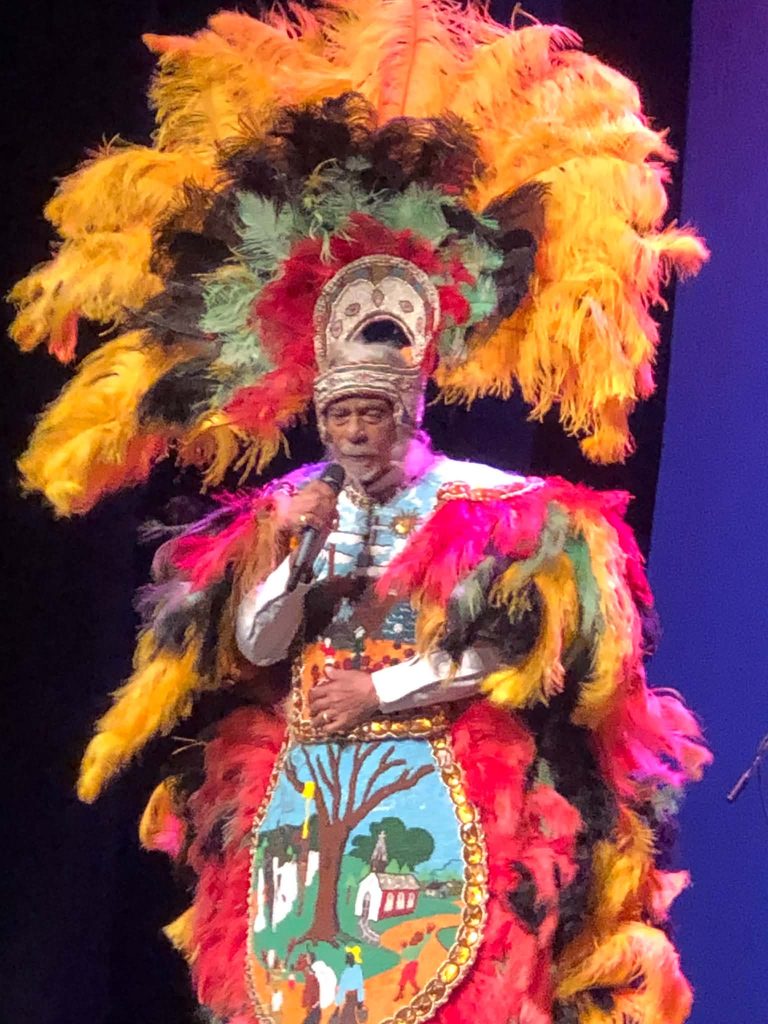
[Big Chief Alfred Doucette traces his ancestry to Africa as well as the Choctaw Nation.]
DOUCETTE & FRENCHMEN
Big Chief: Right after Katrina, I got involved with Frenchmen Street. I used to sing at the Banks Street Bar, and then the storm hit, and then Frenchmen kind of opened up because it didn’t get the water that everybody else got.
So, I started performing on Frenchmen Street. I was trying to promote my music, and Frenchmen Street was a place for me to showcase myself and my music. I got to know all the club owners, and everybody had a liking for me. I met a lot of musicians, and I was able to sing my music with them.
Writing and singing was good to me. Yeah, it was good to me. The faith– it’s a hustle gig.
Hannah: Do you remember hearing people talking about Frenchmen in the ’90s? Was it something that your Indian friends or other musician friends talked about?
Big Chief: No. On the real, I didn’t know too much. Alcohol never was my thing– I’m not much of a drinker. I drink a cup of Henny and then I’m done. I never did hang in the barrooms. When I got involved with “Marie Laveau,” then all the songs started coming, and I’m singing all these songs, and I’m going to the studio, and I got involved with Frenchmen Street.
Frenchmen Street was a good era for me, when I was singing club to club. I made money. I had a guy come up to me and stuff two $100 bills in my shirt pocket. He said, “Chief, you see, we enjoy you so much,” he said, “man, here.” I couldn’t believe somebody would tip that much money, but he did. We depend on that, because a club might pay 15% and you rely on the tip bucket. If you’re not good, the tip bucket ain’t gonna do nothing. Frenchmen Street don’t be an asset to you if you’re a downer.
Laura: Things are much more tip-based on Frenchmen…
Big Chief: Well, people walk in the club, club is jamming, and there’s no cover charge. There’s I think three clubs on Frenchmen Street who do cover charges. The clubs that don’t, they do the percentage of the bar in the bucket, and really that’s no money. You might get $150, $200 out of the bucket and the bar. But you got to make that work.
Hannah: Any specific clubs on Frenchmen that were especially important for you?
Big Chief: [chuckles] Just about all of them. I sang in all of them: Apple Barrel, DBA, Cafe Negril, 30°/90°, Bamboula’s… When I walk in the club and they had a live band there, it was, “Hey, Chief,” you know, “We got the Chief in the house!”
DBA has been my favorite club. I worked at DBA a few times and made money. That’s where I got that $200 tip from, from DBA. [But] all the clubs is pretty much equal as clubs; it’s the people that makes the club. The music draws the people, if there’s people out there. Because I can be singing, say, the block of Cafe Negril, and down the street some people hear me and come down and see who’s singing. That’s how Frenchmen used to be for me: I would draw people. You need somebody to draw people.
Hannah: Can you name some of the bands you played with, just because I’m curious.
Big Chief: Girl no, I can’t! [Laughter]
Hannah: Okay [chuckles]. That’s totally–
Big Chief: Gene’s Music Machine, Christian Duque– I can’t name all of them.* Call me up and I’ll get up there and sing a couple of songs!
[*Who could name them all? A quick internet search reveals Big Chief Doucette playing on Frenchmen with Walter Wolfman at DBA, the Hipshakers at Apple Barrel, Big Pearl and the Fugitives of Funk at the Louisiana Music Factory, James Andrews/Trombone Shorty at Café Brasil… to name just a few.]
Big Chief: Frenchmen always has been a place to showcase the culture of New Orleans, and this is a culture city. People learn how to play music on the corner in my neighborhood. Someone’s out there with a trumpet or saxophone, on the corner blowing, and then somebody would join them, and then somebody would come join them, and then they have a whole grand damn band on the corner.
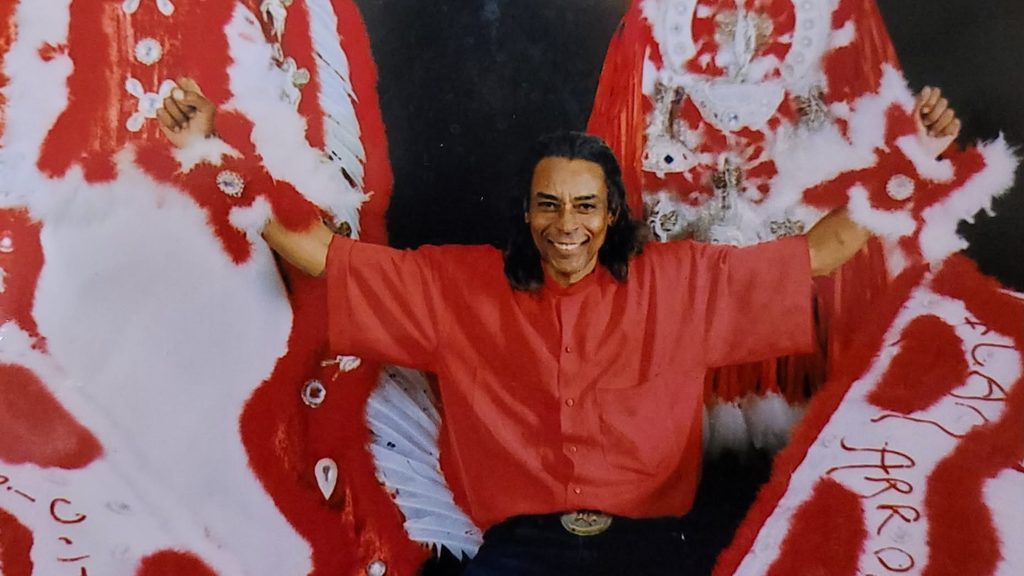
“PUTTING IT BACK”
[Covid, taxation, government spending, crime, discipline, rising wealth inequality, civic responsibility, patronizing Frenchmen venues]
Big Chief: Corona came through here and took over the world. Corona was the worst thing that could happen to America. Anything you thought you might want to get involved with, Corona was right there saying, “Come on, I dare you.” It was right there to block you. I don’t care what it was, Corona was right there saying, “No, no.”
Corona came through, and Monkey Pox came through here, we got the storm [Ida] that come through here and shut all this down… And we’re not getting no support.
[Since the pandemic] Frenchmen Street is missed by a lot, a lot of people, because whatever money they made on Frenchmen was money that was put back into the city.
Hannah: Right, because it’s all local.
Laura: That kind of relates to one of the questions we always ask people– okay, maybe Frenchmen’s kind of shitty now and it’s falling apart like you said, but what can we do as a community, the government, as people to cultivate places like Frenchmen that might grow in the future? What do we have to do to–
Big Chief: It’s going to take revenue. There’s no money– that’s the main thing. Money draws people, people draws money. We had the Jazz Fest at Armstrong Park, they moved it to the Fair Ground: look at the people it drew. See, it’s the music, it’s the culture. People come for the culture. [So,] put back into the culture. Put back into the music. Government needs to take care of their end of the business.
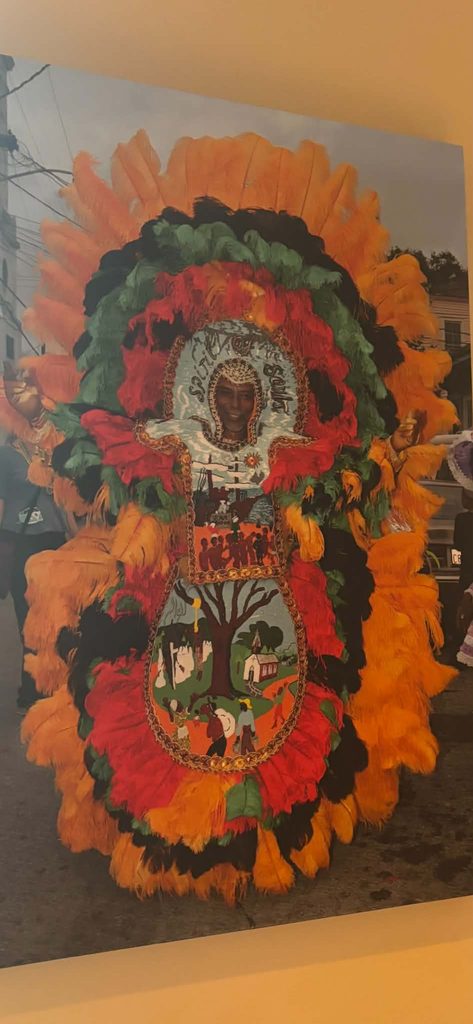
I’m a Mardi Gras Big Chief, I make the Indian suit, but don’t nobody give me no money to help me make the Indian suit. I make it out of my own pocket. I’m a carpenter– I work. When I come home at night, I sit down and sew five or six hours at night. On Saturdays and Sundays, I sew all day to make that Indian suit for Mardi Gras Day. My Indian suits–Marie Laveau, Strange Fruit, and Prince of Peace–they’re going to Europe. Yeah: they’re going to Europe. People want to see our culture, but nothing is getting put back into our culture, because I did this out of my pocket. The Baby Dolls, the parades– that’s people that’s doing that out of their pocket. And the city benefits by it.
I used to do concerts–international concerts at the Auditorium, at the Dome–but we left it alone. Because the city come at the end of the concert with their hand out for the taxes. For the chances that we’re taking and the money that we got to put out, we said, you know, it’s really not working. The tax was so great.
The mayor is not really doing her job, I feel. She’s not putting back into her city. See, Frenchmen Street has taken over music-wise from Bourbon Street, because a lot of people say they don’t want to go on Bourbon Street because of the kids. I told a Channel 6 newsman, I said, “If government don’t put back in my neighborhood, my neighborhood will come in government neighborhoods.” That’s what’s happening– kids is breaking in cars, stealing guns and jacking you… and jacking you, and jacking you. I got $30,000, $40,000 worth of jewelry I don’t wear. I don’t think that they would jack me because of who I am–everybody knows me–but these kids today, you can’t say that. When they took discipline out of the home–“You can’t put your hand on that boy for what he’s doing,”–the kids went crazy.
[When I was coming up,] I had good teachers. I’ll never forget a man named Mr. Clarence was building a screen door and he said, “Alfred, come here.” I had a football in my hand and we was going to the lot to play football, and I said, “I’m going to play football…” He said, “Man, come here, man. I want you to hold this screen so I can staple it down.” I kept on going. He told my pa, [laughing] and my pa tore my ass up. Next time I saw Mr. Clarence and he was doing something, I went over there [chuckles] and said, “You need some help?” I was never brutalized, I was never bruised, but that got my attention. When they took that out of the home, the kids went wild.
All these kids robbing one another, killing one another– they just don’t have no direction. Everybody is scared, bro. They’re hungry. We have facilities– we have the airport, we have places in New Orleans East that can be utilized to do things for the young people so that they don’t do a figure eight on St. Roch Street. Right over here, St. Roch and St. Claude, they’re running in the neighborhood, doing figure eights, running into businesses with their cars, killing a lot of people…. That’s government not putting back.
My mamma said, “Don’t clean your house when somebody’s coming to visit you; clean your house every day.” What’s wrong with the government? They’re not cleaning their house. They’re willing to spend $700 million on a wall and we can’t take care of America. That’s ridiculous.
You know, in the United States, liberty is good to everybody. [But] I don’t understand a person worth $500 million in America alone. One person is worth $500 million? King Tut took his with him and we found him, didn’t we? I mean, you got a $100 million, you can’t spend it in your lifetime. I remember coming up at the bar, people were [only] striving to be a millionaire. I had white folks in my neighborhood, they had grocery stores [unintelligible – store/family names?] and I used to hear Mr. Joe talk about, “If I can just get to that million, I’d be all right.” Old man used to talk about it all the time. I don’t know if he ever got to it, but [I know if he did,] he would look out for the neighborhood.
My brother made Indian suits for the kids in the neighborhood. It wasn’t just my nephew and my nieces, but kids outside of my family. We would go in our pocket and buy canvas, buy beads, buy thread, buy needles. I just can’t see how the people that’s worth so much more money won’t put it back in my neighborhood, and your neighborhood, and your neighborhood. I’m just trying to understand why people that’s got all this money just won’t put it back.
[…] The mayor’s not putting back into her city [either]. She’s spending money here, there, and everywhere, where she’s really not supposed to be spending it. What she needs to be thinking about is these kids with these guns. I got some ideas in my head about how that could be stopped, how we can solve the police problem, but the city has got to do their job.
And we have to do our part for [the mayor] to do her part. There’s no workforce. We have to participate. We have to give back. I mean, we throw cans on the ground and there’s a thousand cans on the ground, you understand what I’m saying? Don’t put cans on the ground, throw them in the garbage can. We got to help government. We, as a community of people, we have to put back into government and government got to put it back into the people.
Frenchmen Street is a place that don’t never, ever need to die. It’s got the music, it’s got the culture. It needs to stay alive, but it’s not going to stay alive if you don’t have the people. The clubs, if they don’t have people, they can’t pay. It’s just so hard on the club owners to pay a decent salary. [The musicians are] hungry. They want to work, they want to play, they want to sing– they got to have money, like everybody else. And 15%, 25% of the bar, that’s no money if you got no people in the place.
Lagniappe:
HOUSE & HOME
Big Chief: This, New Orleans, is my home. I done lived in a whole lot of places and come right back here. I come right back here.
It’s the culture that makes Louisiana, and New Orleans has got so much culture in it. That’s why people come here. I’ve heard people say, “I’m leaving because of this, that, and the other,” but where you gonna go? Anywhere you go, there’s crime. Anywhere you go, you could get carjacked, and anywhere you go, you got somebody could stick a gun in your face. Where you gonna go? You got to make it safer. This is my neighborhood. You know what I’m saying?
My brothers live in Eastover, out in the East, and they’re doing fine. One was a cop, one was a contractor, and he said to me, “Why don’t you sell that big old house and move out here?” I said, “No, no, this is my neighborhood.” I’m born and raised right around the corner. I was born at my mama’s house, 1940, and this is my home. This is where I live. That’s my bedroom, this my kitchen, that’s my bathroom, and this is my living room. The rest of the house is for somebody when they come in from out of town. You know what I’m saying? I’m happy.
This house is 122 years old. This house was owned and built by a Black man. This house was used to make suits–and clothes. The guy [who built it] was a seamstress. He went to New York and Chicago and places like that and took their ideas, came back and made suits and sold them here. Out of his house. And here I came in here and start making Indian suits.
I didn’t know that before– my girlfriend Emily’s friend works in City Hall, and she told Emily about this house.
Laura: It’s so beautiful.
Big Chief: You know, when I bought the house, it was full of termites. 2007. I was working on my house on Rocheblave Street, trying to put it back together after Katrina– I saw this house. I passed it every day. One day, they had a big old plywood sign up with a phone number on it. I called the number, I said, “How much are you asking for this house?” He said, “$85,000.” “That’s out of my budget.” “How much can you afford?” I said, “Oh, I got $50,000 in the bank.” “Oh, we can’t take $50,000.” I said, “Okay.” Bout an hour later, “Mr. Doucette? We’ll take the $50,000.” [chuckles]
The whole house needed to be re– The house had termites. It was a woman that was 83 and a boy with down syndrome, I think, living in this house when Katrina hit. The city was on her to board it up and was giving her a hard, hard time, so she thought she’d dump it. She lived with her son in Alabama, I think, and I bought the house.
It’s a cypress house. That’s why I bought it. Me being a carpenter, I know about cypress houses. The houses that they’re building today is termite food. I knew this house would withstand storms, and I knew this house [with proper care could] withstand termites. When I had to jack and level the house off, walls cracked, the plaster cracked. So, I just gutted the house and re-wired and re-plumbed it. I think I spent about $280,000 or something to put it back together.
But it’s tore up again. [chuckles] It’s hard to get help, and when you do get help, they want $200 a day or $250 a day.
I’m 82 – I just don’t have that strength anymore. But I still have the knowledge.
Hannah: I’m so sorry that you’re having such a time trying to fix it after Ida, it’s–
Big Chief: Baby, let me tell you, everything happens in its own time. Like I said, I made it through, and I ain’t rushin’ nothing. I ain’t in a hurry to go nowhere. My girlfriend say, “Why don’t you–” I say, ‘No, no, no, no, no. I don’t want you put no money in this house,” I say, “No, I’m going to get it done.” I will get it done. See these floors? I put these floors down.
Hannah: I was admiring the tile. I like the color.
Big Chief: I had good teachers. I got fifteen trades under my belt. Roofing, plumbing, roofing, plumbing, cement, bricklaying, carpenter work, ground… The trades are dying. We had manual training, we had vocation in school– all that was taken out of school.
When I was coming up, I had people that were doing the work, and I would ask them questions, and they answered me. I know every board that goes into this house because my grandfather taught us when we was young boys. I was like eight years old, and [when my grandfather would] take a house apart, the grandsons would take all the nails out and stack the boards up. He taught us all the numbers from young.
My dad was a carpenter, my brothers were carpenters… Carpenter work has been good to my family. Carpenter work has been good to me: I had a farm in Mississippi, I had thoroughbred horses from carpenter work. My kids has grown and gone– they in Texas, they got family, they buying their own houses. They’re doing great.
Carpenter work was good for me, and I was good to it, because it was like art. Yeah, it was like art. I loved it. I love to make two pieces of wood come together.
–Laura DeFazio [Ed.]
***
P.S. Check out this WWOZ video interview from 2018 for an up-close look at Doucette’s beadwork and some of the carpentry work he’s done on his house:
***
Interviewed by Laura DeFazio & Hannah Kreiger-Benson 8/25/2022
Transcribed by (a human at) GoTranscript.com
Transcript corrected by Meredith Foster
Edited for clarity & concision by Laura DeFazio
Published to Frenchmen Notes 10/27/2026
