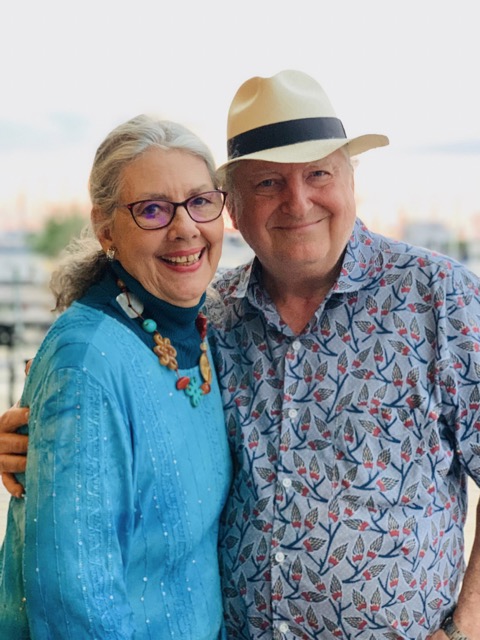
Edited excerpts of a conversation with Alan and Deborah—who opened the Dream Palace in 1976—and their daughter Erica on December 6, 2022. Interviewers: Hannah Kreiger-Benson and Laura DeFazio. Where it says “interviewer”, it means that it is unclear from the recording which interviewer is speaking.
EARLY YEARS/BEGINNINGS OF THE DREAM PALACE
Hannah (Interviewer): All right. Do you mind if I just stick this one [recording device] over here?
Alan Langhoff: No, sure go on. I think it’s probably getting–you get the better sound closer to me than on the table over here. As long as I don’t kick it over, we’ll be fine. When I kick it over the conversation is over.
Deborah Langhoff: I’m not sure Hannah knows, but in 1981, he and I started a computer consulting business. That was really our full-time business. The whole time we were- -we had The Dream Palace. We lived there, we worked there when there were gigs, but the real business which Alan is still involved with was a computer consulting business. We lived above the Dream Palace. She [Langhoff’s daughter Erica] was born above the Dream Palace.
Erica: I mean, I was born in a hospital.
Deborah: The day after.
Interviewer: Frenchmen Street native, that’s amazing.
Deborah: Yeah, we were there until ’88.
Alan: ‘88, yeah, we had two kids in a three-story walk-up above the bar.
Interviewer: tell us all the early timeline, how it happened? The why, the where, the what?
Alan: Yeah, the timelines. Let’s start with the timeline. The thing about it is, I don’t know exactly how far back to go to start this stuff….So, when I was in college I was a photographer here at UNO, which was then LSUNO, for the newspaper and the yearbook, and all that. I lived down in Marigny, and pretty much ran in the Quarter like it was my own.
[laughter]
Alan: I started taking a lot of pictures of bands. Guys like The Radiators, and all those guys, I took pictures of their early bands when they were in college. I’ve known some of those guys since I was through all 18 and stuff. I worked on Bourbon Street at Your Father’s Moustache, which was a big training ground for bartenders. It was a very interesting club, it was a banjo club. You might want to look that up. It’s an interesting kind of thing. They were six or seven of them across the United States and run by a guy by name of Joel Schiavone. A lot of guys in the business came out of there, Vince Vance & the Valiants came out of there. Our Sunday afternoon gig was Vince Vance & the Valiants, and some of the great trad musicians of the day played with me back then. Fred Lonzo, you know, Fred? You know who this is? The trombone player?
Interviewer: Oh Freddie Lonzo, yeah!
Alan: Yeah, Fred played in the band, and a guy you’ve probably never heard of, who was a terrific cornet player, Wes Mix played in the band. I can remember Les…I can’t remember Les’s last name though. He was the first banjo player we ever met. Anyway, I was always interested in the club scene. Deborah and I both hung out at this really great old Spanish bar called La Casa, and all that. We were definitely into the French Quarter and into music and all that. Then eventually–
Deborah: This is mid to late ’60s.
Alan: Eventually, I started traveling. I started skydiving and I was traveling with the skydiving, and really just selling jewelry on the road and stuff like that, and I saw the problem. The problem being that if I bust my ass, I’d better have a place to sit.
[chuckle]
Alan: So that’s when I went about the deal of buying the building and opening the bar. I bought the building in June of ’76. The bar opened in January of ’77. I bought it from a guy by the name of Michael Ruprich, who’s actually quite infamous in the New Orleans bar business. I guess he had decided to run off to Florida, but I don’t really know that for sure.
Interviewer: But it was a bar already?
Alan: The Dream Palace has been a bar in one form or another since the postwar years, for sure.
Deborah: But it was not called the Dream Palace.
Alan: Right. I have met several owners of previous clubs. Not really clubs, but bars. My favorite owner was this guy, Benny. Benny came in a couple of times to tell me old war stories and stuff, but he essentially ran a pool hall.
Deborah: If I can interrupt you just for a second, that’s really to establish those three addresses, that came as a municipal– Those are municipal assigned addresses, and it’s because they were three different businesses at one point or they were divided in some way.
Hannah: 534 [Frenchmen]?
Deborah: 528, 532, 534, it’s all the one building, but it’s three openings. [To Alan] Didn’t you tell me at one time, there was a division down there?
Alan: Well yeah, actually Benny’s story was that he was doing the pool hall at 528, and his buddy had the 532 location. And I guess 534 was just residential. Then at one point or another, all the girls started hanging out in the pool hall, and so the guy cut Benny in, and eventually, Benny bought him out and it became Benny’s Place. So, Frenchmen Street was very lively back then. Actually the bar, I don’t know the name of it– was on the corner before Cord’s Underground. I never went in this bar, but it looked like an old neighborhood, maybe Seamen’s bar, not a lot of action or anything. I only passed there casually on that corner a few times. I was living in the eleven hundred block of Royal, so I didn’t really– In fact, the world did not cross Esplanade. It was a big deal when after years of campaigning, I got the French Quarter map to turn to include the triangle.
Deborah We were 10, 12 years into the business.
Alan: The map, psychologically, everything stopped at the Esplanade from the Quarter. I mean, my thing was I always figured ’76 when I bought the building and I said, “Well, the action has to come my way. All I’ve got to do is hang on for five years or so.” I was wrong because the World’s Fair came. When the World’s Fair came, all the development money went into the Warehouse District.
Deborah: That was ’84.
Alan: That was 84. It was announced in ’80 that they were going to have a World’s Fair in ’84, and everyone scrambled to buy warehouses and open bars and la, la, la, la, la. So all the free cash in town went that way; all the speculative money went to that. It took more like 10 years for my 5-year plan to work. We started the bar and really my ideal was just to have a residence above a business. I knew what I could afford, and it was very hand-in-mouth, you know? When the computer business came along, I went, I used to say at that point, if I picked up my phone to do bar business, I was losing money.
Deborah: The difference between ’76 and when we started the computer business in ’81, and then the computer business was really going after we got married in ’83. So during that time, the bar went from 24/7, which it was known for in the earlier days, to being eventually as it was, ’85, ’86, ’87, more the big gigs, more weekends.
Alan: When we started having babies, it was easier for me to book four or five gigs a month and not operate a daily bar. I had plenty of work in the computer business.
Hannah: Oh, so it would be closed on the other days.
Alan: Right. I could open– I could make my big money in three Radiator gigs and two Little Queenie gigs a month.
Laura: Yeah, a lot of people remember the big shows being on weekends.
SKYDIVERS, BALLERINAS, EARLY RELATIONSHIP
Alan: It was great. I’m thrilled to have had life doing that and all of that when I was young. All my skydiving buddies would come in, if you’ve been and you’ve seen the skydivers on the ceiling of the Blue Nile. Yeah, the guy who painted the ceiling is this guy Rain Webb. My guys came around all the time, every week and stuff, and actually, at Mardi Gras, they came from all over the United States to jump in New Orleans and actually we jumped across the Lake to Covington, and then everyone would come down to the Dream Palace and they’d all run around being crazy skydivers, and in the bar was a little extra zhuzh on the costuming, you know?
Deborah: So as Rain was painting the mural, Alan would come in and, you know, Alan commissioned him to do the mural, but Alan would come in and make suggestions.
Alan: Well, he had the idea, he wanted to see the book. I had a photography book on the early days of skydiving, it’s called Skies Call, a matter of fact. I lent him the book, and he used the book, and he painted all those skydivers and the parachutes and everything on canvas and then applied deco-podge to the ceiling. Those are actually on paint on the ceiling. The coolest thing about that is, I love this thing of the—so he started drawing this net around it. And you have to look very carefully to see this because it’s a light green net on a peachy pink surface. But, if you look in the net, there’re ballerinas in the net and they’re pulling the net, see.
Interviewer: Oh, I love that.
Alan: Then, of course, Deborah comes around later and I want to marry a ballerina.
Deborah: In around ’72, I moved to New York and I had a professional ballet career in New York.
Interviewer: Oh, my God. Amazing.
Deborah: But I would come home on the holidays and that’s how I stayed in touch with Alan over the years. Then I moved back in ’80, ended my career and I looked up, and there were ballerinas on the ceiling. I went, “What?!”
[laughter]
Alan: So, you can take the Voodoo with that any way you want it.
Hannah: It worked! [laughter] So you guys are both from here?
Alan: We went to high school blocks away from each other, public high schools.
Deborah: Alan and I also met at UNO, again, he was friends with–
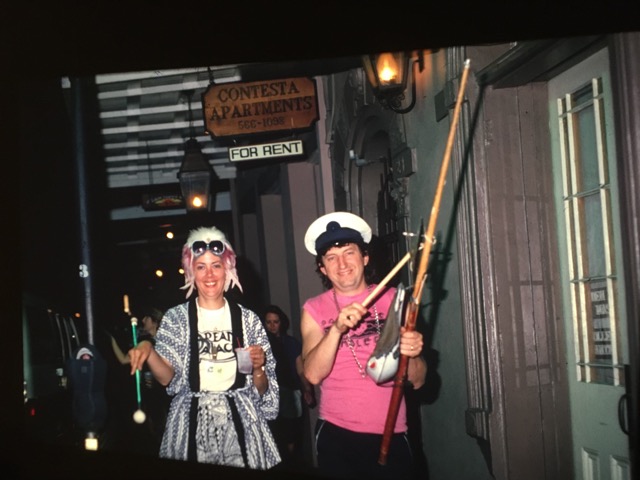
Alan: Deborah’s first husband, John Murphy, was a musician I met at school. I met her later through him and he was a terrific singer in one of the big rock bands, local rock bands at the time, a band called Yesterday’s Children. They were a well-known band, you know, and they were really rather competent. Deborah’s still in touch with a couple of the old guitar players and stuff. I noticed for her birthday, Richard Morant had sent her a hello. So we’ve been involved in the local scene for really our entire lives. As a kid, what I used to do in high school was I would take the bus down to the library and I would work in the library until nine o’clock and then I would hang outside of Preservation Hall, just in the window outside of Preservation Hall. I used to get upset because almost all the weekday gigs were Sweet Emma. I was like, “Oh God. Sweet Emma again. Can’t I ever hear anything else?” [laughter] I still stayed for most of the Sweet Emma.
OPENING THE BAR:
Deborah: When you have a second, I’d like to talk a little bit about how we started the bar, because we do have a little bit of a timeframe here. So, when Alan and I started living together in ’80, I became the bar manager in ’81 and managed it ’81, ’82, ’83 together with Alan. But–that’s how I know, we always had legal permits, and that’s one of the things that I saw on the website that I wanted to make sure we didn’t get too far down the line without talking to you guys.
There was something called the Mayoralty Permit and the first one the Dream Palace had, they got when Alan opened the bar in ’77, it was handwritten. They didn’t write it on the computers. They had a pre-printed form and then filled in by hand, Dream Palace, whatever. Then you had to pay extra taxes. It wasn’t a great thing, but it was a one step in the legality. Then I know by the time when I became Manager of Record, you know you’d have to go down and they do the whole thing. I know, we carried that permit, not only just a business permit and occupational permit but a permit to do live music.
Interestingly enough, we kept it the whole time we were operating the business. Now, there was a time when we leased the bar out that the permitting lapsed. Dream Palace was grandfathered in because we had been doing it so long. Then a tenant let it lapse.
Interviewer: When was that?
Deborah: When we came back in ’96 or something, ’95-’96, I needed to re-up all that, and I had to pull out all those old records to prove that I had it, because as you know, you know much more about this than I do. It was a quite a to-do.
Interviewer: But you were able to.
Deborah: Correct. and when we sold the business and when we sold the building to Jack [Mayhew], we sold it fully permitted. Everything. Every time we operated it, it was fully permitted. Now, I’m not saying we didn’t occasionally have a month where we were behind on taxes, but we were going to catch up. We never opened without a license. That was something: Alan’s parents were both bureaucrats-
[laughter]
Deborah: -and he taught me how to go to City Hall and get people to help you. Because they want to do business. It’s the zoning and all that is very complicated then and now, but for the Dream Palace it wasn’t, we were one of the few that actually had it. Yeah, you know, even some of the tenants were able to keep it going. I don’t think it was until it became Istanbul—and maybe it was the name change that gave Suleyman [Ayden] trouble–I do not know.
Alan: I think it was, I would say, it was a lack of action rather than trouble at that point. Because it had the precedent, you walk in the door, you reapply, you get the damn thing.
Deborah: Yeah, but the license was blocked.
Interviewer: That was ’96 when he had it?
Alan: When we got it back? When we displaced the last tenant? Suleyman is in ’88 ’til–
Deborah: No. ’89, I think. ’89 to ’96.
Alan: Yeah, fine. ’89-’96, Suleyman.
SELLING THE BUILDING/Y2K PARTY
Interviewer: And then you sold the building to Jack Mayhew?
Alan: Yeah, right.
Deborah: We owned the building until–
Alan: 2000.
Deborah: December 31st, 1999 at midnight.
Alan: You’re right.
Deborah: Yes. Yes, that’s when we got out entirely.
Hannah: that must have been a big event. I think that was the one that Davis Rogan, was talking about. Some big [band]..the Radiators playing or–
Deborah: That was us.
Alan: Actually, we were talking about-
Deborah: The last one?
Alan: -we can’t remember-
Deborah: We can’t remember. We tried to remember.
Alan: Who was the New Year’s Eve band? I don’t think– it could have been The Radiators, I don’t think so.
Deborah: Was it Iris May Tango? Because Davis Rogan was talking about being on the Y2K on the roof. I think it was the Dream Palace he was talking about.
Alan: It could have been Iris, because that’s what’s more like what I was doing then. The Radiators would have been too big. They would have been in a bigger venue by then. Yes and I don’t think Lil Queenie and the Percolators were around anymore at that point. That was one of our other favorite bands.
Speaker: Little Queenie and the Percolators?
Deborah: Oh yes.
Alan: The Percs.
BOOKING BANDS AND BEYOND:
Deborah: They [Little Queenie and The Percolators] played every– Yeah, Alan describes his booking, at one point when Faubourg opened down the street and they had the second music club on Frenchman Street, Alan booked the rock and roll in the Dream Palace. He also booked the jazz down at Faubourg. He would-
Alan: Yeah it was cool having the two clubs [on Frenchmen].
Deborah: To wear both those hats, you know. George [Brumat, who opened the Faubourg]] was a good friend.
Alan: -I would say probably some of the most influential musicians that I got to mess with back then, and we got to mess, the great James Black was a jazz drummer. You probably never heard of James Black. James Black?
Hannah: Yes, I’ve heard of him.
Alan: Okay, so James Black, Mose Allison, and Ellis and all of that, but James Black from the Faubourg, was just the most incredible drummer I’ve actually ever heard. And I’ve heard a lot of them. James Black, but of course, the wild man in the whole bunch is, of course, Gonzo [James Booker] himself, you know? It’s too much to just actually have gotten to mess with all these guys.
Deborah: Alan had lots of fun.
Alan: I did have lots of fun.
Deborah: I had lots of fun too, but you know…
Speaker: Was that on the same nights that you would have the rock shows and the jazz shows?
Alan: Well yeah, sure, sure. Both clubs had to go simultaneously.
Deborah: Oh, and we’d be constantly up and down the block. Now, we were actually– We’d often be more at the Faubourg. Because it was quieter, and we could talk.
Alan: They had a good air conditioner and no one was going to ask me to mop the floor.
[laughter]
Interviewer: Those are good perks.
Alan: That’s what they say, you know, in the food and beverage. When you get to the top, you get to mop. Did you know that?
Interviewer: I did not.
Alan: They mean it literally. When the spill occurs, who’s the only person that is not physically in the middle of doing something? The manager. The manager has to get the mop, unplug the toilet, whatever it is.
Deborah: In the very beginning too, we did a lot of unusual gigs, when we were still opening more than just weekends, and big gigs. When we still had the regular thing going. We did Broadway shows, we did New Leviathan [Oriental Foxtrot Orchestra], we did poetry readings, we did comedy shows, we did, you know, all kinds of– Alan had a kinda, an open venue thing.
Alan: Right, we did a lot. I guess my favorite of the weirder shows would be, that we played regularly, and they came back for us when we reopened in ’96 was the New Leviathan Oriental Fox-Trot Orchestra. That was like a regular Sunday thing for us, at least once a month.
Deborah: I think when we slowed up that because– The computer business has always been the major business for our family. When we slowed all that up, that’s one of the things I think really fed into the energy that Brazil enjoyed with that open-door, always-available, kind of thing, you know?
Alan: Yeah, so that’s when they started doing the brown bag concerts at the Brazil. Oh we saw Ade [Salgado] by accident the other day. We were at Budsi’s getting lunch and then Ade’ was getting something to go. We run to him every now and then.
Interviewer: He’s a character.
Alan: Oh yes.
Deborah: Wesley Schmidt, who I’m sure is a real-
Alan: Icon-.
Deborah: -culture bearer of renown, he was a friend. In 1983, he married us. Then I guess it was ’80 After Paul, so it would’ve been the mid-late ’80s, he became our manager.
Alan: He managed us for a short while before he moved to Snug.
Deborah: Before he moved to Snug. Snug needed a manager every day, and he was just doing weekends for us.
Alan: Yeah, and that was right when we sold to Istanbul–and so when he went to Snug.
Deborah: We didn’t sell anything to Istanbul, we leased it.
Alan: Yeah, that’s what I mean. We leased it.
Deborah: [chuckles] Just to be clear.
ORIGINAL VISION FOR THE DREAM PALACE:
Interviewer: In terms of questions, what I wanted to ask was, why did you buy the building? What was your vision, and did what actually happened match your vision?
Alan: I guess my original vision, when I was a freshman in college, after my freshman year, I went to Europe for the summer, and I hitchhiked around Europe and wound up in Berlin. In Berlin, I went to a bar called the Old Eden Club. The Eden franchise in Berlin still exists, because I saw it in the movie recently. At that time there were three Edens. There was the Old Eden, New Eden and the Playboy Eden were the three big Eden clubs.
I went to the Old Eden, and it was a multistory, multi-room bar, and it would take me 20 minutes to tell you all the different things. I can tell you right now, I remember 1, 2, 3, 4, 5, 6, 7 different parts of the venue. So when I came home from Europe, I told my Mom, I said, “You know, Mom, I’ve got this great idea. I saw this bar in Berlin, The Old Eden Club blah, blah, blah, and if we could open a bar like this would be fantastic. You know, it would be a great place to do this, the Old Mint Building. That Old Mint building.”
Anyway. I had this idea for a bar then, so that was in the back of my head.I guess that has to be ’68. [8 years before Dream Palace opened] Then I moved down to the French Quarter, and the next year, I guess, I moved down to the French Quarter. Well, one thing led to another, I guess.
Deborah: And you know, the bars, there were some cool bars back then. There were bars, obviously, gay and lesbian bars. Gay bars and lesbian bars, and there were bars like The Intellect, that were very, very small, strictly folk singers. The Intellect was on Bourbon Street, and then there were bars where you’d have to go up to the attic.
Interviewer: That’s cool.
Deborah: That’s where you could get served. If you behaved yourself, you could get served at 15. I can seriously attest to that.
[laughter]
Deborah: So, the idea of having a cool bar that served your own…you know, sorta, “if I like it, then other people are gonna like it”. That’s how baby boomers think.
Alan: I think the biggest thing that I didn’t realize were two things. There were several things happened that I didn’t quite realize when I finally set to do it. One of them was that we would be on the cutting edge of interracial bar life in New Orleans. That did really not exist- previous to that.
Speaker: Why was that particular spot, you think, so interracial?
Alan: I think part of it was location, but part of it was just that I had a mixed peer group, That I happen to have black friends. And the music. Of course, the music was part of it and all that. But, I mean, there were lots of bars-
Deborah: I would say the only exception to that, previously, was Charlie [B’s]. That was a jazz club though. That wasn’t rock and roll. And it was not a neighborhood bar.
Alan: It was on Rampart Street. It was really a club, club- on Rampart Street. Charlie Bering, great fixture in the New Orleans music industry, went on to produce Nighttime Concerts for the Jazz Festival for many, many years. The great Charlie Bering.
Deborah: His daughter’s still around, Celu Bering.
Alan: In fact, Erica exists because of Charlie Bering, and that’s a whole other story.
Erica: Thanks Charlie.
[laughter]
Alan: Yeah, so it was that, and then also, how important it would become as a musical estuary and that kind of thing. I was going to open up a neighborhood bar and sure we’d get some bands in or whatever, but you would be on the cutting edge of this, dynamic renaissance of New Orleans music. This is the beginning of the Neville Brothers and The Radiators and James Booker is coming back online, and Professor Longhair.
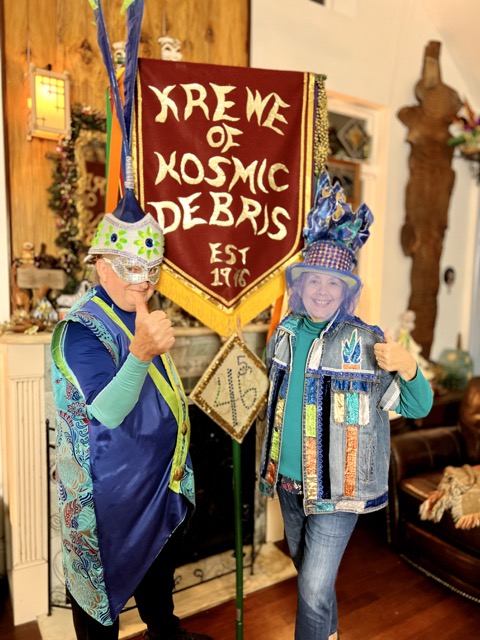
Deborah: James Booker was Alan’s first Grand Marshall of the Krewe of Kosmic Debris, which he started for the bar.
Hannah: I mean, what you’re saying is why we’re doing this project. It’s because Frenchmen Street was, it became a force that nobody could have imagined.
Alan: Right, right right! And it was–I will tell you, I think one of the big keys to that was, the beginning I had a guest house, a rooming house, upstairs. I ran the Dream Palace Guest House and I had–
Deborah: Second floor and the third floor. The guest house was before me.
Alan: Yeah, so, when I had the guest house, there was no third floor. I built that as life went on. It was only two stories. The front was divided, each of the two parlors at the front was divided into two small rooms. That two could only be accessed from the balcony and two had doors to them. It was 1, 2, 3, 4 small rooms, two big rooms, and then the kitchen wing.
So I lived in various locations, I lived in the kitchen and one of the little rooms, and I rented out the other rooms, and well, that was good. I mean I had people come from all over the world. I actually had two Swedish couples. One had gone around the world to the east and one had gone around the world to the west, and they were in my kitchen talking.
Speaker: Wow. That’s so cool.
Deborah: The thing about how Alan morphed the building over the years from what he got –and I knew it because I had friends in the neighborhood–I knew the shape of the building when he got it. It was dark. There was nothing that had happened in that building for years. There was one woman who was a squatter in that building and then over the years, as the needs changed for the club and for our family, first he built the attic, and he lived up there. Then he made the attic nice enough for me to live up there. Then we had two of our three children while we were living up there. So there was another bedroom, I mean, it was beautiful. Not like what it became later–
Alan: You’d be scared to see what it looks like now, but, and remember, so–
Deborah: We don’t know. We don’t know what it’s like since Jesse [Paige] has it. Jesse’s all right.
Alan: I would think Jesse probably did a good job with it.
Deborah: Jesse’s done a great job with it.
Alan: I think there was interim time where they put in too many walls or something, and I just shudder. When I did the attic, the big room—you know, there’s the big gable, right? So the room was 20 foot wide and 50 foot long, with two giant skylights and the double doors at the end of them. And an I-beam out the end of the building with a chain hoist on it. Then there was a wing, and also, what you might not realize is the building, originally when I got the building, it was a gabled roof front, and a wing, and a patio.
Deborah: The back was open.
Alan: It was a patio.
Deborah: Now that might not have had the right permit.
[laughter]
Alan: And, the wing itself had disintegrated to the point that there was no sill left and the studs was sticking in the mud. It had an incline of about 18 degrees. When you walk from went like that, it still to this day has a little pitch, because I was worried about the roof. To jack it all the way up. So the first thing I did is I got in there with giant scaffolding, like big scaffolding like this, and threw the whole place full of scaffolding and I-beams, cut it all loose and then cranked it up and then put in new walls. That was step one.
Deborah: Then-
Alan: And on the patio, that opened to a little restaurant on the patio. I got a tenant for my little restaurant and we called, it was the Dream Palace and the Reality Patio Restaurant.
I had built a little kitchen across the back, and they did a great little business there and they served in the wing and they served out on the patio. A friend of mine was a wholesaler of plants and stuff. So we got a deal one day when she needed a tractor trailer unloaded. I had all my pit crew, all my guys we went over there, and we unloaded this tractor-trailer for her, in return from which she came in planted this giant tropical garden.
Down the side, my building in the back. With all the rain that went into that thing exploded. It was the most luscious stuff coming up Like the banana trees but she all this exotic stuff, I didn’t even know it all was, all these variegated things.
MORE ABOUT THE EARLY YEARS
Deborah: I want to get you back because Hannah and Laura, they don’t have a whole lot on the website about those very, very early years in terms of what the business– like, what the streets were like, that sort of thing, and I’m thinking what we had talked about was there were some established things on Esplanade. Like Ruby Red’s, Lil Linda’s, there was a bar around the corner. The Port of Call was a well-established bar. It had been open 10 years. Some of those guys eventually moved over to Frenchmen Street when they saw what Alan was doin, basically, they could see that.
Hannah: Port of Call is related to Snug somehow, right?
Deborah: Yes, it is.
Hannah: George Brumat–
Deborah: –is the common denominator there, and Mike Martin too, I guess, but Jason [Patterson] has good history on that. But, there was Cord’s, Cord’s Underground was there. Then there was also the Casbah, which is where–
Alan: Apple Barrel is.
Deborah: The Apple Barrel is. That was a restaurant. Actually it wasn’t. It was just opening when Alan was there. He remembers the opening of the–
Hannah: How do you spell Casbah?
Deborah: C-A-S-B-A–
Alan: Maybe H on the end?
Deborah: That was two stories in the Apple Barrel building. Then the rest was pretty much daytime commercial, and you can go back on that, but those were, they were restaurants.
Alan: Right. You had the bookstore. Looking at the next block, the bookstore was on the corner. Next to the bookstore was the Swiss Bakery.
Deborah: You all have talked to Lenny, right? I think you’ve talked to Lenny.
Hannah: No we’ve not talked to Lenny. We’ve talked to Jason Patterson before. Lenny is deep in our list. I would love to.
Deborah: Lenny made our wedding cake.
Alan: Yeah we had an all-Frenchmen Street wedding. Everything was from Frenchmen Street when we had our wedding. It was great.
Deborah: We were there, and it was the hottest day of that summer.
Alan: It was yes. We had it on the second floor.
Deborah: Around that time, on the second floor, we had taken over for our living space. So, for quite a bit of the time that we were there, the second floor, you know, the building kept morphing.
Alan: Right. When we were having the kids, the second floor was our living rooms and everything and it had the nice big kitchen with the good hood… , so we had the wedding there and all of that. Yeah, so there were other interesting businesses though like the–
Deborah: There was the tattoo parlor
Alan: Oh. Actually, I think one of the most interesting things were the Oyster Houses. There were two of them. One that faced Decatur Street and then it actually L’d through to that–what`s the name of that old Monaghan place down there? 13? 13. Ok, so that wing was actually, that was part of the Oyster House. There was a wing in the Oyster House there. And then where [Cafe] Brasil was, was I guess as it started out, it was a guy there was dealing antique automobiles. And then there was another guy who actually did a pizza supply house.
Deborah: So, we’re getting close to the time that we had allotted, but I’m wondering if there’s something specific that you would like Alan to touch on.
Laura: Do either of you know just really quickly– Do you know when Valentine’s opened and who opened Valentine’s? I think that was there before Snug.
Deborah: Jason should be able to give you that exact date because he was the landlord. I did some research and found a Valentine’s menu, I think, in ’77. As far as when the buildings were bought, I think that those two things happened pretty close to each other, and the same with Tips. I think the 501 Club Uptown was opening about the same time. The big difference for our business and I say, ours because it was for the whole time that we had it, was the uptown clubs, which were some of those clubs were roughly the same size, Jed’s and you know, The Maple Leaf, whatever, but they drew on Tulane, Loyola, they drew the university crowds. It was automatic for them.
Alan: The thing about Frenchmen Street was it developed this very locals feeling because there was no university right around to draw from. So we had to market that. We had to market it in a time when there was no internet, there was no cell phones. It was all us going out, posters. We have a million stories about all that but you know, that’s for another time, but that was the key difference, I think, in the development of the music scene.
Interviewer: Interesting.
Deborah: But the same bands would rotate through. We’d have to wait to get a Radiator’s gig because they wanted to make sure they had their Tips gig set, you know. So it was this constant rotation. The Dream Palace, we had trouble getting those things finalized in time to get it into the monthly magazine, to get it into Wavelength.
Alan: Yeah, if there was a monthly magazine half the time.
Deborah: There was Wavelength.
Alan: Yes, Wavelength and it was-
Deborah: I’m sure you’ve probably looked at some of those old Wavelengths because they’re very informative.
Alan: There’s a Jon Newlin article in one of the Wavelengths where he talks about the early bands. He’s got about half a dozen of the photos I took in it. I think it’s– What was Camile’s first band, the other band not–?
Deborah: The Other Side?
Alan: No. The one with Les Gray.
Deborah: Oh, The Palace Guards.
Alan: The Palace Guards, right. So that was one of Newlin’s big fetishes was The Palace Guards. So he had some pictures that I took of The Palace Guards and some other stuff too.
Deborah: So they asked in particular about Cord’s–
Laura: Is that chord like a musical chord like C-H-O?
Alan: It’s C-O-R-D-S. So, Cord’s opens, let’s see, June of ’76. I’m going to say it’s in its second or third year by that time. So it is a disco a la Fat City. Do you know about Fat City? It’s a Fat City disco-type thing for kids to wear their slick stuff and go get fucked up. Cord’s [was] a trip. They’d done some extra renovation on it just about the time I arrived that renovation was finished. They made more room in the back, but Cord’s is not pulling it anymore, you know. Flavor du jour is no longer the flavor du jour. …Then, of course, they blew it up for the money.
Laura: I heard that
Alan: It about killed the guy in the house on the Chartres Street side.
Hannah: Oh my gosh.
Alan: It was a beautiful family and I knew this family and they had a tenant in the back and the guy, the mama, daughter, the adult boy and the two kids, they all scurry out the front and the guy goes in the back to check on the tenant who’s already jumped out the back window and he takes, he gets hurt coming out the second time. So they almost killed somebody.
Interviewer: Oh my God.
Hannah: I didn’t know it was like that!
Alan: That’s got to be August of ’76. It was a trip…I saw something in the newspaper that there was a fine for illegal storage of kerosene or something like that…
Interviewer: Wow.
Hannah: The one last thing I wanted to ask is just roughly, when did people start talking about “Frenchmen Street” as a street as opposed to just ‘this venue’ and ‘that venue’? Do you have any sense of when that was?
Deborah: I think it might have happened in Billboard. Remember that Billboard article that came out when we, by then it was like, ’94.
Alan: Oh God. No, no, no. I don’t know. When it became a Frenchmen thing–
Deborah: When it became a national–
Alan: Frenchmen St. became a thing, and I don’t know.
Alan: I took out an ad with all those businesses.
Deborah: What do you think?
Alan: We took out. I took that. I went–we went got $50 from everybody in a three-block radius -and took out an ad, which actually Bunny Matthews drew for the Figaro newspaper and it was about this size or so and it had the street and the map and old, little buildings and it was “Come to Frenchmen Street, little Canal Street.”
Hannah: Little Canal Street? Do you have that image anywhere? I want to put that on the website, for sure.
Deborah: Yes, we got it somewhere.
Alan: It’s somewhere. We’ll have to dig it out. It’s in the piles of stuff. So, I was pressing for that early. The biggest thing was every business card, every flyer we did had a map on the back of it on how to get there because no one knew. I mean, when I bought this building, I did not know where Frenchmen Street was. I lived in the 1100 block of Royal.
Interviewer: That triangle area is kinda tricky.
[laughter]
Alan: Right and I was four blocks away.
Interviewer: That’s funny.
Alan: So, putting Frenchmen Street on the map was just one of the—but I think, if you’re looking at the overriding thing for Frenchmen Street, it was that it was a critical mass developed because of the burgeoning music scene, the change in race relations where people were going to go to integrated clubs. You know what I mean? When I was in college I’d come to all the antiwar marches and all the NAACP marches. Deborah’s been, too. Washington on the antiwar marches and all that kind of stuff. So, you have a different generation coming along to do something else here and then that kinda mutated– It’ll be interesting count, how many, on a given Friday night in 1975, how many bands were playing in New Orleans at public bars. It can’t be 10% of what’s playing today.
Deborah: Yeah, so very early, Alan thought, you know, we were both art majors and so we thought that was important. We made that a part of the bar. The bar was the only place that was happening from ’76 until really Faubourg came along. Then it was another 10, it was 10 years of operating before [Cafe] Brasil started up. So, that was a long stretch of us, by ourselves.
Alan: Yeah, so, in modern terms, I guess you gotta call us early adopters. That would be the technical term.
Deborah: I would say by the time the third club came along and our kids were older, then you would go to Frenchmen Street instead of just going to The Dream Palace. But they had been doing that up on Maple Street and on Oak Street for years. I guess that has to be late ’80s. By the time we leased out to Istanbul. There was, you know, more of a circuit among the bars.
Alan: Yeah, we leased it in ’88 and for January of ’89. I’m going to say something like that.
Deborah: I’m so glad that you found Alan and that you wanted to hear these stories because we operated mostly for our generation and then the younger group came in from Tulane and everything, but we were more proprietors and less participants at that point, you know? Most of the folks who were really active in our group aren’t down there. You all are hearing those stories.
Hannah: We got all the different eras.
Alan: Yea, lots of little different eras. The biggest legacy for us is the Marching Club. On Mardi Gras day, 500 of my closest friends show up every year without an invitation, and it works great. Yeah for [Krewe Of] Kosmic Debris, yeah. And we march all year, although it’s been killing me not to go on marches. We have a new grandchild, so I’ve been COVID-sensitive and not marching. We march all year. I mean, we do the gay Easter parade and we do something for Bastille Day. We just did one of my favorites, which is, believe it or not, the Night before Thanksgiving. It’s a great day for a tumble.
Deborah: We can’t get into the Tumblers stories, we’ll be here all night.
Alan: You’re right.
[laughter]
