Guitarist/songwriter Jeff Treffinger, known for his work with Tribe Nunzio and The Geraniums, is also an architect who builds recording studios and works in historic preservation. He was one of the owners of beloved Warehouse District venue The Mermaid Lounge (1994-2004).
***Thank you to the Threadhead Foundation for supporting our editorial work in 2026!***
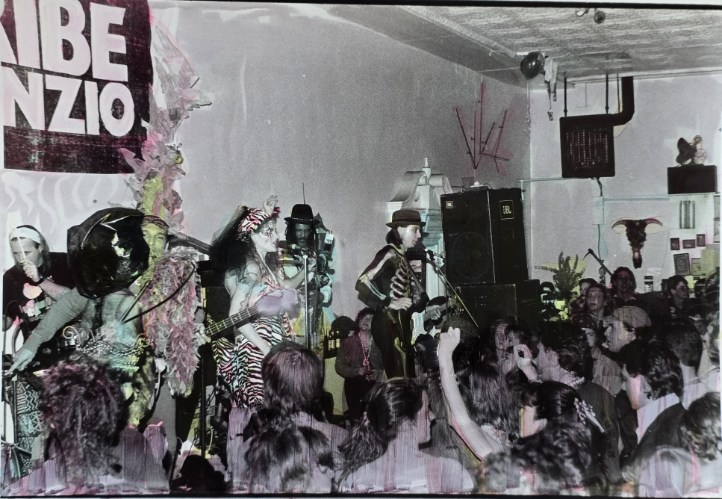
[Treffinger (skeleton) with Tribe Nunzio at Café Brazil. Photo by Jim Merrill.]
HOW JEFF FIRST GOT TO FRENCHMEN
(Adé Salgado, Tribe Nunzio, Café Brasil)
Jeff Treffinger, 9/1/2022: Adé was the connection for me to get to Frenchmen, and I guess it goes back to, oh, probably late ’70s? Early ’80s? Somewhere in there. I was busking in the Quarter. I was a Tulane student and I had a good friend, Dwight Davis, who played flute and saxophone; I played guitar, and we’d panhandle on the weekends. There was a coffee shop on Governor Nicholls called Until Waiting Fills. I don’t know if you’ve heard about it?
Laura DeFazio: Yes, Sid Snow told us about it!
Jeff: That was Adé’s place. I first met Adé there, although, you know, just coffee, never really talked to him very much.
Several years later, I was in a band called Tribe Nunzio. We mainly played at a club in the Warehouse District called The Economy that was run by a gentleman named Brendan Gallagher. It was a fertile environment filled with artists, poets, and musicians. There were a lot of interesting bands playing down there, such as Shot Down in Ecuador, Jr. you may have heard about– they were a big band. There was Waka Waka and the Bush Hogs as well; another couple of them will come to mind (hopefully).
Anyway, Adé heard about us and saw us at the Economy one night. He had just moved his coffee shop onto Frenchmen Street. In those days, his office was above the stage. On the left-hand corner of the room there was a stairway up to it, and the stage was underneath it. He served espresso, coffee, and that was about it. And water.
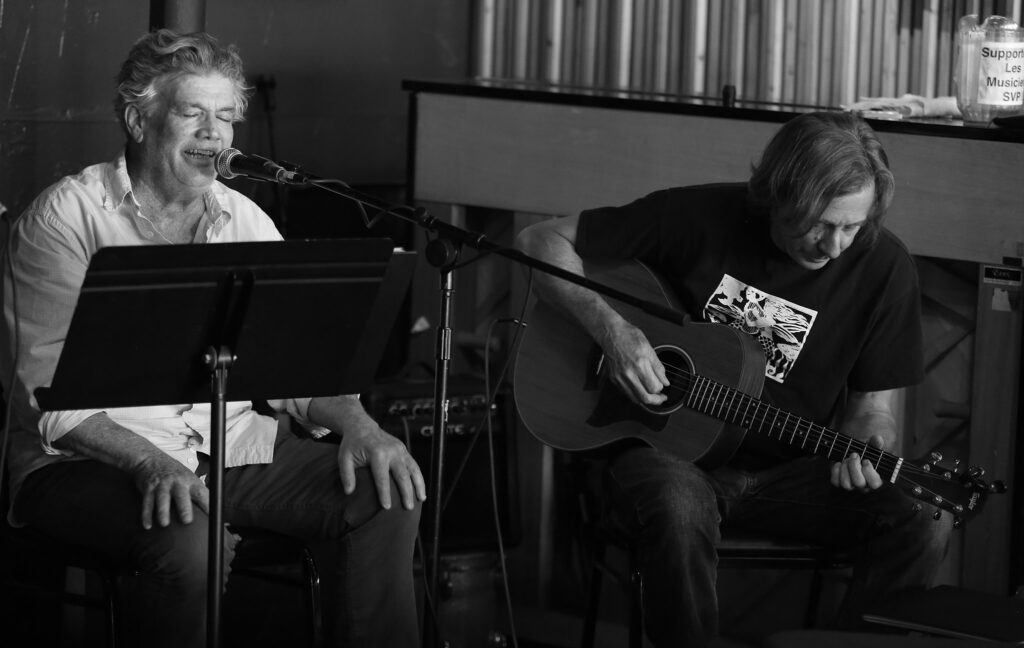
[Treffinger (R) and Brendan Gallagher performing at Buffa’s. Photo: Eliot Kamenitz.]
Hannah Kreiger-Benson: That was in the Café Brasil space?
Jeff: Yes, the same space. He didn’t, at that time, have anything to do with the building other than renting that one space with the bathrooms and the main area. We played in there a few times. Coffeeshop setting– it was fine, but very small crowds. Adé, at the time, was married to a woman named Renee [sp. unconfirmed]. She was a masseuse and whip-sharp. She would serve coffee with Adé and together, they ran the business. At some point after a gig one night, the three of us were talking, and I was like, “You should get a liquor license.”
That’s when Adé explained to me that he had once had a drinking problem and was not comfortable becoming a bar. I remember Renee expressing her confidence that he could handle it. I selfishly said something to the effect of: “Dude, there’s so much money to be made if you sell liquor….”
Shortly thereafter, they started the process and applied for a ABO permit, and they put all the signs up in the neighborhood. At that point, Frenchmen Street was much different than today. There was Snug Harbor; there was the Dream Palace, which only opened occasionally– they weren’t open as a regular bar; there was the Apple Barrel; and then there was Swiss Confection Bakery–that’s now on St. Charles Avenue. There was Theatre Marigny, which is now where DBA is. There was an electronics repair place, which is where “Bamboozla” [sic] is now. [Frenchmen] was so seedy and bare. There was nobody there most of the time. This was ’88, ’87; I’d moved here in ’78, I went to Tulane and graduated in ’85, then Tribe Nunzio started in like ’89, ’88.
[Adé] eventually got the liquor license, and at some point renovated the club and got rid of the second-story office– built a stage across the back. Jane Howard used to do all the backdrops: there were these gigantic fabric backdrops that would adorn the stage, and she would change them out every few months. They defined the club because of the window-wall on the street.
I remember the first gig we did when he had a full bar, and it was insane. He went from making a couple of hundred dollars in coffee sales to probably $5,000 – $8,000 in a night selling booze. I remember Adé going, “Treff-een-GER!!! What are you drinking?” [laughter] He was just like, “Hoh Hoh Hoh!”– that great Adé laugh.
He always hired really beautiful, super intelligent women as his bartenders, and he was always like, “It’s a race: To sell as many drinks as you possibly can. From the time we open till the time we close, it’s a race.” That was his philosophy. And so [the bartenders] were short on talk: they didn’t bullshit, they just moved from customer to customer. He did all the back bar work, he did all of the trash hauling. He worked his ass off.
Adé was a force. This man came from absolute poverty in Brazil and then saved money to the point where he bought that building from Joseph Cannizzaro. The whole building: cash. Then he bought another building on, I want to say, Pauger– a house– and renovated that himself. I’ve never seen anybody work so hard and just save his money. Nobody buys a building from Joseph Cannizzaro, cash.
Adé is like an action figure: he’s always eaten incredibly carefully. He was a big fan of Jay Martin’s bee pollen. Like, he would eat quarts. He used to have yellow marks on the corners of his mouth. [gestures; laughter] Like, “Ade– bee pollen!” He was like, “Yeah, man!” Because that was his speed– he would just eat bee pollen and always eat really good vegetables… Clean, clean, clean. […]
… But, that’s the story of the building. You know, the place used to be a brewery. It used to be a brewery that took up the whole block.

[Former Café Brasil space circa 2019ish. Photo by Adé Salgado, taken on my camera, during a strange, brief, & fortuitous encounter on Frenchmen Street.]
Laura: Wow. Do you know when that was, when it was a brewery?
Jeff: I’d be guessing, I’d be guessing.
[…] Adé still lives upstairs, I’m sure you know that. … When I first met him, he lived at Marigny and Chartres in a house, the second floor of a house, and we had our first children within about a week of each other. His son, Sol and our daughter Ana were born very, very close to each other, so we had that first-time father connection.
Hannah: We would love to talk to him at some point…
Jeff: I have no contact with him. I see him, and whenever I see him, it’s all warm and beautiful, because were good friends. And we really had a real respect for one another, because he knew that when we [Tribe Nunzio] played, we were going to bring 200 people into the room, and then there’d be another 100 or 200 outside. We would always get Lundi Gras. We’d get the best Jazz Fest weekends. I mean, that was sort of our room. It was us and the Iguanas that lit the early Frenchmen Street fire.
TRIBE NUNZIO
(Songwriting, rhythm section, Holden, Geraniums)
Laura: Did y’all have a specific night you ended up playing at Café Brasil?
Jeff: No. The only regular night that we were shoe in for was Lundi Gras. We did Lundi Gras probably four or five years running. We’d start at about 11 and we would finish at dawn. We would play until sunrise and then we’d hit the streets. Oh man. It was wild.
Hannah: And just because we try to fit things in in time, you said several years in a row, that would’ve been like ‘89, ‘90, ‘91?
Jeff: Yes. It was before and during the birth of– I put a pin in my life when our daughter Ana was born, because she of course changed the course of my life. But I can remember being without a kid. No responsibility, didn’t have to go home. My wife Maria was with me; young and wonderfully foolish. We’d end up at La Peniche for breakfast.[As of March ‘26, that building now houses Ike’s Love & Sandwiches.] In those days there was a group of French CODOFIL* teachers and they followed Tribe Nunzio like crazy. They also lived on Kerlerec Street–they had a house they lived in–and they were wild….
[*Council for the Development of French in Louisiana–the State’s official Agency of Francophone Affairs.]
Tribe Nunzio was primarily a dance band–we were funky–but it was a song band too. I was very interested at that time in writing songs and was studying songwriting, so it wasn’t just, like, a jam band. There was structure. I was working at Tulane at that time– I ran a wood shop and taught furniture building and did a bunch of stuff. But I had a good friend [there] who was an author, and he was in the habit of getting up at four in the morning and writing. I started getting up at four in the morning and studying song structure. Like, “This is a great song. What makes it a great song?” I wanted to learn the craft of writing songs.
So, we had really good songs. We had one of the most– this is what changed my trajectory– We had one of the most powerful rhythm sections I’ve ever played with in my life. Damon Shea and Vernon Rome, who were both in Waka Waka, they came to me through a mutual friend. We had been doing some experimental stuff with the early Tribe Nunzio and gone through a couple drummers, and we had a bass player… [When] Vernon and Damon stepped in and that’s when I realized, “Oh, this is what you need. In order to launch people into a frenzy, you need people who can play like this.” I mean, I’d been playing music my whole life, since I was seven years old, but when I met those two, and when they took hold of these songs, it was like “Okay, I’ll just follow you all and try to keep up.”
[…] The woman you should talk to, too, is Elizabeth Miller. “Holden” Miller. She was the front person for Tribe Nunzio. We both sang, but everybody looked at her. She had these incredible costumes and this great stage presence. She was just sassy and funny and had a great voice. She came down to go to Tulane and stuck, [but] she’s currently in Chattanooga, which is where she’s from. When we wrap up, I’ll give you her contact.
Because of the magneticism [sic] of Holden we attracted a huge crowd. People just wanted to be her, or wanted to be near her. She lived in Marigny just on the other side of the Elysian Fields, so she was always on and around Frenchmen Street. She had a convertible, white VW… [his cadence conveys that she is a very cool guy] and a white German shepherd, named Beau… She hit the streets, she was like her own parade. Very, highly intelligent. And funny. And irreverent. Anti-smoker– she used to carry a water gun on stage with her and she would blast whoever smoked cigarettes anywhere near the stage. She just like, “Pew pew–” Sometimes it didn’t end so well.[Laughter] She was great. She is great.
Hannah: When did Tribe Nunzio kind of sunset, like what year?
Jeff: Probably ’92, ’93. Something like that. Then we did reunion gigs. Unfortunately, Damon, our drummer passed away right before COVID. What came out of Tribe Nunzio was a band called The Geraniums [crosstalk] that I was in, with Brendan Gallagher, who was a poet and singer of sorts. He operated The Economy. So that’s how they all fit together. I met Brendan, who is actually from New Jersey like me. We became lifelong friends until he died last year.
So. You know. It’s interesting to see how these bands– where they start, where they go.
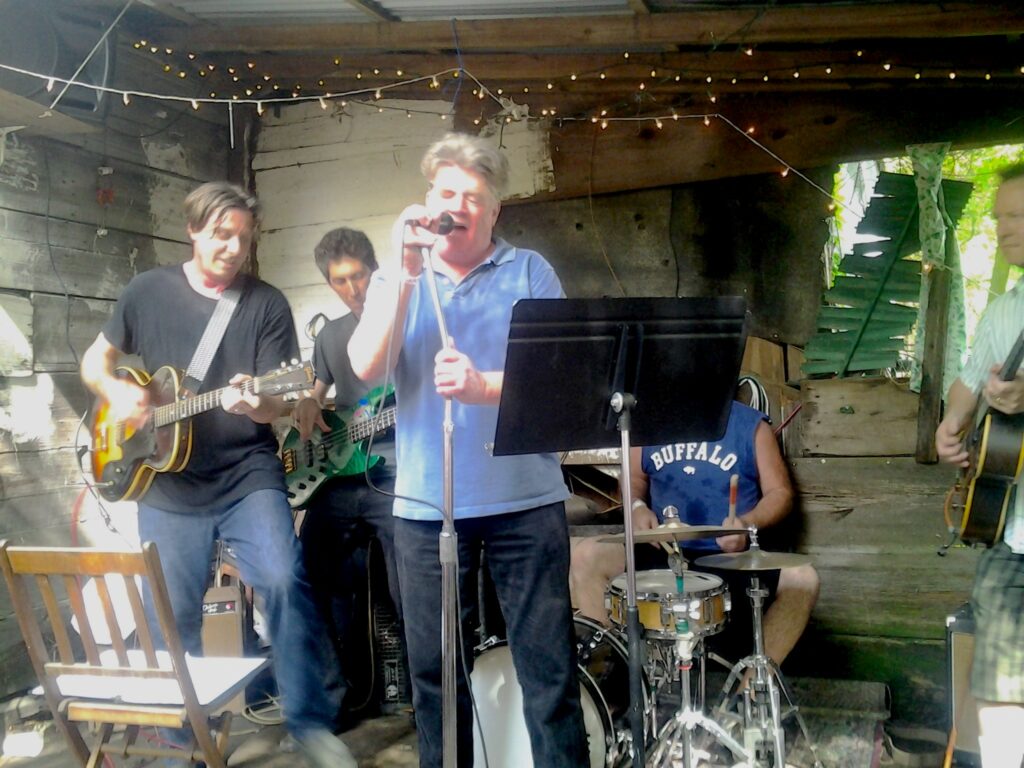
[The Geraniums at ChazFest. Photo: Natasha Sanchez.]
KINGSWAY STUDIO
(Iggy Pop, Carol King, Neil Young, etc.)
Jeff: I’m an architect as well, and I had built a lot of recording studios in town. That was sort of my specialty: night clubs and recording studios. I built the studio for Galactic, I built one for Better Than Ezra, and I designed one for the Neville Brothers….
Hannah: Wait, the one on Terpsichore Street? I’ve recorded over there.
Jeff: Yes, I built that. That was a mechanic shop.
Hannah: That’s a nice studio. Good job.
Jeff: Thank you. I built a bunch of them. It started at Kingsway, which is another sort of tangential connection to Frenchmen Street. That was Daniel Lanois’ studio, in that big house at Chartres and Esplanade on the river/Quarter side, which was the Arnaud Residence. Germaine Wells lived in that house and she was the daughter of Count Arneaux (of the restaurant fame). Dan bought that place for under $200,000: a four-story corner mansion. It was messed up, but he fixed it, and I was on the team that helped him renovate that building.
But there was a lot of interplay between Frenchmen Street and the bands were recorded at Kingsway because of proximity. I can remember rehearsing, doing a sound check at Café Brasil one afternoon, and looking out the window, and there’s Iggy Pop. And I knew Iggy from working in the building– like, Iggy and I would have coffee together in the morning. He was recording, and then suddenly I’m onstage playing and Iggy’s watching me going like, [gestures/ growly exuberant noises/ exclamations of “Yea!” and “Shit!”]
Laura & Hannah: [“Wow” noises]
Jeff: Emmylou Harris recorded there. Blind Melon recorded there. Robbie Robinson recorded there. I remember walking over to Café Brasil from a Jazz Fest party at Kingsway one night– we had a gig– arm in arm with Holden and Carole King. Carole King had a Neville Brothers baseball jacket on, and she had just sung at a party at Kingsway.
And I remember going in one day to get paid; I had my three-year-old, four-year-old daughter with me, Ana. And I’m waiting for the chief engineer, Mark Howard, to write my check. I’m chatting with him and I look up, I’m like, “Did you see Ana?” He goes [does an Canadian accent], “Well, she came in witcha.” They’re all Canadians. Everyone talked like this, you know, “Ey”…
He goes, “If you go in there, if you go in the studio, be fucking quiet. They’re doing BVs” [backing vocals]. I’m like, “Okay.” I walk in and they’re listening to a playback of The Wrecking Ball, you know that record. I quietly walked in and came upon Neil Young dancing with my daughter.
He’s holding her hands, and Ana is smiling at him. [Laughter] They’re dancing in circles and I asked Neil Young, “May I cut in?”
He goes [soft, slightly nasally voice], “This your little one?”
I said, “Yes, she is.”
He goes, “She cute.”
[Laughter]
So, you know, Iggy Pop, all those people, would make it to Café Brasil because that was the bar. That was the coffee shop. If you needed an espresso in the middle of the day, you want to get out of the studio, you go over there.
Adé loved it, because he never knew who was going to drop in. Dan would bring
whoever was recording over there, or Mark Howard, or Trina [house engineer Kathryn “Trina” Shoemaker]. It was a big beautiful family and I am still friends with all of those people.
That’s when, I guess, other people started getting the idea about Frenchmen Street. I’d say probably mid-to-late-’80s or early ’90s? It was a slow growth, but suddenly all these clubs started popping up.
MORE FRENCHMEN VENUES
(Dream Palace, Apple Barrel, Café Istanbul, etc; Aydin siblings)
Hannah: So, when you talk about Frenchmen Street [venues], you talk about Café Brasil and DBA. Are there any other places that are on your mental map of Frenchmen Street?
Jeff: Well, also the Dream Palace. I mean, it was a club that the Radiators worked– that was their home base. But we played there [too]. We did a few Halloween shows there– that was another night that we would end up at Café Brasil or the Dream Palace. I remember doing a blacklight show at the Dream Palace– ‘cause we could, ‘cause it was dark. That was pretty magical.
The Dream Palace was a great venue to play, and…. you know, the Apple Barrel? Has always been there. That was always a place where somebody would be playing acoustic guitar or something. But none of the other places existed then. I mean, Snug Harbor– was always a little too expensive for me. I couldn’t afford the $15 ticket to go see people there. I did a couple of times, but you know. I saw some shows and plays at the Marigny Theatre. I remember when Santa Fe opened up, that was a big thing: a restaurant. Across Washington Park from…. It may not still be there, but it’s the same woman who owns Santa Fe up here on Esplanade.
That’s another person you should talk to. [Fatma Aydin] and her brother… Oh, Suleman. They’re Turkish. [crosstalk] Well, she used to own a place called Mona Lisa in the Quarter [on Royal Street]. That was her first restaurant.
Hannah: Then they opened Café Istanbul?
Jeff: That’s right. Café Istanbul was upstairs from the Dream Palace; they were in the same building.
Hannah: Suleman is on our list for sure. [*Unfortunately, he has since passed away.]
Jeff: I just saw Suleman at Lowe’s the other day. [He’s like,] “I’m retired!” I’m like, “Yeah, you’ll never retire.”
I remember Suleman after Katrina running into him somewhere like, “What are you doing?” He goes, “I’m driving for the [Army] Corps of Engineers.” I’m like, “Really? Driving what?” He goes, “Whatever they tell me to.”
[laughter]
Jeff: He’s so great. He and I share a passion for agriculture. I also grow microgreens and sprouts. Which if you care to, I’ll show you before you leave, it’s in the back in my house, I have a grow-room. And I sell to restaurants and people.
Laura: Oh, wow!
Hannah: I would love to see. That’s fantastic.
Jeff: So, he and I grow things, so we always talk about what we’re growing.
MUSIC VS RED TAPE: POST-KATRINA ERA
(Mermaid Lounge, DBA; Noise ordinances, permits, zoning; “Music on the streets”)
Jeff: I don’t know if you’re aware but I was one of the owners of The Mermaid. The Mermaid Lounge. We operated in the Warehouse District from ’94 to 2004. And then we actually tried to relocate on Frenchmen Street.
We went to a Marigny Neighborhood Association meeting, and we were pitching– we were going to be in the space where “Bamboozla” is now, that big glass front? We were going to rent the thing. The Cahn family owns that building. Jules Cahn has all the archives and footage of the parades and all the historical New Orleans connections, and [it was] his sons who we were dealing with and negotiating with.
But the Marigny Neighborhood Association said, “No. We don’t want another bar. We’re already at the limit.” That was after Katrina, or maybe right before. Might have been spring or early summer of 2005. Euclid Records […] was another place that we looked at moving to, but…. I think Katrina hit and the whole thing evaporated. It was like, “How could we do this now?”
But, yeah. The city made [Frenchmen] a district. It’s a zoning overlay.
Hannah: Yes, that passed in 2004.
Jeff: That’s right. We applied right after that. They had a cap on the clubs. The number of live music venues they could have as provisor of the district.
Hannah: Just for all here, that was first proposed in 1992 by Jackie Clarkson [Jacquelyn Brechtel Clarkson]. It took 12 years for it to pass, and by the time it passed, it was obsolete, because more clubs had opened in the meantime.
Jeff: Yeah, the whole thing was a shit show.
Hannah: If it takes you 12 years to pass, sometimes–
Jeff: All the neighbors were like, “Waahhh, it’s too noisy.” I’m like, “Well, you moved here. You bought property on Frenchmen Street.”
I’m very good friends with Tom Thayer. I’m sure you’ve talked to Tom. [He’s on our list…] Tom’s great… . He’s been through it and back with [DBA]. I renovated that bar for him. It was during the time when the sound ordinances were coming down strong on a lot of club owners.
The City of New Orleans hired this guy from Mississippi [Dave Woolworth, acoustician from Oxford] to do this noise testing analysis, and Tom hired me to rebuild the stage at DBA. That was September 2011. I know it was 2011 because he shut the club down [and] I had all my people lined up to go in and rebuild it.
We soundproofed it, and we isolated it from the sidewalk. I think I had a two-and-a-half-week turnaround from the time they shut the club and they were going to take a break, and then they had a huge party. And on the second day, my father died in Pennsylvania. Tom, although under a huge gun to get this done, toasted my father with his favorite scotch as said to me, “Get the hell out of here, go take care of your family”
One of my friends, Sage Maas, who’s an electrician, stepped up and ran the site while I was gone. We just phoned each other every couple of days and he kept the crew running until I got back. We opened up on time (and over budget).
Hannah: I thought [this would have been] a year or two later, because the big noise ordinance stuff was the end of 2013 until the beginning of 2014.
Jeff: It could have been Tom saw it coming. Tom’s wicked smart, and has had– his story is unbelievable. It’s like Homerian. He had all these partners–they had a DBA in New York City–and he came down here with two or three or four partners, and I think two or three of them died. And so, he had been wrapping up all their personal affairs, settling their estates, and he had me draft plans of the building so he could sell it. He had it sold right before COVID hit.
Laura & Hannah: [in unison] I remember that.
Jeff: [But] he had a handshake deal, and COVID hit, and it was like, “Nope.” [crosstalk] … [“We don’t want to] invest in a club right now.”
So, even recently during COVID, he hired me. He and a couple of property owners, because they had been setting up shows in the market space across the street, and they wanted to figure out how they could do that legally, permanently– so they hired me, because I know a bit about zoning.
And I helped them for a short while before I realized there’s no real way you can do this unless the city… you know… The only way to get a live music permit is to have it as a secondary use. You have to have a primary use as a nightclub. Then the live music permit, which is a mayoral permit, is a secondary permit. And you can’t have that outside. The city’s thinking about that right now, allegedly they’re trying to revise the ordinance so that they can have some kind of provision for outdoor venues.
Hannah: Oh, we got that passed! I work with MaCCNO…
Jeff: Oh, that has been passed! Oh, good for you. Congratulations.
Hannah: That’s how I got into this project to begin with, was just from the legal and cultural economy standpoint. But we did just get that passed 6-0–good job, City Council– so outdoor live music is now protected. It’s relatively limited, but it’s–
Jeff: What are the limitations?
Hannah: Until 10:00 PM…
Laura: Is it illegal after or just “not protected”?
Hannah: [laughter] I will not say on the record.
[Hannah describes MaCCNO’s work; Hannah and Jeff chit-chat about who they know in common in the zoning world.]
Jeff: [Outdoor music] is something that should have happened a long time ago.
Hannah: It’s interesting that it took COVID to break it open in some ways.
Jeff: It did, to return to what the city used to be. Which is music on the streets. Which is one of the magical things of New Orleans.
I mean, we used to play at The Economy– The Economy was a club at Girod and Commerce in the Warehouse District that was in the ruins of the World’s Fair site. So there was nothing there. […] All this development that was supposed to come on the coattails of the World’s Fair never happened. It was like the East Village in the late ‘70s– there was nothing. Nothing, nobody. We used to do these huge block parties with Tribe Nunzio outside of the Economy on Sunday afternoons, you know? And we’d set up in the street and play, and it was wild.
In fact, that’s where Adé came and saw us. I remember seeing him on a Sunday afternoon, and I kinda recognized him from the coffee shop. He always called me by my last name. I don’t think he has any idea what my first name is. He just likes saying Treffinger: “Treff-een-ger! You come play my club!” That’s Adé.
Hannah: That’s how it happens.
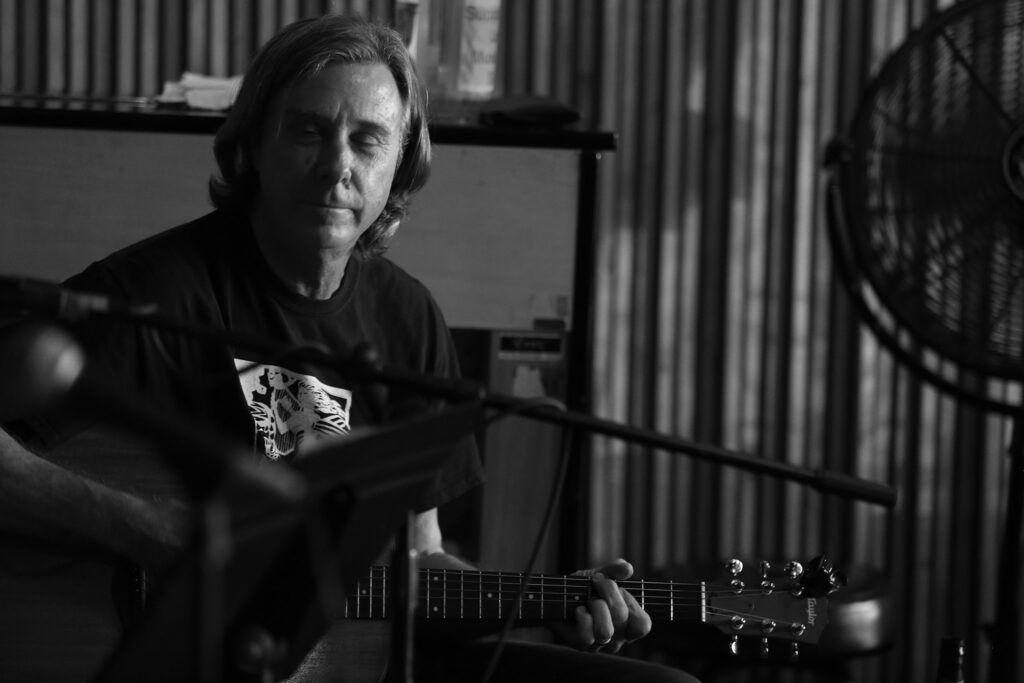
[Treffinger at Buffa’s. Photo: Eliot Kamenitz.]
SEVEN FEET IN SIX WEEKS
(A short interlude about architecture, archaeology, and historical preservation education)
Jeff: I did a survey for the National Park Service–an architectural survey of all the clubs and venues from the historic jazz period. You know Bruce Raeburn? [Drummer and longtime Tulane professor who ran the Hogan Jazz Archives for decades.] Bruce was a consultant. And I ended up renovating the Kid Ory House through the PRC [Preservation Resource Center], and the Red Allen House on the West Bank in Algiers.
Hannah: I’m assuming you’ve seen the website, A Closer Walk.
Jeff: I’ve heard of that.
Hannah: It’s a music venue, history, geography of music in the city. It’s done by a guy named Jordan Hirsch. He’s phenomenal.
Jeff: Oh yeah, all the weird little halls– Because as I’m sure you know, in the early period of jazz, it was all cotillions, social events, like little Saturday night things that were put on by the wealthy white people in town–
Hannah: [stage whispers] Or brothels…
Jeff: Or brothels, or brothels, true. But yeah– the places that they sent me to, I was like, [awe] “This place…” And sure, this is where Buddy Bolden played…..
I remember I was running a job training program 2002 to 2004. A group of us who are in construction were like, “We need to train new kids. We need to take high school kids and show them: “You don’t have to go to college. You can be a tradesperson.” Our program was to expose them to building trades, give them jobs, and the first project we did was we built a wall at the back of the Kid Ory House on Jackson Avenue. The foundations were crap, so we had to pin the house, and take all the bricks out, and rebuild the whole foundation. So we had this gigantic pile of bricks.
So we worked a summer with six kids from Carver High School who were 17, 18-year-old kids in the masonry program. They built a brick wall that– There’s a documentary I have called Seven Feet in Six Weeks. And it’s these kids’ experience coming in green and meeting craftsmen, having professional masons visit them. John McCusker [New Orleans photojournalist who was with The Times-Picayune for three decades], he came to the site one day. When the building was gutted. He came with a vintage phonograph–with a big bell, you know?–and he explained to [the kids] that Louis Armstrong was in this house, “like where you are sitting right now. He was in Kid Ory’s band. Buddy Bolden may have played because they were all in this same neighborhood.”
All these kids were like, “Holy shit, in this house?” And it was just gutted to the studs. And in fact, I still have clay beer bottles from under that house. Clay beer bottles.
[Laura mentions working on an archaeological excavation in the Tremé and the density of artifacts in urban vs. remote sites. Funnily enough, it turns out that Laura and Jeff both worked for the same archaeological company at different times and chat about people they know in common in that world.]
BACK TO THE MERMAID
(David vs Goliath; Mermaid/Frenchmen pipeline)
Jeff: The Mermaid Lounge [1994-2004] had a liquor license that came with the lease. It was in an empty neighborhood, nobody was around, and we could do anything we wanted. It was like a clubhouse. We never had a mayoral permit for live music; we never would have been granted one because they are controlled by the politicians.
When Pres Kabacoff developed the Cotton Mill [apartment complex] next door to us, there was a big pressure on us to reign in our business model– I called Gambit, I’m like, “I want you to write about this.” Because they were sort of rumbling about, “We’re going to put all these people in these high-end apartments, and you’re right next door…” And I’m like, “Yes, we are. And we were here first.”
So Gambit published this article, “David Versus Goliath,” and HRI [Kabacoff’s business] came to us after this article came out and said, “Oh, we’re going to invest in the club, and give you money for soundproofing, and da da da.”
And they never did anything. But I did find an interesting thing out, and I remember sending a very complete letter, with data, to Pres Kabacoff. I went to City Hall, and asked someone in Zoning to “Define disturbing the peace. What does that mean?” They’re like, “Well, the way we measure it is that in every neighborhood there are average decibel sound levels at different times of the day, and if you’re exceeding that average after 9:00 or 10:00 PM, then that can be considered disturbing the peace.”
I’m like, “Fair enough, and how do you determine that?” He goes, “Well, you would have to hire somebody with a DB meter to do a survey…” I’m like, “Okay.”
And so I did. …And It just so happened the Mermaid was located right next to the on-ramp for the bridge.
[laughter]
So, there were motorcycles and tractor-trailers going up that on-ramp making 90DB, 80DB, 110DB all night long.
Laura: That’s awesome.
Jeff: So we flip the stage around so that we closed the entrance on the corner that goes to the Cotton Mill, entered in an alley that faced the bridge so all our sound went out that way. We never had a problem with them after that. David beat Goliath.
[laughter]
Jeff: […] You know, when I booked The Mermaid, starting in 1994, so many of those bands came off of Frenchmen Street. Iris May Tango. Mutiny, which was an experimental jazz project. The Klezmer All Stars. The Iguanas… All of those bands had their developmental periods on Frenchmen.
… What I really adored about the New Orleans music scene–and this probably partly came out of Frenchmen Street and Café Brasil–was the fact that people were so willing to work together, and reshuffle band members to create a different band. You know? It wasn’t, [thick, meatheady voice] “This is MY band. We’re the best. Beat us.” It was like, “Oh, yeah, you got a gig?”
You could call one person and book five different bands. Like if I called Ben Ellman, I could book Lump, the New Orleans Klezmer All Stars; Rob Wagner, Iris May Tango and Mutiny… I had a very small rolodex. People realized that in order to make money as a musician, you had to play as many nights as you could, and that meant you needed to be in as many bands as you could. There wasn’t any sort of professional jealousy between bands, just humorous backbiting where necessary.
FRENCHMEN THEN VS NOW
(“Opportunistic bohemians” vs branding; the magic of the fringe; the magic of Adé’s chocolates)
Jeff: Frenchmen Street was huge [in how it figured into working musicians’ ability to make their livings]. Still is. More so now, frankly, because there are so many clubs. You got the Spotted Cat, and you’ve got DBA… There’s probably 10 clubs on that street that employ the same 50 people.
Hannah: Frenchmen Street grew organically, it was this incredible– you used the word fertile, like it’s this musical incubator. What can we take from the arc that it’s had, and use it as a community and as a city, to nurture other music incubator spots and corridors in the city?
Jeff: I don’t think that’s possible anymore. What happened with Tribe Nunzio on Frenchmen Street couldn’t happen now. Once the politicians got involved, they took the organic growth out of the equation. Just the commercialization, because you can’t commercialize an incubator. That’s the problem. Those days are gone.
Like, when I came to the city, there was a place called the Glass House–you probably never heard of it. The Glass House was on South Robertson in Central City, and that’s where Dirty Dozen started playing. You could go to the Glass House, leave your car doors open– don’t lock them, don’t leave anything in your glove box or your car. But I would go to The Glass House and see the origins of the Dirty Dozen, and it was an incubator. The Economy was an incubator. The RC Bridge Lounge, The Circle Bar, The Mermaid Lounge. All these little– I call them islands.
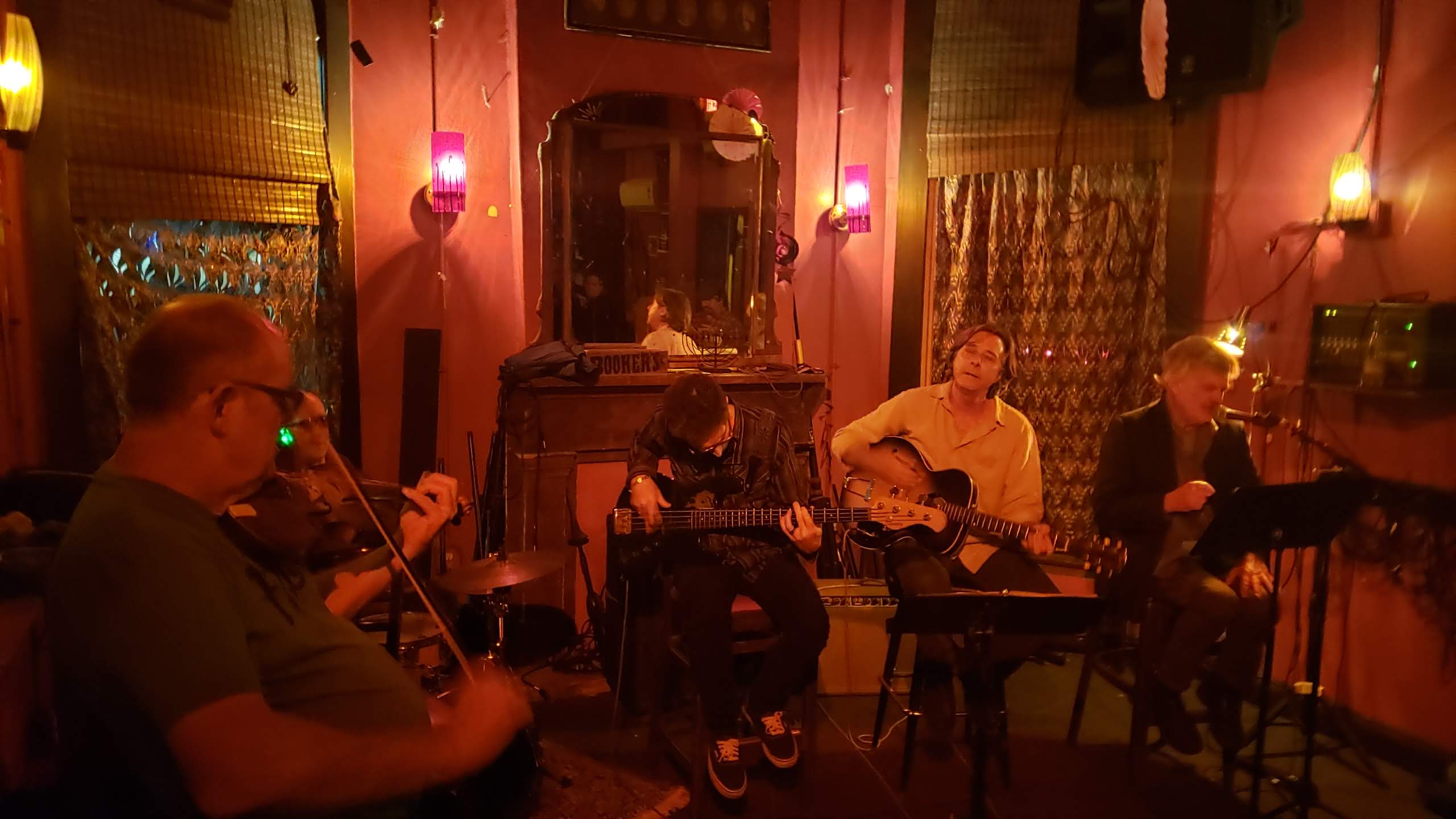
[Treffinger, 2nd from right, with The Geraniums at Circle Bar. Photo: Natasha Sanchez]
Jeff: You can’t do it anymore. You really can’t find those places because the people with really interesting ideas can’t open those kind of businesses anymore; too much red tape and busy-body neighbors.
The kinds of places I mentioned above sprang from opportunistic bohemians– With regret, those people are not welcome or cannot afford a seat at the table of commerce these days.
There are thankfully exceptions– I mean, I still see the Saturn Bar as kind of incubator. To me, that place still has a vibe.
Laura: What do you think changed? Is it the regulations that have changed, or is the people…
Jeff: The over-commercialization. People taking advantage of a brand. Frenchmen Street became a brand. When I was playing actively on Frenchmen Street, it was a dump. It was a forgotten commercial district that nobody really knew what to do with. It was zoned commercially, there were all kinds of little weird businesses, but it wasn’t this dense concentration of nightclubs.
In New Orleans [these days], it’s hard to have a neighborhood bar. Or to go into a neighborhood that nobody’s exploited and get a liquor license. I mean, there’s a moratorium on liquor licenses. And to find a place that has a liquor license, and then to slyly put live music in the place…. At The Mermaid, as I’ve mentioned, we never had a mayoral permit.
[…] We have an apartment in the back [of his house] that we rent as an Airbnb, and every time people are like, “Yes, I’m going to go to Bourbon Street,” I’m like, “Don’t.” [laughter] “Don’t. You can drink anywhere you want…” The next time I see them, they’re like, “Holy shit, what a pigsty.” … I told you.
Frenchmen Street is maybe one or two notches above that, but it’s still going that way to me. I mean, I’ll go to DBA to see certain people. I’ll go to Spotted Cat. But in terms of hanging out on Frenchmen Street, it’s just…. I find that… I just don’t fit into what’s going on there.
There was a time when Frenchmen Street hatched Banda Logun. I don’t know if you’ve ever talked to people about Banda Logun– I got to record them and hang out with them and I made a demo with them. And Royal Fingerbowl– Alex McMurray is still one of my best friends. I used to play there with a band that I was in with my sister-in-law, called Trova, which did Cuban music all written by Silvio Rodríguez. And Kufaru, who you might have heard of, was a very close friend of mine, and he played percussion in all of these bands.
There was just a lot of magic, because it was still on the fringe. And you could get in and out easy. You could park right around the corner and walk with your guitars and your amp in your hand and set up and play and have a couple of drinks and go home. And hang out with Adé…
I remember hanging out with Adé 15 years ago, 20 years ago; we’re on the street and we’re just sitting there, reminiscing and talking, and he’s giving me– he said, “I’ve got some chocolate,” and I was like, “Oh, great let’s have some chocolate, I love chocolate,” and after an hour I’m like, “What the fuck is in this chocolate?”
[laughter]
If you don’t get an interview with Adé, I’ll go down there and drag his ass out. …He’s like a phantom. I think when Café Brasil shut down, and he had his house renovated, and his kid was kinda grown, he went into a kind of hibernation. God knows, in ten to fifteen years he worked harder than most people do in a lifetime.
I probably haven’t seen him in five years, but I know if I did, we’d pick up exactly where we left off. Because I love him, and he loves me. We were very close and we did serious business together. And: he liked the band. He dug the shit out of our band. Coming from Brazil… You know, we always had a percussionist and a drummer, so there was a lot of drumming, and a lot of that kind of Mardi Gras-influenced music.
[…] And you should also talk to Kenny Claiborne. [We eventually did! Interview forthcoming.] Kenny would play in our band and actually went on the road with [Tribe Nunzio] because he was Holden’s– you know, they dated. So he would help do sound, and then he would play harmonica with us under the pseudonym Sunny Picnic; which I always loved.
Kenny still lives right there on Chartres Street, and he has for 30, 40 years. Kenny and Adé, a few years ago, mentioned that they were the last two residents that weren’t, like, in an Airbnb.
And Kenny, after Katrina, set up a– He called it a “radio station,” but he really set up his PA system outside his house and just played music for all of the workers, the National Guard… “Everyone come and hang out in front of Kenny’s place.” He called it “Radio Marigny.” He actually had T-shirts made out for it. He has some really incredible stories of what went on on Frenchmen and in that neighborhood during and after Katrina.
Laura: I’ve heard of amazing things about that, how it just brought people together….
Jeff: It did. They were the only people there, Adé and Kenny. And they were cleaning out Port of Call because all the meat went bad, and they were taking stuff down to the river– it was insane.
***
Interviewed by Laura DeFazio & Hannah Kreiger-Benson on 9/1/2022
Initial transcription by GoTranscript.com; corrected by Dominique Ferguson (Max Krochmal’s UNO class)
Interview edited for clarity & concision by Laura DeFazio
Posted to Frenchmen Notes on 4/3/2026
