Interviewed by HKB & LD March 12, 2021
Edited by LD
INTRO Q&A:
Interviewer: Do you remember when you played your first gig on Frenchmen?
Davis Rogan: It was in ’93, ’94. The Klezmers [The Klezmer All-Stars] were playing Tuesday nights.
Oh, but then there was something with Kermit [Ruffins] … I might have played with Kermit. I’m going to say the earliest I could have played would be ’92, ’93, but my band All That started regularly playing at [Café] Brasil in ’95.
Int: When was Frenchmen “the best”?
DR: ’95 to 2000. Do people usually give a single year? Why don’t I say, “1996: The year All That takes over the motherfucking planet.”
We really felt it, too, you know? You’ve got like 200 people jumping up and down and screaming it at midnight …
Int: What makes Frenchmen “Frenchmen”? Is the fact that it’s this whole blob of clubs, its own musical ecosystem? And have you seen anything else like that in the city?
DR: In terms of a blob, I remember actually a long, long, long-ass time ago—this was like when I was still getting carded and shit—when the Maple Leaf was young. There was the Maple Leaf, and across the street was Jed’s, and around the corner was Carrollton Station and Jimmy’s. There were some things where five or ten bucks would get you a wristband for all the clubs. I remember for earthquake benefits, things like that.
TIMELINE: DAVIS & FRENCHMEN
Pre-‘80s
(Early Frenchmen experiences)
DR: Okay, what I guess I’ll start with: my dad used to work there. He was developing wash [unintelligible] filter systems and stuff when I was in elementary school. His research was on Frenchmen. But this is past Washington Square, between Dauphine and Burgundy.
I went to McDonnell 15, and when I graduated—sixth grade graduation—we got hamburgers at Ruby Reds, which is now the Dragon’s Den. So that’s a bit of “way back.”
And I remember hearing the about the jazz flautist Eluard Burt, and Lee Grue was a poet, and they used to do this jazz poetry thing at Until Waiting Fills. [Until Waiting Fills was the name of the French Quarter coffeeshop Adé Salgado briefly took over before being evicted and relocating to Frenchmen. Unconfirmed, but interviewee seems to be saying that the Frenchmen location was originally called Until Waiting Fills as well before it was Café Brasil] … . I can’t say I went, but that was some early Frenchmen.
The ‘80s
(High school/college years)
THE DREAM PALACE
DR: I’m high school class of ’85. Franklin: the old building. I’m going to say I started sneaking out underage like in ’83, ’84, when I was 15, 16 years old.
The consistent show which I first started going to–I guess in high school, and then when I came back for the holidays–was the Radiators at the Dream Palace. I think it started at 11:00, and it was five bucks at 11:00, and then it was $3 at 1:00, and then it was $1 at 3:00. Three sets. The cover diminished, but a hit of acid was always five bucks.
A hit of acid is still five bucks…. It’s really weird how that goes.
And I remember going to see Black Flag play at the Dream Palace in 1984 … The clubs had traditional New Orleans music, but also touring punk bands.
The streetcar left Canal on the hour. We lived in Carrollton and none of us had cars, and it took about fifteen minutes to speed walk from Frenchmen Street to Canal and St. Charles. Like, fuckin’ booking. You would try make a call at 1:45, or 2:45, or 3:45… You had to leave on the quarter-til to make it to the streetcar. Hell, I don’t think they let 16-year-old kids do that shit anymore.
CAFÉ BRASIL
DR: That was high school. I went away to college in the fall of ’85. When I was home for summers and home for the holidays, I remember checking out music at Café Brasil. The Iguanas and Tribe Nunzio. You should talk to Jeff Treffinger [of Tribe Nunzio]. He was a co-owner of the Mermaid Lounge and also did Mermaid Records. He cut the first demos for all that Royal Fingerbowl, a bunch of other stuff.
Oh, and Fredy Omar, through all the ’80s, was another standard of Café Brasil. That was always great, because he was an attractive guy. He brought out lots of Latin women, and men came to buy them beer, and that’s called the music business.
So that was my high school Frenchmen, my college Frenchmen.
PIANO LESSONS WITH JON CLEARY / MEETING REBIRTH
DR: I took a year off between sophomore and junior year [of college], so I was back home actually from ’87, ’88. I went to work at this law firm—to discover I never wanted to work in a law firm. But, I was also getting piano lessons from Jon Cleary. I’ll put this in keyboard years: Someone stole Jon Cleary’s Yamaha DX7. I had an Ensoniq ESQ-1 that I was lending to him. He said, “Davis, do you think I could borrow your keyboard?” I’m like, “Sure, man, you think you could give me a lesson?” I was trading for lessons. So I would walk from this law firm in the CBD to where Jon lived in the Bywater, and then I would walk back home again to catch the streetcar.
So that was the ’80s. I was in high school, college. I saw some punk rock shows. I saw The Rads [Radiators]. Saw music at Café Brasil. I’m getting new piano lessons from Jon Cleary …
… Oh! I’m walking home [from Cleary’s] one day and I saw this band busking. It’s like ’87, ’88, and I saw this brass band busking in the streets. And you know, everybody I’d gone to high school with had gone away to small private liberal arts colleges to get the fuck out of town. I went to Reed. Everybody I knew from high school that was still here was, like, wearing a pink polo shirt, wearing a baseball cap backwards, and I didn’t want much to do with it. I saw this brass band, and I was like, “Man, these guys are fucking cool.” I remembered brass band music from growing up in New Orleans; Walter Payton, my New Orleans band teacher, was Nicholas Payton’s dad. So I made friends with them. Those guys turned out to be the Rebirth Brass Band. So I was little white boy Dave, hanging out with Rebirth.
The ‘90s
(All That, brass bands, DJing, jam band invasion)
KERMIT’S LITTLE PEOPLE JAM (INCUBATOR)
DR: So then I come back [from college, for good] in ‘90, ‘91. Kermit had wanted to start a band outside of the Rebirth. He wanted to start his own little solo project. I could play a little bit of keyboard, but I also had a car. I was the guy with a car, which was a 1967 Volkswagen Karmann Ghia. I paid $50 for it and drove all the way from Portland. Probably why I might have scoliosis…
We had Kermit Ruffins‘ jam session every Monday night at Little People’s Place. That band was Jerry Barbarin Anderson, Kermit, Arthur Kastler, Jonathan Freilich, Ben Ellman, and Ben Schenk. So you see, that turns into Galactic, The Klezmers, and All That [Rogan’s band]. All come out of Kermit Ruffins’ jam session.
ROGAN FORMS ‘ALL THAT’
DR: I had always wanted to have a band with a sousaphone for a bass. You got to remember this is twenty years before Trombone Shorty or Big Sam. So, I did it first thing, thank you–me. [chuckles] Anyone else claims otherwise is wrong, and I’ll fight them!
The idea was I wanted to have a 1970s funk band with a big horn section. The two bands I think I saw prior to forming All That were Medeski Martin & Wood—I was like, “Oh my God”—and I saw G. Love & Special Sauce. And I was like, “I can do that.”
All That was born of that. I was jumping up and down and rapping, the drummer was another passable white rapper, and I had a B3, and a Clavinet, a Wurlitzer … probably scoliosis again. It was brass band tunes and ’70s funk.
ALL THAT HITS ITS STRIDE
DR: So, All That was formed, and I’m thinking it started to come together in ’94, ’95. So ’95 might have been the summer I was playing at Café Brasil. It was Kirk Joseph, the sousaphone player from the Dirty Dozen Brass Band; Keith “Wolf” Anderson, the trombone player for the Rebirth—that was Wolf’s first band outside the Rebirth; Kevin O’Day; Alex McMurray; Ben Ellman; Brice Miller; and me.
On August 9th, ’95 we recorded our first demo. It’s easy to remember the date because it’s the date that Jerry [Garcia] died … I’m sorry, I’m not a big fan. Anthony Bourdain was interviewing me once and I was like, “Man, there wasn’t enough acid in Berkeley to make [the Grateful Dead] interesting to me.” And I got fucking hate emails for years!
Why was I on that? Anyways, All That played the Dream Palace, we played Café Brasil, we played the Dragon’s Den—the Dragon’s Den was definitely one of our big spots. One or two shows at Checkpoints. Checkpoints was more of a punk club and we’re a funk band, but there were some times where it was like, “It’s Jazz Festival, we’ll give you a gazillion dollars.”
Then there was a period of time when the Dream Palace turned into Café Istanbul, and the upstairs club was Club Istanbul. When it went back to being the Dream Palace, they nixed the upstairs for a minute. The upstairs didn’t come back again until it became the Blue Nile. Unless I’m wrong, and I could be.
Interviewer: I know it was a trad jazz club for one year in 2000. The Tin Roof Café.
DR: Right!
[Note on this progression of clubs: Café/Club Istanbul closed in April, 1996 and reopened as the Dream Palace. Then, to quote Hannah’s paper, which you can read here, “The Dream Palace operated until they sold it at the end of 1999 to a group of investors led by traditional jazz clarinetist Jack Maheu … In May of 2000 Maheu’s group opened the Tin Roof Café in the space, as a venue specializing in traditional jazz … [It] closed in July of 2001, just over a year later. Blue Nile … opened in the old Dream Palace/Café Istanbul/Dream Palace/Tin Roof Café space in February of 2002.”]
NEW YEARS SANDWICH
DR: Our main, iconic spot was Club Istanbul. It was Frank O’Connell managing, and we were there Fridays at midnight. It was $5. We started at midnight. We went until three or four, and the place was fucking solid packed every Friday. Line out the door.
[The audience] was cool because it was actually a mix of Tulane kids who were hip to it—a mix od college kids, locals, and a couple of tourists who had found out.
When was this? 1996. I remember when because of the New Year’s show, where the whole thing was swelling. People jumping up and down, screaming, “1996, the year All That takes over the motherfucking planet! 1996, the year All That takes over the motherfucking planet!”
Because we believed. I did, in my heart.
That was New Year’s 1996. Which is funny, because we can sandwich that with New Year’s 1999. Between them, the original lineup goes away, and I put together another lineup, and then they mutinied, and I had to sue them, and the whole thing falls apart, and it was just really ugly and shitty because… you know. People are shitty.
So, 1999. This is the Y2K New Year’s, and once again, I’m back upstairs at Club Istanbul—wait, it’s back to being The Dream Palace. 1999, Y2K. [transcriber’s note: so the upstairs was reopened? See earlier – “The upstairs didn’t come back again until it became the Blue Nile. Unless I’m wrong, and I could be.”]
First of all, New Year’s Eve is the day after my birthday, so I’m always a little rough around the edges. Especially when you’re 28. And I had spent all day getting a bandmate of mine, Kevin O’Day out of jail. Except, he wasn’t playing in my band that night. He was playing in Iris May Tango—Kevin was also the drummer for Iris May Tango. There was a little bit of personnel shift between those bands; really, I was the first person to [unintelligible – hire?] brass band cats. It was like ‘Frenchmen Street Dudes’ with ‘Brass Band Cats.’ This was a first.
So, it was New Year’s Eve of 1999. I think Kirk was the sousaphone player—because we had Kirk, and then Matt Perine, and then back to Kirk, and then Matt Perrine. They switched off and on, and then in 2001, when we did a live record, they both played together. So two sousaphone players. Which we did before the Little Stooges, I guess? If we’re going to get into “Oh Davis-the-old-man says a bunch of shit he did before everyone else.” [laughter]
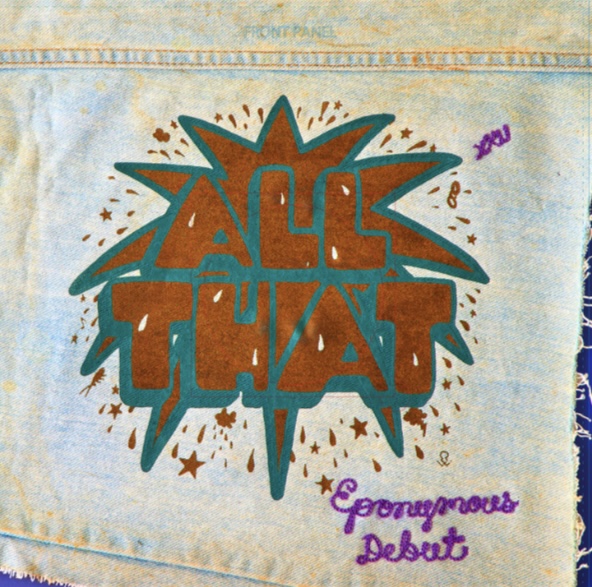
That [2001] record was All That, The Family Album, which is a live record at the Mermaid Lounge. In ’95 we’d recorded our first demo, and then ’97 we put out the record Eponymous Debut, and then that iteration of the band dispersed, and another iteration came together, and then we put out a record on Rounder [The Whop Boom BAM, 1999]. And then we proceeded to break up and that was a whole thing…
But anyways … New Year’s Eve of 1999. It was December 31st, 1999, and because I’d helped this guy get out of jail, Iris May Tango is downstairs sounded fucking great. I’m playing with some guys [transcriber’s note: if IMT was playing downstairs, is Rogan saying he was playing upstairs with “some guys”? see above comment r.e. whether or not the upstairs was open at that point in time. If it wasn’t typically, maybe they opened special for the Y2K party? Or maybe Rogan meant that he was playing a different timeslot]. And I just remember it was the countdown to midnight and I walk out on the balcony—it was at the last five minutes of this century, of this millennium—and Adé was on the roof of Café Brasil, smoking a joint and surveying it all.
THE DECLINE OF ALL THAT
DR: All That … We did our thing, and then Alex McMurray got signed to TVT Records, and so my guitar player leaves with my drummer.
Then Anders Osborne says, “Oh, sousaphone for bass, that’s a good idea, nothing personal Davis, but … ” Kirk left to play with him.
[transcriber’s note: see two paragraphs above – I’m assuming both McMurray and Kirk both left after recording the Rounder record, thus breaking up the second iteration of the band. But it’s also possible Rogan was saying that McMurray’s departure marked the end of the band’s first iteration, and Kirk’s the end of the second.]
I was watching The Decline of Western Civilization Part II: The Metal Years, and there was this one band saying, “Yeah, well, Megadeth stole our drummer, yeah well, Guns and Roses stole our guitar player,” … Maybe you guys just didn’t have it, and you were just a farm team for people who did. So… [sighs] I don’t know.
No. All That was a great band. It was a three-piece horn section, sousaphone for a bass, killer drummer … The thing about All That I realized was that the way to keep the band mine was to blow a hole in it, bring it back into the harbor, and dry dock it. So that’s what I did. It’s mine, motherfuckers! I’ll sink it if I need to.
I mean, nowadays, we get together and do reunions and stuff. We get along a lot better. Once David Simon decided to depict All That as the Brassy Knoll in the show Tremé, I got to put the band back together. But put the band back together on salary! Like, “Okay, we’re going to get together and work for a day and everyone’s making a thousand bucks.”
Everyone’s like, “Oh yeah, great, good to see you!” Putting the band back together… There’s nothing like putting the band back together on a Hollywood budget, you know?
WHEN THE JAM BANDS CAME
DR: The mid- to late- ’90s [New Orleans] funk band scene was All That, Galactic Prophylactic—you’re going to have to guess which one makes the big time—and the Klezmer All Stars, New World Funk Ensemble, Iris May Tango, Mas Mamones …
Another thing that happened in the ‘90s was that the jam bands came. I always think of that Steel Pulse song “When the Soldiers Came” … When the jam bands came to Jazz Fest, that was the beginning of the end in terms of local bands being able to make money at Jazz Fest. When the promotional company Superfly sprang into place, they discovered that there were these hordes of people who would see nothing but jam bands.
The big name jam bands were suddenly doing State Palace and the Saenger, so that the high-level New Orleans bands were suddenly into Tipitina’s. And then the mid-level bands were pushing into the smaller clubs.
So at first, it wasn’t like Government Mule was pushing me out of a gig, so much as the Nevilles were playing at Tip’s, so now all of a sudden Jon Cleary is playing at The Mermaid, and I don’t have a gig.
And now you look at these things where it’s MLB [Marshall Law Band?] with QRT [? hard to hear] and it’s like, “Oh my God, it’s the trumpet player from Lettuce, with the guitar player from The Greyboy Allstars, with George Porter!” Whatever the fuck. Like, the three names that the kids would latch on to and shit.
After Phish played in ’96, it’s never been the same since. All of a sudden, there was no fucking work for All That. Or anything. This was the late ’90s. This was when the jam bands turned Jazz Fest from a chance for locals to make money to not. It wasn’t a light switch, but over a couple of years.
Int: It was a dimmer.
DR: Yes. It was a fader. And it was a five year fade. Because you know, that used to be fucking money week. To paraphrase James Singleton, you could make summer’s rent during the week of Jazz Fest.
EMERGENCE OF THE BRASS BAND SCENE
DR: [On the other hand] the late ’90s was a great time to be a DJ on WWOZ. First of all, because I did a show called the Brass Band Jam and I got to document—I saw the brass band revolution happening. I got to interview and document a scene as it was being born. And that was pretty fucking great.
Int: Did those brass bands play on Frenchmen in the ‘90s?
DR: They would make the occasional incursion, but… When Rebirth started playing Tuesday nights at the Maple Leaf, that was the beginning of the commercialization of the brass bands. You didn’t see the brass bands in a lot of the clubs before. The reason could have been that the clubs wanted three or four hours where the band was actually on the stage for 50 minutes of each of those hours. A three-hour brass band gig was more like a hang, and they demanded a lot of money. The Rebirth played from 11:00 to 3:00, but it was actually more like 12:15 to 1:00 and 2:00 to 2:45. I think the club owners on Frenchmen wanted something where there was more music playing. So Donna’s was the place where the brass bands were really doing their thing [back then].
By the time the Rebirth went to the Maple Leaf, that was [hard to hear – “spoiled”?], so I went to Kemp’s. Frederic Kemp was a saxophone player for the Fats Domino band and he had a club on Washington at LaSalle called Kemp’s. The Rebirth played there on Thursdays. You know the original Dew Drop Inn? Just up the street. In Central City.
The ‘00s
(New bands, leaving OZ, Treme)
NEW PROJECTS
DR: Right. So, it’s the aughts and I’m like, “Okay. Fuck seven piece bands, fuck collectives. I’m going to do something where I’m in charge.”
Then I thought, “Oh my God, I’m 32 years old. I’m too old to be jumping up and down and rapping. I’m just going to get dignified and sit behind the piano, and write some clever songs, and tap into my New Orleans R&B roots.”
So, I formed a quartet. It was going to be drums, bass, I’m on keys and singing, and one horn. That way there’s no “section.” So whoever’s there can fucking do whatever they do. It was a simplification of a quartet, based around some clever songs, rooted in New Orleans rhythm and blues.
The first title for the band was Elvis Marsalis. I never got the cease and desist letter, [but] I kinda bagged it and we changed it to the Davis Rogan Band. Mostly that was Sundays at Bacchanal. We were one of the first bands to play at Bacchanal. This is like pre-Katrina, so 2002 to whenever. You were paid $40 in store credit, which you drank.
I guess by ’01, ’02, Spotted Cat is a thing, and the painter, Curtis, is the bartender, the manager. He hires me. He’s great. I’m doing Monday night solo piano, or Davis & Drums, which was me with Chris Davis on drums. I guess I started playing the Spotted Cat post- the All That breakup. So I would say from 2000 to Katrina, it was the Davis Rogan Band, and I’m getting more into the solo and the small band thing. The place [on Frenchmen] I’m performing regularly is the Cat at this point. Mondays; I think I’m doing weekly. Did we do the Den? I don’t know. And the other places we’re playing [off Frenchmen] at this point are Bacchanal and whatnot.
LEAVING OZ / TREME (SHOW) ORIGIN STORY
DR: So then I made a demo called The Davis Rogan Band, and then in the summer of 2005 I released Davis, The Once and Future D.J., because at this point, I had been fired/left WWOZ: they had been like, “If you play any more of those rap records, we’re going to fire you!”
So I said, “Okay,” and I played a bunch of U.N.L.V. and Cheeky Blakk and got fired very visibly for that. That’s why Cheeky Blakk guest starred [… rest of sentence unintelligible].
So I recorded The Once and Future D.J. in 2005, and I send the test pressing to Disc Makers, and I put it in the post office on Loyola Avenue on August 28, 2005 … and it gets lost in eight feet of water.
But the guy who engineered the record fled with the hard drive—a 200 gig hard drive was the size of a suitcase at this point—so I was able to release the record in New York over Katrina. OffBeat comes back into print December of 2005, and in it is John Swenson, who splits his time between New Orleans and New York. There’s an interview of me with John Swenson and he reviews the record.
This guy, David Simon, who’s a producer for Home Box Office, has always wanted to do a show about New Orleans and New Orleans music, always pitched it, but New Orleans never had enough profile until Katrina. When Katrina gave it the profile, he pitched it, and he comes down to New Orleans to research. He reads the article about me, buys the record, and decides to base the character on me. It’s a good record, so I got the job. It’s called merit, which never really happens in the music business.
So, post-Katrina, I’m consulting for this TV show. Spotted Cat gives me the first Saturday of every month for the late-night show, and now I’m also playing a lot at Three Muses, and we love Sophie [Miss Sophie Lee]. I’m consulting for this show, and … There was this period where [Simon is] writing the pilot, and everyone’s like, “Oh, everything’s going to hell in a handbasket!” I just remember someone coming up to me at a second line saying, “It’s never going to be the same, once you do this.” I told him, “I’m getting paid.” You know?
I don’t know. But I mean, you can consider the merits, or demerits, of Tremé, but out of everybody who was on that show, I placed more music than everyone. More than Allen Toussaint, or Galactic, or anybody. So I’m very thankful for it.
The ‘Teens
CHANGING CROWDS
DR: It used to be you didn’t really want to play in New Orleans more than once a week, because that’s how you got a crowd that would come to see you. And now, it’s constant fucking turnover. It doesn’t really matter at all. It’s all strictly tourists. You could play one place, and you could play someplace the next day, and that doesn’t have any detrimental effect on your ability to draw a crowd. Which is cool on the money side.
That’s the thing about the first Saturday of every month. My electric bill is due somewhere between the 9th and the 12th, and $300, done.
Int: “Make your rent in a night. Make your bill—”
DR: Make your electric bill in one gig. Goddammit. Can’t do rent anymore, but you can do an electric bill!
Lagniappe Anecdote:
DR: I was on OZ from ’91 to ’03, and I remember the musicians would always say the most interesting things when the records were spinning, and when we stopped to do the interview, then they would clam up.
I was telling that story to Allen Toussaint—Allen Toussaint said, “Well, that reminds me of the cartoon where the man finds the frog with the beautiful singing voice, and he builds a theater for the frog, but then they open up the curtains and the frog doesn’t sing.”
I was like, “Yes, Mr. Allen Toussaint.”
He’s like, “And that frog only appeared in one cartoon.”
