***Thank you to the Threadhead Foundation for supporting our editorial work in 2026!***
Soul vocalist Sierra Green’s musical projects include Sierra Green & the Giants, Sierra Green & the Soul Machine, and the Sierra Leone Experience. Her exuberant and highly danceable performances–full of horns and funky basslines–have become a huge hit with Frenchmen audiences in recent years, earning her the nickname “the Queen of Frenchmen Street.”
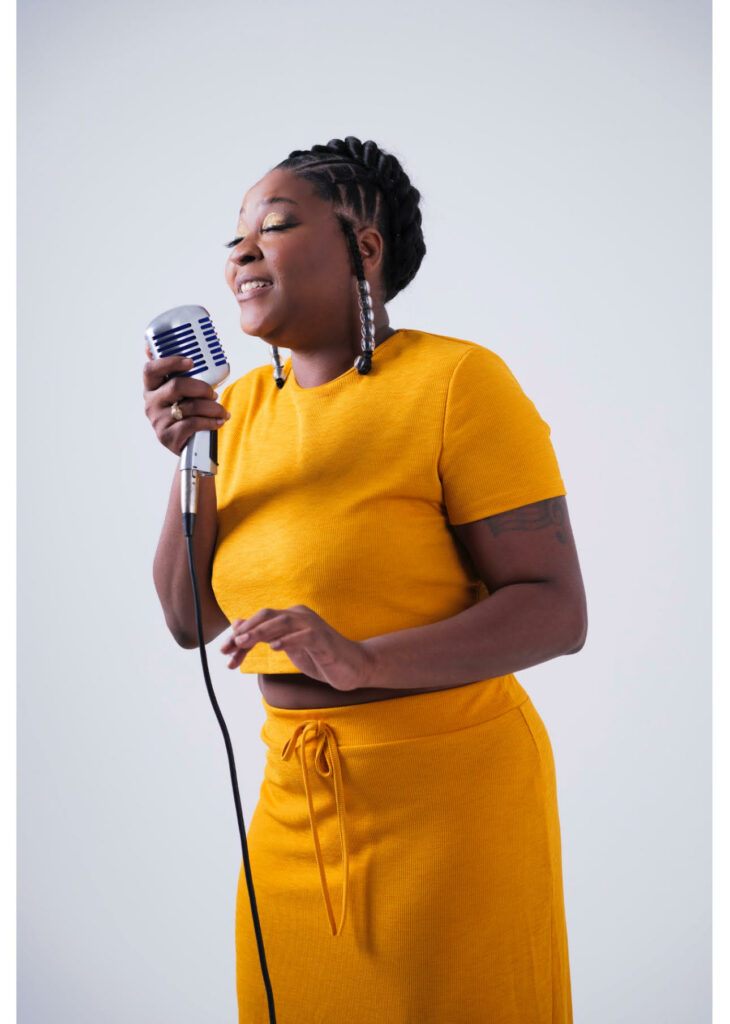
[Photo courtesy of Sierra Green]
Sierra’s musical origins
Sierra Green, 4/19/2021: I’m born and raised [New Orleans]. Downtown area. I started playing on Frenchmen around 2016; my first gig was at BMC. I was ‘Sierra Leone Experience.’
HKB: When you were younger, what did you know about Frenchmen?
SG: Nothing at all!
I didn’t know anything about Frenchmen ‘til I started working it. Yeah, my mom was a very protective mom… So we couldn’t go too many places, and I was one of those kids that obeyed and listened. I didn’t sneak out, stuff like that. I still loved music: I was singing at Christmas parties at home, I sang at Church a lot– that’s the foundation of my singing.
After Katrina, I went to Oklahoma for nine years, and that’s when I started really getting the [music/performance] bug. I’m 35; I was 18, 17 when Katrina hit.
HKB: So you were a “young adult”…
SG: I was a baby. Trust me. [laughter] It’s amazing how when you’re 18, you really think you’re an adult, but you’re really still a freakin’ kid.
…They did a lot of country music in Oklahoma, which I wasn’t fond of at the time. But I grew to love the stories, and I started singing those songs. But then the venues– they didn’t have venues to go to. So, I was only singing at libraries and at one festival they have every year. I started saying, “Man, I could go home and make some money….”
So I went home. I started on the corner of Frenchmen Street, just singing for people. I would stop people and ask them could I sing for them. A couple musicians heard me on the corner singing–I started meeting musicians, and they started letting me sit in. Like, “Come here Wednesday, I’ll let you sit in…” “You come here Thursday….” I started going to people’s jazz shows, singing with the piano. And my ‘lil name got out, and they was like, “You should start a band!”
Whaaaat? I thought I was gonna come out there and sing with people; I never thought I’d have my own band. And that was it: when I got my own band, I took off.
How Frenchmen compares to other music locales
SG: I’d say Frenchmen is different because of all the many clubs that are down there. You can literally hear six to ten different new bands on Frenchmen when you feel like that. Walk out the next door and come into the other door. And [musicians are] literally like, [whispering, mimes waving/gesturing] “Come sit in. Come on.”
HKB: Yeah, you see somebody you haven’t seen in forever and you’re like, “Oh yeah! They are a really good bass player, I gotta call them” or whatever.
SG: For real. Oh, I’ll tap on the glass and let them know I’m there [pantomimes]: “Hey, call me!”
From my experience, people come to Frenchmen [when] they actually want to enjoy the live music. Versus Bourbon: they’re drunk and want to hear loud music. Which is why I don’t play Bourbon. I want to be heard, I don’t just want to be the background.
And being where it’s at– I think Frenchmen is the perfect street in the perfect area.
Noise complaints
SG: Frenchmen Street has been there way before us, and people still move there and complain [about noise], which I don’t understand. I don’t understand how you move into this area and complain about the music like… Did you research what area you were buying your house in? Did they not tell you your house was right next to a row of clubs? [laughter]
Changes on Frenchmen?
LD: You said you started playing on Frenchmen in 2016 or something. Has the street changed a lot in the time you’ve been playing there? [Not including the pandemic].
SG: No.
LD: Huh, yeah, I guess that makes sense. ‘Cause it changed before then, but it’s been kind of the same since.
Venues (& movie stilts)
LD: Do you have a favorite venue to play on Frenchmen?
SG: I like Spotted Cat and Café Negril. Whole lotta energy, be so live in them two clubs right there. Bamboula’s too, I’ll put them all on the list. I love the energy in Bamboula’s.
HKB: Do you have a least favorite that you’ll play at but you don’t love it?
SG: I had a least favorite and I won’t play at it anymore: [redacted!]. That should be all I need to say!
HKB: Unfortunately, that’s not surprising.
SG: That club used to bring me embarrassment from clients. The bathrooms, the food– I didn’t even use the bathroom there. I would have to tell my band to play instrumentals so I could go across the street and use the restroom. It was that bad. I stopped working with them maybe just a year before COVID. So I did 6 years with them too, on and off.
Chris Rock actually came in there one time while I was singing on stage. Him and his wife– they looked around, and they left. In my head the whole time I was like, “Why did I have to be at [redacted] tonight?!” I would have done the same damn thing with my wife. I would’ve walked her ass right outta there!
[laughter]
That was [during] Essence Fest– all the stars were out that night.
But what I noticed about Chris Rock is that he’s really short! He’s so short! They make him look so tall, I would’ve thought Chris Rock would be as tall as they make it, but we were about eye-to-eye, girl, and I’m 5’3.
HKB: Wow, there’s a lot of male celebrities that- in movies or whatever–
SG: Make ‘em look tall!
HKB: Yeah!
SG: Mhm. They real shorties.
HKB: Tom Cruise, I think, is 5’5 or something.
SG: WHAT?!
HKB: Something like that, yeah.
SG: I would’ve thought he’d be 6 ft something.
HKB: I think it’s all tall shoes or…
LD: They have him on stilts.
SG: That damn camera just be lying to us, huh.
HKB: We know that’s true.
Other (more successful) comedian appearances
SG: I used to do Apple Barrel every Sunday, the late show, from 10 to 2. A comedian came in– I don’t know if y’all are familiar with a movie called Juwanna Mann –he’s the main character. I suck with names, but he’s a funny comedian who also does movies. [Guessing this refers to either Miguel A. Núñez Jr. or Tommy Davidson.]
He was in the gig the entire time. I sang one song and he just stood up and made the club clap for me– he just made them do everything. He came up to my microphone, and he said, “You’re gonna be a star one day. You got this, just keep doing what you’re doing.”
[See the previously published “Sierra Green: Manifesting Cedric” for her account of having Cedric the Entertainer in the audience!]
Frenchmen through the week & seasons (plus an adorable interloper)
SG: My son trying to get a cameo in here.
HKB & LD: Hiiiiiiiii.
LD: How are you?
SG: He’s also a little drummer and guitar player.
HKB: Oh my god, musical family!
SG: The first [post-shutdown, presumably] night I had a private event, I found out my son had COVID so I had to cancel. It was like, “Ughhhhhh.” So, that’s why we all quarantined right now. If I have it, I’m asymptomatic.
But before COVID, I was working seven nights a week, sometimes doubles and triples all weekend.
HKB: [jaw drops*] All of them on Frenchmen?
*this one was a video recording
SG: Mhmm. [Unless] I had private events or if we traveled to go to festivals, I was on Frenchmen. For seven years, seven nights a week.
LD: Which venues made up your –
SG: All of them. I played every club at a different time of the night, every different day. Except Tuesdays– Tuesday was the only day off. Monday was the slowest night we played; Tuesday was the slowest night actually ever.
HKB: What are your thoughts about the different seasons of the year, like festival season, or when it’s hot and there’s fewer tourists. What are the best months of the year, what’s the flow?
SG: I guess I was always blessed in this area because we just flowed. I had a year booked up before I could get to it, that’s how busy we were even with Frenchmen Street seven nights a week, then I would have to cancel my normal– I had residencies. I had 7… I had over 8 residencies. [unclear whether simultaneously or at different times]. And when festivals would call, I would have to cancel a residency to go travel. Or if I got a private event.
About the only time I didn’t care for Frenchmen [was] when it was cold. I don’t mind the heat, I don’t mind the heat at festivals. Me, personally, I don’t like freezing. My throat gets tight, I have to keep my warm tea, I’m complaining trying to tell the owners to close the door… Which is fine, but I don’t like the cold seasons. That’s when I make the least money, because people just wanna be cozy.
Making a living / Bandleading philosophy
SG: I was told by this old musician, used to be a jazz musician, named Al: “If you ever wanna keep your musicians, pay ‘em.” And I was always blessed to get the best musicians, because I paid them. It’s not about me, even though it’s my band. It’s about us and the team. And as long as I hire great musicians and pay them, we have a great show and we make good money. So that’s my strategy.
HKB: What was a normal night for how much money you would make? What was the level of ‘Oh, that was a good night’, what was the level of ‘Oh, that was terrible’?
SG: When you walk in, you can sense what you’re gonna make, really. Depending on the day and crowd and if they tippin’. You can sense it when you do it enough. I’ve been very blessed, I usually travel with a five-to-seven piece band. And on a normal night for us, we makin’ 220-300 a man. My goal was the least we would make would be 150, maybe 2[00] a man.
Out on Frenchmen I did five pieces–if I brought in two (more) pieces, it was to help other musicians who asked me could they work with me. I’m all about my musicians. I put my musicians before me. They like my babies, I call them my grown-man babies. And I take care of each and every one of them, everywhere we go.
Monday night would’ve been our slowest night. When I say slow, we’d probably only make $80 to a man, 80 to 100 dollars a man.
Tips, guarantees, & management
SG: I would keep tallies of my tips and my guarantees of our money. Sometimes I would make more money in tips than we were actually getting from the bars. …I think for me, a tip was a tip. The club should not be basing our money off of what we’re gonna be making in tips. Those are frickin’ tips. And I feel like it’s a slap in the face. Don’t worry about our tips, just pay us!
I can’t stress enough about the clubs need to pay us more money. At least pay your band a $100 per man, off the bat. At least that. If you got a 5 piece, give them $500. They can afford it. It’s not like a lot of bands about to bring ten people on and say, “Here’s my band, give me $1,000.” The highest band you have is about a seven or an eight-piece with a piano.
HKB: And a lot of band leaders are pretty aware and also recognize that they- on a Tuesday- might have a smaller version of the band.
SG: Right.
… See, again, I wouldn’t know [about the pre-2016 changes to Frenchmen]– I just know it’s still the same since I started. And I think it needs to change again. They not paying musicians enough money to be out there.
That’s the flipside of it. [Some of these clubs] want us to work our backs to the bones but they don’t wanna pay us; they only want to pay us depending on us making tips, which pisses me off. Which is why I went and got a manager, and why I want guarantees if I’m going to play. I look at it like this: If you want quality, you gon’ pay for it. And I’m a quality band.
HKB: So you were able to get guarantees from some of the clubs?
SG: I was.
HKB: That’s amazing. That is definitely not true for everybody
SG: I feel the best way to get what you want as a musician on Frenchmen or Bourbon is to legitimize your band, get a business LLC, and try to get management. Or deem somebody in your group that’s the best talker and you can [in air quotes] say they’re “management,” and you get your guarantees like that. Don’t let them tell you what they wanna give you; you ask for what you want. That’s my best way of thinking about that.
The Covid blues
HKB: One of the things we’re trying to figure out is how the city can–or the community even can– help other music spots grow. You know, Frenchmen has been changing over the years and it’s still so important, but how do we make sure there’s always a place in town where somebody can make their whole living?
SG: I would say the city needs to get behind their musicians a lot more better than what they do. And support us a little bit more than they do, because we the life of this city, next to food and alcohol. And I feel like they support food and alcohol more than they support the musicians.
LD: That’s a really good point, yeah. Like, you look at COVID too, there was so much effort into developing outdoor dining and things like that–
SG: Yeah. I felt–a lot of us musicians felt–very hurt by the city not standing up for us in that era when we couldn’t work. A lot of us were doing very bad. I was blessed to own a band for seven years and be able to file on some these clubs and get the unemployment–there’s a lot of people who don’t own LLC rights, who couldn’t get unemployment. See what I’m saying?
It was rough for a lot of musicians for a little bit. Still is now, but it’s picked up a little bit. [smiles] Very little. A lot of clubs are hesitant right now ‘cause they trying to figure out the best way for them to open up in the new situation.
HKB: And there’s still some restrictions. I think it’s still–if you’ve got singing indoors–I think it’s still only 25% [capacity].
SG: Oh, you can sing in there now, you just– it can’t be a lot of people in there.
… See now, the Jazz Museum*, they always support musicians. I did a couple of virtuals over there when they were doing virtuals outside on the balcony; I actually want to get another gig over there. I like it out there.
[*The New Orleans Jazz Museum is located on Esplanade at the foot of Frenchmen Street, in the Old US Mint. They feature rotating exhibits about New Orleans music and culture, which will hopefully someday include, if we can ever get our act together, an exhibit on Frenchmen Street through the decades. While not a “venue” per se, the museum hosts a variety of concerts and during the pandemic had a great series of local artists playing on the balcony.]
HKB: Is there anything specific you feel like you want to express about how Frenchmen can come back from the pandemic and be at least as good, if not better?
SG: I think they need to start doing at least a $5 cover, until they feel different. And then you need to give the band a piece of that cover. I really feel like this would be a good time for them to at least charge $5 to people. You can tell them the $5 is to support the band and support the coming back of the club. Period.
See, a lot of [musicians] are so used to going out there playing because this is our heart, this is what we like to do. But then at the end of the night, we home and… Hey, I know this is what you love to do but no, this is not right. This is not, no.
HKB: And that’s been the problem with the pandemic too, it’s not just people not making a living. People’s hearts are dying, not being able to express yourself and play. I was trying to explain this to somebody who wasn’t a musician. They were just talking about it from making a living like, “Oh it sucks people can’t make a living.” And I was like, no no no people’s identities and people’s… you know.
SG: I was depressed, I ain’t gonna lie, for about five months after the shutdown. My last show was March 17. And I was depressed: I didn’t want to be on social media, I didn’t want to do virtual. It sucks! You don’t have the energy from the crowd, it’s basically singing to yourself. I tried it a couple of times, but it just wasn’t… I couldn’t get a vibe off of it like that. And then we don’t have the right equipment, the phone sucks, you can’t really hear.
Yeah, it was depressing. But, I talked to God and I asked Him, was this a shifting for me? Did He want me to do something else? And He told me to hold on, so.
***
See also our previously published short, Sierra Green: Manifesting Cedric!
***
Interviewed conducted by LD & HKB on 4/19/21 via Zoom recording
Transcribed by Tali Gorodetsky (Jazz Museum intern)
Interview edited for clarity & concision by Laura DeFazio
Posted to Frenchmen Notes on 3/10/2026
***
Thank you to the Threadhead Foundation for supporting our editorial work in 2026!
