As guitarist and singer of the iconic Radiators, Dave Malone helped define the New Orleans swamp-rock sound for over three decades. He and the rest of the Rads honed their “fishhead music” on Frenchmen Street in the ‘70s and ‘80s.
***Thank you to the Threadhead Foundation for supporting our editorial work in 2026!***
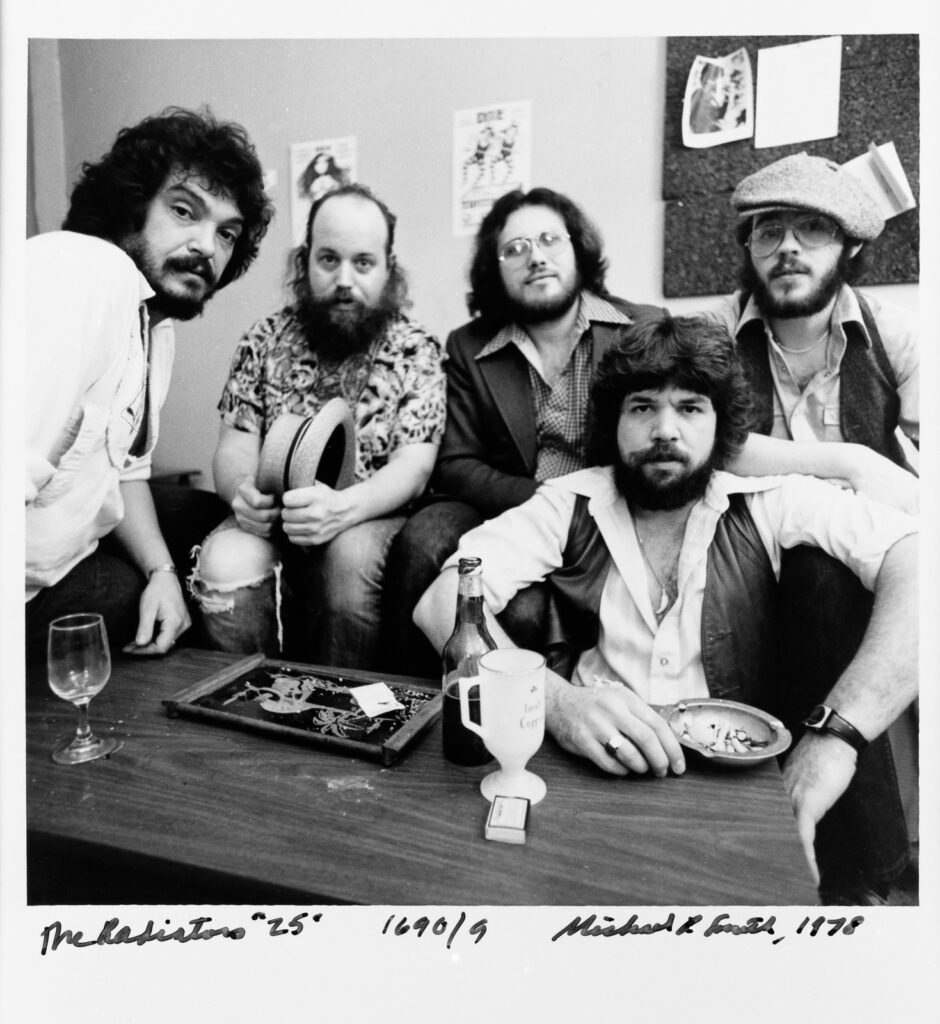
[The Radiators, 1978. L to R: Frank Bua, Ed Volker, Camile Baudoin, Dave Malone, Reggie Scanlan. Photograph by Michael P. Smith ©Historic New Orleans Collection, 2007.0103.1.807. Thank you to Heather Green at HNOC for stellar archival assistance.]
THE RADIATORS’ ORIGIN STORY
[Rhapsodizers, Luigi’s, Texas Chainsaw Massacre, Dream Palace]
Dave Malone, 10/29/22: My experience in the Radiators was that “Frenchmen Street” was based almost completely around the Dream Palace, which became the Blue Nile. When we were starting the Frenchmen scene–and I firmly believe that we were a factor in starting it–the Dream Palace and Snug Harbor were the only two places there with music. [The Dream Palace opened in January, 1977. Snug Harbor’s predecessor, Valentine’s, opened sometime in the late ’70s.]
We were the thing. I feel that very strongly. The way that happened was that we, the Radiators, inherited a gig from some members’ then-current band at this dump– Oh, not dump: magnificent. Those two words I get interchanged, “magnificent” and “dump.” This place was called Luigi’s, a pizza joint near UNO on Elysian Fields, and all the music-loving lunatics there became the earliest Radiators fans. They founded the Krewe of MOMs, which is Mystic Orphans and Misfits, and we became their band for everything they did.
We played every Wednesday night at Luigi’s. There was no cover charge, and they encouraged us–almost demanded–that we’d just go outside the box and play whatever the heck we wanted.
Hannah: You inherited that gig from a band called…?
Dave: The Rhapsodizers. Three of them went on to join the Radiators: Ed Volker, Camile Baudoin, and Frank Bua. They were in the Rhapsodizers with a guitar player, Clark Vreeland, and a bass player sitting in named Becky Kury, who was famous, or infamous…. They’d played every Wednesday night at the pizza joint. I don’t know the particulars, but we inherited their gig when the three of them, myself, and Reggie [Scanlan] formed the Radiators. Wesley Schmidt was the manager of Luigi’s and became the talent booker at Snug Harbor later, so it all tied in, in obscure kind of ways.
But all the people that came to see us, and danced like whirling dervish maniacs, followed our– Well, let me back up. One of the lunatics, Alan Langhoff, and his wife, Deborah Langhoff, opened the Dream Palace. They painted this cosmic constellation [mural] on the ceiling… By the way, one night, Mike Stipe from REM was in there, and we were playing, and he spent the whole time looking up at the ceiling. It was really something. I didn’t know if it’s still there– I hope it is. It was a great mural.
So, we started doing that two or three times a month. The [other] places we were playing were Jimmy’s, Tipitina’s and Maple Leaf occasionally, and Jed’s. Luigi’s maybe overlapped a little bit, but we got fired because of our drummer taking a chainsaw into the pizza joint and cutting up tables.
Yeah, that story became a song called “Texas Chainsaw Massacre.”
[Laughter]
Dave: [We got fired from] a gig that had no cover, where we were bringing all the customers to them. In a lot of ways, it was not a good idea to fire us…
But anyway, at first the scene on Frenchmen– there was no scene, except for people coming to see us. And it grew and grew, and the Tulane kids got hip to it, and that was the beginning of non-locals traipsing down to Frenchmen Street, which at the time seemed like going to Mars from Earth.
There wasn’t a lot going on on Frenchmen Street [otherwise]. All those clubs, and the food places–what’s the one on the corner? I don’t know if it’s still the Praline Connection.
Hannah: Praline Connection just closed this year.
Dave: Oh, really? Yes, well, that wasn’t there. The only things that were there were the Dream Palace [opened 1977], Café Brasil [opened 1985] , and Snug Harbor [opened in the late-70s as Valentine’s, became Faubourg in 1980, became Snug in 1983]. And around the corner, later, Checkpoint Charlie’s opened [1994; the building housed Tortilla Flats in the ‘70s], but that wasn’t on Frenchmen. The Apple Barrel was there, I think [opened 1981], and Adolfo’s [upstairs] was a restaurant, maybe… And that was it.
And so we packed the Dream Palace week after week […] You can hone your skills at home or in a practice room, [but] the important part of that equation is doing it in front of a crowd and learning how to entertain. Learning, perhaps, what works and does not work, and if you’re game to change what you’re doing, or augment it or alter it slightly. “Oh, okay, well I like this thing with all diminished chords, but people seem to hate it…”
That’s a real art. And that’s a particular thing, having a gig where you can play to people. Whether you get verbal feedback or booze or claps, you have a sense of what’s going well up on the stage. Which is why–if you see some fans out there, and they were there for the first four songs and then you look around and they’re gone–it’s deflating a little bit, but maybe not completely. If you’re someone like me who pays attention to the crowd, and I know full well that I’m there because of the crowd, you [can learn].
The Dream Palace was our club, maybe even more so than Tipitina’s, because we were really not only allowed but encouraged to do whatever the heck we wanted to do. Just like Luigi’s. We were lunatics, and we had entirely too much fun. No one got hurt by the people burning their clothes on the dance floor… [Laughter] We actually had a song called “Willie Burn Your Shirt”… I have a lot of stories there…
I mean, the place [the Dream Palace] was nutty. It was not dangerous-nutty, just cuckoo. Funny-cuckoo. Like at one point, there was sort of a gay gift shop next door–it became the Three Muses–with glass displays windows, and in the window was a five-gallon tub of “hot lube.” That ended up being a song, too– “Hot Lube.”
Hannah: I don’t think I know what hot lube is, and I’m fine with that.
Dave: It’s a sexual lubricant.
Hannah: That part I got.
[Laughter]
Dave: There were always wacky things that influenced our music, either directly or indirectly. We’d do whatever we wanted on our break–stay out on the street, or go to the second or third floor of the Dream Palace and… do what rock bands do. Quint Davis actually had an apartment around the corner, but I don’t think he wants to talk about that.
So, Alan Langhoff and Deborah started the Dream Palace, and we played there for many years. In the mid-to-late ’80s, we started going on the road a whole lot, and then we didn’t play in town a whole lot anymore. But our becoming the Radiators… Frenchmen Street was a very important [part of the] history of the Radiators. Very. Our local fans started it all, and then the Tulane crowd started going there, and we then didn’t know how brilliant we were in encouraging our connection with Tulane. I’m so glad we did, because every year, the siblings of people that had gone to Tulane had gotten tapes. We always allow people to tape our shows.
So you see, this word of mouth phenomenon was crazy, cool, good for us. And it trickled out to where we were going out of town and there’d be lines around the block at places we’d never played before, and we looked up on the stage and people were singing the lyrics back to us. We were like, “What the hell’s goin’ on?”
Hannah: Do you have any sense of–
Dave: I don’t have sense at all.
[Laughter]
Hannah: Was it just luck that allowed the Dream Palace and the whole little ecosystem of the street to flourish the way it did, or do you have any sense of why it happened, why there and not in a different part of town? Why then?
Dave: Because someone has a vision, and pushes it, and tries to make a thing out of it, and enough people follow along. One visits Frenchmen Street–when we were playing–and it was like a safe zone: “Oh, I can come down here, I’m not going to get hassled, even on the street.” That was very much true. Very rarely did the cops come and tell people to stop being assholes. So it was probably thought of as a safe environment to just let loose.
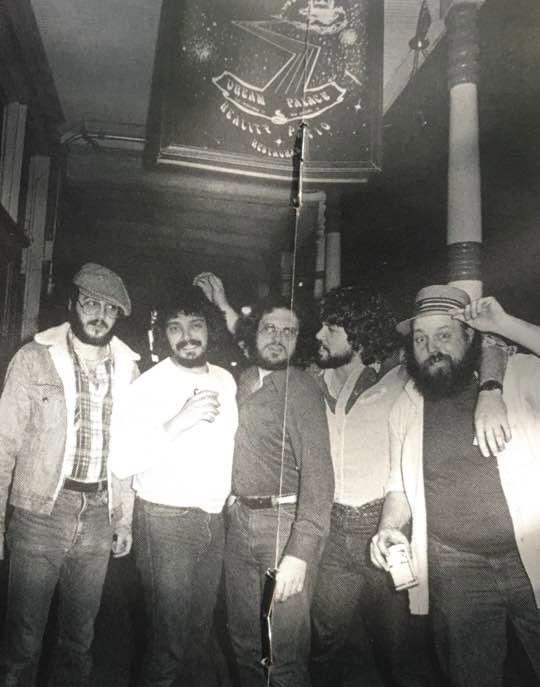
[Rads outside the Dream Palace. Photo courtesy of Dave Malone.]
FRENCHMEN IN THE ‘90s / ‘00s
Dave: I think [Frenchmen] was a lot more focused when it was just the Dream Palace, when that was the destination. The few times I’ve been on the “newer” Frenchmen– [and the version I’m talking about] is still pretty old– it seemed like people didn’t stay somewhere, they migrated, so you didn’t have a concentrated scene around any one place. I may be wrong.
Hannah: No, you’re not wrong. It seems like an important factor, later on, was the flow, the street traffic, the density of music venues. People could wander back and forth, and so there was a scene that existed, people having a gig down here and then over here in the same night, or people having a gig over here and then going to sit in over there, going to see their friend’s gig. The density of music venues became really important. But I think that was more like in the ’90s.
Dave: That’s not anything that I’m interested in. When I went out to see a band, I went out to see that band. I didn’t have 40 different flavors of ice cream to enjoy the bowl of ice cream. There’s something weird and less attractive to me about too many choices.
Hannah: That is definitely true.
Dave: It doesn’t help the band feeling like they have these really staunch, dedicated fans if they see them for four songs, and then, “Oh, they left.” It makes you feel like, “Okay, what’s going on here? I’m just one of many things, I’m not interesting enough to hold a crowd?” That’s my thoughts on that. What do you think, Hannah?
Hannah: No, I think that’s definitely right. I think what happened in the ’90s was a different phenomenon where bands could make a living not based on a dedicated fan base, but just based on foot traffic, and there being kind of this density, and Frenchmen Street becoming “Frenchmen Street,” not just “the Dream Palace” or “Café Brasil.” That became a different phenomenon.
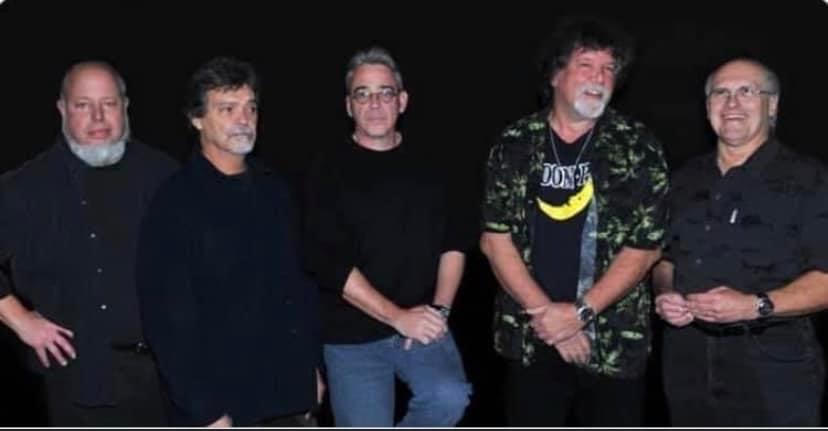
[L to R: Volker, Bua, Scanlan, Malone, Baudoin. Photo courtesy of Dave Malone.]
PAY, PARKING, VENUES, THE MUNICIPAL APPARATUS
Dave: Some other musicians illustrate–and I don’t know if it’s true, it’s just the gist of what I’ve been told–that because of the watering down [of Frenchmen] and now having so many options, the pay scale went straight in the toilet. Because the scene attracts people that maybe [have only just] reached the level of professionalism where they ought to be playing out in public, and unfortunately, those people will underbid the people that should be doing the gig but have said, “Wait, I’m not playing for chicken feed anymore. I want X plus X plus X.”
And the powers that be say, “Oh well, tough shit, we’ll get somebody else to do it [for cheaper]. Not only that, they’ll pay us to let them play.” I’m like, “Okay, something’s going wrong here…”
Hannah: No, you’re totally right about the quality and the pay, the race to the bottom with pay. When you guys were playing at the Dream Palace, were those gigs a notable chunk of your total income, or was it kind of more incidental, or do you not really remember?
Dave: It was enough of our income to be a thing. We had somebody collecting at the door. Our fans understood that they want to come to this clubhouse, and you don’t get in the clubhouse for free, and the entertainment is going to be unpredictable and musically sound, and I guarantee you’re going to have a good time. If you can’t have a good time there, you should probably stay home.
We were in control of the money flow, and luckily–I don’t know if it’s luck, kismet, or whatever you want to call it–we had enough fans to have a good door ring every time. I don’t remember what the cut was at the Dream Palace–we probably got 100% of the door, and they were ecstatic to have the bar ring that they got, because our fans were notorious really good drinkers and really good tippers. So the staff loved us. The bar owner, everyone, loved us.
We have records still to this day across the country at venues for the highest bar rings. I mean, that– am I proud or am I ashamed?
Hannah: No, you should be proud. Be proud!
Dave: I make no mistake about entertainers versus artists; it’s kind of two different things, but it isn’t really. Someone plunks down their money, especially someone who doesn’t have a lot of money–they want to be entertained. They don’t want you to give an artistic statement to them. [That’s what] I think–maybe I’m wrong. I’m in the entertainment business, and I [also] try to make music that’s artistically interesting; it at least has to be interesting to me and my family. And everyone else came along for the ride, and we’re so grateful. I think I probably veered off from what we were talking about. [chuckles]
Hannah: No that’s fine! Frenchmen Street has been really important for a lot of musicians– I often use the word “incubator.” It’s incubated a lot of bands and a lot of musicians. It’s been, like you said, the safe, nurturing space. What can we learn from that? How do we as a city–and part of this is on “the city” itself–but how do we as a community nurture the next Dream Palace, the next spots? What do we learn from Frenchmen Street? How do we make sure that we always have those spaces?
Dave: Well, what you learn in my beloved hometown is that no matter what you’ve learned, you can’t implement it if the government is run by a bunch of jackasses. All these different places, as far as I can tell– and again, I’m not the expert on current or ’90s Frenchmen Street— all these businesses should have banded together with the councilmen for their district, or whomever, and formed a united front to have every parking spot by the club to be a designated freight zone. I know people who have gotten their cars towed away while they were unloading.
[Another way to nurture these spaces is] making the pay and the collection at the door fair to the musicians. But first, not undercutting the musicians that have proven that they deserve to be there… “Oh, we’ll just get Joe Blow because not only do we not have to pay him, he’ll give us a hundred bucks to let him play in our club.”
But if the city doesn’t go along with these things that they control, like the parking spaces, I don’t know what you do.
Hannah: I think that’s really important because that speaks to the [fact that] there’s music venues and then there’s the whole ecosystem around them–parking, and all these different things. […] One of the things that I’ve done, with the non-profit that I work with [MaCCNO] that is the umbrella for this project, we tried to push them for freight zones and parking zones for musicians and it was such a frustrating process. It was so frustrating.
Dave: You talked to the city, right?
Hannah: It was just– They didn’t– The city was unable to understand the nuance of what was needed.
Dave: They understood. They just don’t give a damn.
Hannah: Well, that might be a better way to put it, but what they proposed was having a printed paper pass that the venue would have, that they could give to the musician to put in their car. I was like, “No, that’s going to get lost or taken.”
Dave: That’s better than nothing, though. […] Parking is the number one issue I hear. Number two being the pay sucks. Then, the venue owners always charging stuff back on the band: “Oh, you had a beer.” I’m like, “What? Okay.”
Here’s the thing: there’s so many musicians vying to play there, no matter what the particulars are. Has it all become watered down, then?
Hannah: Hugely, unfortunately. In the 15 years that I’ve been here, I’ve seen– But there are still parts with the incubation and safe musical space… Sunday nights at the Spotted Cat for years in 2007, ’08, ’09, ’10, and I think up until recently was this virtuosic modern jazz performance/jam that was just incredible. A lot of players really got to hone their skills there. There was still some of that feeling like what you experienced, but it’s definitely in bits.
Dave: The French-men— people screwed that up royally, “Frenchmen,” not “man”– Street scene could be so great if people just were treated fairly, but people have gotten used to music as some free commodity. What? No. Your burgers aren’t free, neither is song that I’ve spent a week and a half agonizing over to write.
But that became the norm with all this “0.001 ¢ per download,” and that rolled over to some club owners, as though the musicians, they’re not important. But they are.
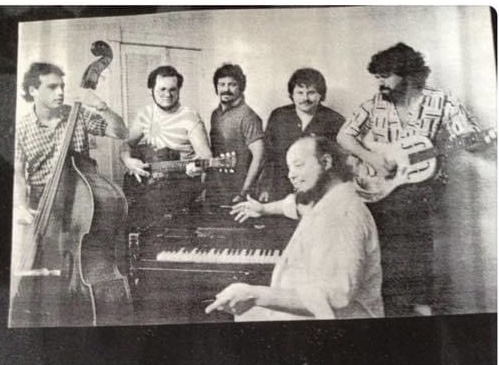
[The Radiators inc. percussionist Glenn Sears, part of band during ’80s and ’90s, standing directly behind keyboardist Volker. Photo courtesy of Dave Malone.]
FRENCHMEN STREET TODAY
Dave: Honestly, I’m out of touch with this new Frenchmen scene, that’s turned into this tourist mecca… I don’t go there. Hey, if that’s what people wanted, great. I hope people are happy with it.
[Before,] real music lovers came and enjoyed Frenchmen Street for whatever reason, and they went back and told their cousins and friends, “Oh, you got to go to Frenchmen Street!” But then this large percentage of tourists that are walking around [today], not unlike the people that just roll up and down Bourbon Street, are not really there for the music. They just want to be on social media showing that they were hip enough to find this scene. Do they really care about it? I don’t know.
Hannah: You’re a hundred percent right. One thing I always point out is that the timing of Katrina 2005 basically coincided with the rise of the internet and social media. This big international spotlight got shined on the city after the storm and at the same time, social media and the internet were ramping up. That really, I think, contributed to that thing of now all of a sudden it couldn’t stay a secret anymore after Katrina.
Dave: You’re right. It’s progress, and it is not. Sometimes the hidden-gem-secret thing, like we had–but we weren’t hidden, we had good crowds every single time–that seems more important than this other thing… But listen, I don’t want to sound in any way that I’m badmouthing any of the stuff going on on Frenchmen Street. I’m just commenting.
Hannah: No, it’s perfect. It’s exactly one of the reasons why I was so excited to talk to you. My hope with this website is that all of the people who really enjoyed y’all’s shows in the ’80s–and the people who maybe live in, [say,] San Francisco and come for Jazz Fest and really love it–this can be a way for them to explore, and read, and think about [Frenchmen Street]. It’s definitely a lot of the same people; the audience is the audience for this project too.
Dave: Those people should be informed. And also the gawkers, and the social media goofballs… They pay the cover charge, great, but are they important to the scene? No.
Hannah: […] Frenchmen Street is so odd in some ways because it’s been a bunch of different things, but it’s unlike anything else in town. […] All the stuff that was happening in the ’80s was technically not legal under the zoning code for the Marigny.
Dave: When I was there, nothing we did was legal. But it sure was fun.
[Read more about the Radiators in the October 1987 issue of Wavelength Magazine! Page 20.]
–Laura DeFazio [Ed.]
***
Interviewed by Hannah Kreiger-Benson via Zoom, 10/29/2022
Transcribed by (a human at) GoTranscript.com
Transcript corrected by Shiuly Akter (Public History grad. assistant, Stephen F. Austin State University, 2025)
Edited for clarity & concision by Laura DeFazio
Published to Frenchmen Notes 07/21/2026

Fascinating! Thanks for the memories!
The Dream Palace was owned and opened by Alan Langhoff and his ex-wife, Jackie Miller in 1976.
The art work (mural, etc.) was done by local artist Rain Webb. It’s still there in the Blue Nile.
I was married to Camile Baudoin back in those days. I was there.
Those early days at the Dream Palace were magical. I saw them everywhere, Tip’s, Jimmy’s, Jed’s, even Cooter Brown’s, but the Dream Palace was my favorite, and Dave is right, that mural on the ceiling was fantastic…
Let’s not forget the cover for the Rads at the DP was $4.00. even quarter rats could afford that. When the first boutique hotel opened, the noise complaints started. The bartender Too Tall held off the NOPD. He said “we were here first!” and the officers bought the argument, listened for a few minutes and left.
The mural was painted by Rain, who often sat at the bar with his back to the band, ignoring the whole scene while he collected free drinks for also painting faux bricks on the post supports .