Edited by Laura DeFazio
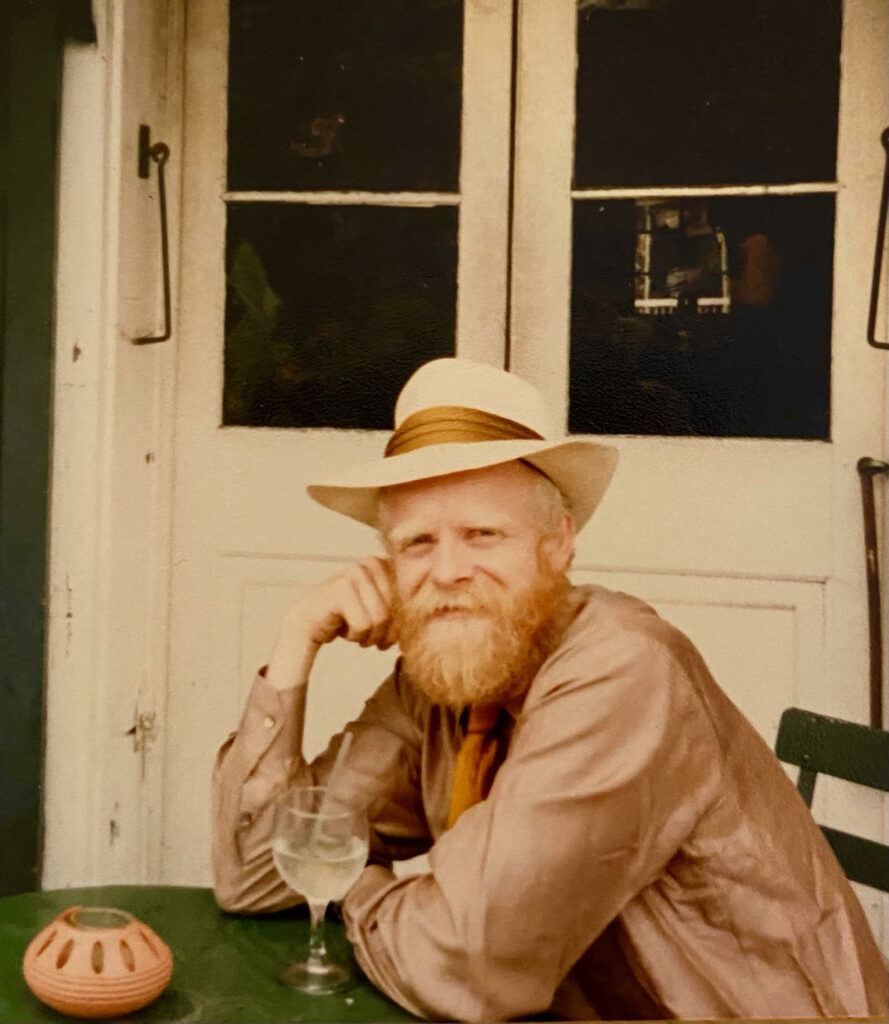
Versatile pianist Amasa Miller is a veteran member of both the Charmaine Neville Band and the Pfister Sisters. (He and Charmaine have held down the Monday night residency at Snug Harbor since the mid-80s.) Born in New York City in 1949, Amasa [pronounced Am-Ah-See] has studied various genres, styles, and instruments over his career and moved to New Orleans in the early eighties after getting “hooked on the piano playing of Professor Longhair and James Booker.”
**This interview was published thanks to the generous support of the Threadhead Cultural Foundation!**
JAMES BOOKER (BROCK, BARF, & SHIFTING KEYS)
Amasa Miller, 8/25/2022: I basically arrived in the city in the early ’80s. I first was visiting around ’80 or ’81, and then I moved down permanently about ’81 or ’82. My future ex-wife moved down a year before me. It was through a connection of hers that I actually got turned on to James Booker.
[My ex-wife] was Italian. Her best friend was Anna Pastoressa, who was married to Jerry Brock. Do you know who Jerry Brock is? Jerry Brock is an interesting person historically because his brother, Walter Brock, started OZ. Walter was a visionary at the start. Jerry was his younger brother, also a big musicologist person but a very early important person to me [personally].
So, he was married to Anna Pastoressa, who was Italian. In those days, if you were Italian, you knew the other 10 Italian people who were in New Orleans. This is not the case now, but back then, it was such a small little community that everybody knew everybody. Or if they didn’t, they knew somebody who knew them. Jerry was a fanatic musicologist already, and knowing that I was a piano player, he insisted on taking me out to see James Booker, who at that point was actually playing at Snug. Anyway, I became a total, you know, head-over-heels fanatic. I caught a couple of years of James–the last two years of his life. [Booker died in 1983.] He did a steady gig at the Maple Leaf–it might have been on Tuesdays, I can’t remember, but I caught every single one. And he was also in the old Toulouse Theatre playing in the lobby.
When I first heard James Booker, it was like coming up on… like, you come into a club and it was Ray Charles playing, and there was nobody there! I mean the first time I saw James, there was only three or four people in the audience, and I saw countless shows like that up at the Maple Leaf. I know the name of one of the people that would show up–I called her Nurse Nancy. Her name was Nancy, and she was a nurse, and she was as much of a Booker fanatic as I was. So she was [at the Maple Leaf] every time I was.
Hannah: Amazing.
Laura: Can you tell us about seeing him at Snug at all?
Amasa: Well, one story is, when my future ex-wife moved down here, it was with our five-year-old daughter, Elisa. She was born in ’76, so this is ’81 or so. I remember one of those Snug gigs in which Booker started feeling sick in the middle of playing, got up and stumbled off the stage, and nearly threw up on my daughter.
Laura: Oh my gosh!
Amasa: It’s one of my early memories of James Booker: the stumbling off the stage, throwing up. He would sometimes play something unbelievably brilliant and then get sick.
This didn’t happen a lot. I remember that one, because basically, that’s like a life-changing experience for my daughter. I should ask her whether she remembers that…
Hannah: I would be honored to have James Booker throw up on me.
Amasa: But, anyway, as I said, it was like stumbling in on Ray Charles and having no one in the audience. It wasn’t just [Booker’s] piano playing: nobody could out-sing him. I mean, James’ version of “Send Me Someone To Love,” no one has ever matched that. No one. Really. It’s heartbreaking.
I’ve been thinking lately quite a bit about him because OZ, they have their interstitial music that they put in, which is always interesting to see. They get favorites and get stuck on certain things. Lately what they’re stuck on is James Booker’s version of The Godfather theme.
Laura: Huh!
Amasa: And what’s interesting about it to me, because I’m hearing these same 30 or 40 bars over and over again in the car as I’m driving around, is that when he starts the piece, he starts it in the wrong key. He starts in the key he doesn’t want to play in it. So he starts [hums a tune], then suddenly, bang, he’s in a different key. [hums a tune]
I just think that’s just so classically James, and he does it so effortlessly. Why did he change keys? Didn’t need to. But obviously, even him, he has his comfort zones. I know what it feels like to start something in the wrong key and then somebody, “Oh, this doesn’t feel good.”
It’s just funny. I’m wondering how many people notice. He does it so flawlessly, this sounds like part of the piece, but because I know James from having seen him live so many times – that kind of stream of consciousness stuff was not uncommon. And you know, the fact that he would just start something in the wrong key and just slip out of it and jump– in a way which is musical. I mean, really, I can’t believe what he did, honestly.
EARLY DAYS ON DECATUR / MEETING THE PFISTER SISTERS
Amasa: … My early days in town, somewhere roughly in there, I was with a country swing band, and that was my resume for a job I wanted delivering pizza. The guy just figured that I wasn’t a good prospect and wouldn’t give me the job. [Laughter]
So, I hustled this gig at Bonaparte’s Retreat. We just started playing there for nothing, and eventually, Jim Monaghan started paying me $5 an hour, which was really the big money, you know. I just felt like I was rich.
Across the street, there was a piano player at the Gazebo. A ragtime player; I can’t remember his name. He was a really good player. I got to know him and the other people playing at The Gazebo while I was over at Bonaparte’s. Eventually, I got offered a gig over there too.
Actually, I think I took that other piano player’s gig… Mainly because I showed up and I was dressed okay. He was actually a better player than I was, though. [Laughter]
Hannah: That’s not always what’s important…
Amasa: So anyway, I started up on Decatur and worked my way to Frenchmen. Decatur, probably around ’84, ’85, [was where] I hooked up with the Pfister Sisters. One of their early steady gigs was on Frenchmen, at Snug Harbor, every Sunday. We’d have to check with Jason [Jason Patterson, longtime Snug Harbor music booker] to find out [the exact details]. I’ll talk to the Pfisters and to Holley [Bendtsen], who’s actually somebody you should talk to. Do you know Holley? You want to have some stories–Holley can talk, and Holley’s got stories. She’s running history tours in the French Quarter.
Anyway, it’s somewhere in the ’84, ’85 range that I hooked up with the Pfisters. We actually played at Bonaparte’s Retreat; it was one of the [early] places we played. I think we played there Sundays.
But then later on we got a steady gig at Snug Harbor with our full band. I mean, including a saxophone, with [Ken] Snakebite Jacobs on saxophone. I don’t know if you know who that is–he left town years ago.
Hannah: No, but I love the name.
Amasa: He was part of the– What was the brass band that just won a Grammy?
Laura: Rebirth?
Amasa: No, not Rebirth.
Hannah: Soul Rebels.
Amasa: No.
Hannah: Dirty Dozen.
Amasa: No, no.
Hannah: Nightcrawlers.
Amasa: Nightcrawlers! Thanks. He was a regular member of the Nightcrawlers. I’m sorry, my memory’s fairly flaky, but anyway. He was a member of the Nightcrawlers, and he was in the band. Bruce Raeburn* was on drums – you know who that is?
[*From 1989 to 2018, Bruce Raeburn was the curator of the William Ransom Hogan Jazz Archive at Tulane University.]
Hannah: I just talked to him the other day. I love Bruce.
Amasa: And his father is Boyd Raeburn [jazz bandleader and bass saxophonist, 1913-1966]. So [Bruce] was on drums and Eric Glaser was on bass, and then I was on piano. It was a four-piece band plus the three girls, Yvette, Holley, and Suzi Malone.
Hannah: Right. I didn’t know the Pfister Sisters had a regular gig at Snug.
Amasa: Yeah it was probably a year or so…
“THEY CAN’T HAVE MY CALENDAR!”
[Amasa pulls out his absolutely brilliant date-book from those years, and we try to figure out which day of the week the Pfister Sister’s full band had their steady gig at Snug/exactly what time period it covered. Hannah finds a Pfister’s Sunday jazz fest gig in ‘86, but we never determine exactly the exact residency specs because a) as Amasa noted, he didn’t always record regular gigs, and b) we all get a bit distracted for a while poring over the book.]
Hannah: I wish everybody had notes like this. You know we’ve been building this website, but the Jazz Museum really wants to do an exhibit on the history of Frenchmen Street.
Amasa: They can’t have my calendar! They’re going to take my calendar!
[Laughter]
Amasa: Over my dead body. I can get all misty-eyed about it, like Kavanaugh– “My calendar!” [fake crying]
[*For the future generations that will be hopefully reading this someday – this is a reference to Brett Kavanaugh. Before he was confirmed to the US Supreme Court in October 2018, he submitted his handwritten 1982 calendar as evidence to refute sexual assault allegations.]
Amasa: I’ll tell you what, I’ll loan it to you. Or photograph every page.
Hannah & Laura: [excited noises]
Amasa: One thing I noticed was that I had a duo gig with Reggie Houston during that year [likely refers to 1986, per Hannah’s later exclamation]. That was probably when I was just starting to work with Reggie, and Reggie of course, later worked three years with Charmaine. He plays saxophone. He’s back in town right now, actually. The band was co-led by me, Charmaine, and Reggie for years. Then Reggie, before the storm moved out to Portland.
Hannah: And right here! It says, Reggie and me at Snug on Wednesday, October 15th, 1986.
Amasa: During this period of time, I was doing all sorts of little gigs at Snug–
Hannah: Wow! Snug on Monday with Charmaine, Snug on Wednesday with Reggie, then I can’t tell– it says something with the Pfisters with a birthday show on a Sunday, but I can’t tell if it says Snug… Anyways, it looks like you might have been playing at Snug three times in a week, which is really interesting.
Amasa: Well, yeah– I don’t know if I have documentation of this, but in my faint memory, I remember one month where I did 17 gigs at Snug in one month.
Laura: Whoa…
Amasa: I don’t know why that number sticks in my head, but I remember making note of the week when it happened. At this point, it’s a distant memory, so maybe I’ve got the wrong number, but the basic content, as you can see, it’s not unbelievable. These dates [indicating book] are a little before the steady gig with Charmaine, because I did this Pfisters gig separate. I wasn’t there with the Pfisters and Charmaine for steady gigs at the same time.
When I started my steady gigs with Charmaine, we were doing occasional Mondays. I would do a duet gig with various vocalists: I did it with her, I did it with Little Queenie–Leigh Harris–and obviously I did duets with Reggie. There were a couple of years where I worked with Aaron Neville. I think that started later, but there was probably a time somewhere when I was working with Leigh [Leigh Harris aka Little Queenie, sometimes styled as Li’l Queenie, particularly in the context of her band Li’l Queenie & the Percolators], Charmaine, The Pfisters, Aaron, Reggie–there’s five right there.
I was doing two steady gigs a week for a while with Charmaine alone–we were doing Thursdays and Mondays for a while. So, in a month, that would be 10 gigs right there.
Laura: Wow.
Amasa: So if I had seven more gigs in that month, that would be 17. As I said, I don’t know when that month was–the calendars that come after this one are in better shape. I’ve got them all the way up to the current time. I’m a compulsive record keeper. It’s a problem.
Hannah: No, it’s incredible.
Amasa: I should have been an accountant. Actually, before you came, I was going to go up in the attic and try to find my old checkbooks. [laughter] I actually have checkbook records that go back to when I was in high school when I got my first checking account from the Bank of New York. And the thing about checkbooks is, as I’m trying to figure out where I was and when, checkbooks would really tell me a lot. [chuckles] I know, for instance, Ben [Schenk] talked about the fact that living in the city was so cheap back then, like when I arrived.
CHARMAINE / SNUG / AUDIENCE INTERACTION
Laura: I was going to ask if there’s anything specific you remember about playing at Snug Harbor? What did you enjoy about it? What did you–?
Amasa: Well Snug Harbor was the perfect place for Charmaine and has been for years. It just has the right combination of size, intimacy, you know, where– she’s number one, and above all else she’s an entertainer. She’s a storyteller and an entertainer, and the singing and the musical part of it is secondary to the fact that she’s a communicator.
Hannah: When did she start at Snug, do you know?
Amasa: That’s what I was pulling these calendars down to figure it out… It’s somewhere in the window of ’85 to ’87. Don’t quote me on anything yet, but probably late eighties. I’ve been there at least 35 years with her. It’s the longest steady gig I’ll ever have because I won’t live long enough to have another one.
[Laughter]
Amasa: To get back to her in that room: it allows her to– She’ll bring people up on stage, and she’s fearless in terms of not caring what happens. Like, somebody will come up and she’ll get them to sing and the whole band will end up going the direction that the person coming up on stage is going in, not in the direction that we intended to go at all. She’s so good at improvising, and she’s terrible with remembering words [laughter]. I mean, she just butchers words of well-known songs, but she’s so good at making up words that, you know. There are so many precious moments where I said to myself, “Oh shit, I should have recorded that, she’ll never remember it!” Now she’s just like me. She doesn’t remember anything.
[Laughter]
Amasa: Basically, what I remember is just all the wonderful times when there would be this magical introduction and magical interactions with the audience. I remember one time an eight- or nine-year-old girl that was sitting right up front was pulled up on stage. And this girl was probably autistic– she had every sign of being totally withdrawn and autistic– but Charmaine got this girl to come up and sing on stage.
Laura: Ohhhh.
Hannah: Wow.
Amasa: I mean, I don’t know how she did it. It was like magic. But she would do this [kind of thing] over and over again. In more recent times, one of her favorite things was to do a section called “More Cowbell” [laughter]. She has about four or five cowbells in her bag. She’ll pick four, five–however many people can fit on stage–and bring them up and we’ll do kind of a version of “Come Together” by the Beatles [sings]. We’ll get that groove going. She’ll get everybody, just because everybody knows that song. Except for Charmaine–she has no idea of the words.
[Laughter]
Amasa: She’ll get people singing along and then she’ll give each one up there a chance to solo and you’ll never know. Of course, some of these people have no sense of rhythm. Not at all!
Of course, we’ve had some of the best drummers be in the band over the years. People like Raymond Weber and Shannon Powell and Gerald French and Russell Batiste and Herlin Riley. Those were all regular.
Laura: Dang!
Hannah: That’s a line up!
Amasa: Actually, one of the first drummers, in the first incarnation of Charmaine at Snug, was– we didn’t even have a bass player at that point. Charmaine was working at Benny’s Bar [on Valence St.; closed in late ‘90s] at the same time, and Zac Cardarelli was playing at Benny’s but he at first didn’t play with us at Snug. At that point, our band consisted of Herlin Riley on drums, me, Reggie on saxophone, Bula Bula [spelling uncertain] on congas. “Bula Bula” is what we called the late Michael Ward*. I don’t know if you know who that is? He was a wonderful percussionist. He had personal issues, which he probably died of.
[*not to be confused with the violinist of the same name]
Anyway, so Herlin, Bula Bula, Reggie, me, and Charmaine. No bass. And you know? Herlin is such an extraordinary musician, I didn’t even miss the bass. The bass was there in my head. But it made my left hand strong in that period!
In some ways, that was one of the most fun incarnations. Then later on we had–I can’t remember which order–but Russell [Batiste] was with us a couple of years. We’d picked him up as a kid. He was a teenager. Gerald [French] was young when he started and then Raymond [Weber] followed Gerald. Raymond was our longest-standing drummer over the years. He’s still with us now. On and off for a couple of years, his son Raymond, Jr. played with us, til he died tragically. Just during the pandemic. That was one of the pandemic [deaths].
WHAT’S IN THE ATTIC? (WAVELENGTH, WWOZ DETRITUS, & MUCH MUCH MORE)
Amasa: There was another piece of primary stuff I wanted to find for you. I know it’s up in my attic, so I will find it. There was a Wavelength article written on me back in– I don’t know what year. It might be ’87 or ’88. It was written by Brent Haywood, who worked at Sbisa’s [on Lower Decatur]. After I did my steady gig at Bonaparte’s Retreat, later on, I did Sbisa’ gigs with Little Queenie. I was playing every Sunday with her. Brent was one of the bartenders there but also a writer. I befriended him and he decided to write an article on me. The article was called “From Bats to Booker.”
I’ve probably got 10 or 20 copies of that Wavelength. If I actually find them, I’ll give you one. I was going to read it [before this interview] because, I said, “This article probably is going to help me jog my memory.” I know it’s up in one of my boxes up in the attic…. I mean, we’re going to clean up, honestly. We’ve been telling God that, “Yes, we will get our shit together.”
[Laughter]
Hannah: If an extra pair of hands would ever be helpful, I’m always happy to come and help do stuff like that.
Amasa: Really? You’d help me root through the attic?
Hannah: I love stuff like that! I would happily do it. You have a recording of me offering.
Amasa: You do know how hot that attic gets?
Hannah: I used to build houses…
Amasa: Here’s an interesting history of this house. We were talking about OZ starting out with Jerry Brock. Walter Brock was really the visionary, right? Jerry was his sidekick brother who never got the credit that he thought he deserved, probably. I don’t really know. But there was a third individual, Ken Devine. Ken Devine had a radio company called Broadcast Technical. And he basically built radio stations. He built radio for the blind.
Laura: Wow.
Amasa: He was the technical person that built [W]WOZ. And he was also – there was a period where he was the manager of OZ. Walter Brock’s vision, but it would not have happened without Ken. Ken was the guy that could actually put up the tower. [Laughter]
Laura: You gotta have the guy who can put up the tower…
Amasa: Anyway, this house used to belong to Ken Devine. He’s a personal friend of mine. We moved in here around ’94 when Ayla was born. My second daughter.
Hannah: I remember her.
Amasa: Anyway, when I moved into the house, there was stuff in the attic that was left over. See that neon up there? It’s not turned on because it’s broken.
Hannah: Yeah!
Amasa: Above there. See the things, they’re suspending– Those are radio parts.
Laura: Wow. That’s really cool.
Hannah: Oh, that’s beautiful!
Amasa: The attic was full of radio station and radio detritus including things like tape recorders, like old four-track tape recorders, stuff like that. Turntables. I need to get rid of this stuff. I would actually love assistance… The right thing to do would be to pull all that old radio [stuff], which is valuable to somebody and get it in the right hands. I wouldn’t even expect–I mean, it would be lovely to sell it, but to be honest, if it went to the right hands, if I don’t have to throw it in the garbage–
Hannah: We can help.
Amasa: My daughters and I have been talking a lot about dealing with this attic. Because I’ve got checkbooks stacked, back to when– I’ve got utility bills from when I lived– Somebody has to help me! [Laughter]. Maybe somebody could take all of this equipment, and remove it from my house, and have it go someplace where it will be– I mean, it’s historical!
Laura: It sounds like a project. I love it.
Amasa: We’re getting so distracted.
Hannah: No. This is what it is. [crosstalk]. This is perfect.
FRENCHMEN VENUES THROUGH THE YEARS → LIL QUEENIE & PERCOLATORS → BACK TO VENUES
Amasa: I was kind of checking the pulse of Frenchmen Street every Monday night for years, at least going back into the years you can see. I can prove to you! [Indicates calendar; laughter]
Back to the late ‘80s– I don’t know what the Spotted Cat was back then. On one of my first gigs at Snug, I didn’t even notice the Spotted Cat. Whatever that business was, you must know.
Laura: It was wholesale oysters for a bit…
Amasa: The Dream Palace was the thing, when I first moved to town. I remember that was the tail end of [Li’l Queenie &] the Percolators.
I came to town and just missed the Percolators! I might have caught a gig, but I did get to know John Magnie early, and he was one of the most welcoming people ever. I’m in awe of John Magnie as a player, as a musician, as a human being. I have nothing but good things to say about him.
Anyway, unfortunately, his collaboration with Leigh [Leigh Harris aka Li’l Queenie] was winding down. And Leigh, I don’t know exactly what happened but she was like this close to becoming the next Janis Joplin. She was better than Janis Joplin. I mean, I played with her. Leigh could be everything from Betty Carter to Janis Joplin. Janis Joplin couldn’t be Betty Carter, but Leigh could do credible Betty Carter and then belt out Janis Joplin.
She just had an incredible musical mind. You know, if I was playing the wrong chord she would sing the notes of the right chord. She didn’t know the name of it, she couldn’t tell me what it was but, you know, her ear was unbelievable.
I really miss Leigh. I’ve got deep connection with her because she was also the dedicated babysitter for my younger daughter, who was born in ’94. I know I was playing with Leigh in ’94 because we used to use Leigh as a daytime babysitter. It was after the Percolators blew up and she was just sort of doing piecemeal gigs. I was working with her at Sbisa’s. She had her string band together, The Mixed Knots. She had various little side projects going, you know, but she would be the daytime babysitter.
She’d be safe as long as it was daytime. If it’d get to be evening, then the drinking was a problem. [Chuckles] I remember taking her home after gigs… I was her ride, you know, she didn’t drive at all when I first met her. It was probably a good thing too. But I would take her home, and sometimes I’d have to help her get into the house. For the first set, she would be extraordinary.
I know that I played Snug with Leigh for sure. I don’t remember much about the other [clubs]. DBA wasn’t there yet at that point. The only music clubs were Snug and– I don’t know when Café Brasil started. It seems like it’s been there forever. I don’t remember before Café Brasil, but I was here before. I don’t remember when it got bought by [the Favela Chic people]. Who was the guy that owned it for years?
Hannah & Laura: Adé.
Amasa: Adé, right, yeah. So, Dream Palace– so that was all there was on Frenchmen Street.
“SWEET SPOTS IN HISTORY”
Amasa: Then the heyday was kind of when Spotted Cat started getting going. The Jazz Vipers were one of the regulars. The original Jazz Vipers, which includes Neti [Vaan]. She was part of the original. In fact, they would’ve never gotten recorded without Neti, because Neti’s together, unlike most musicians. Neti can actually get stuff to happen. [Laughter]
Hannah: She was a very good mentor to me when I was 22.
Amasa: Really? Well, she produced Ayla’s album, my daughter’s album. [Neti] is of course in the islands now. I don’t see her much because she’s in St. Lucia.
Hannah: Living her best life.
Amasa: Oh, I was going to say that the Viper days to me were the beginning of the kind of “bohemian period” of Frenchmen Street. Where it was like… There’s places that are sweet spots in history. For instance, in Paris in the late 1890s, New York City in the ’40s and the ’50s. I was born in New York City in 1949, and I’m old enough so that I could’ve seen Thelonius Monk play live, but I didn’t. I’m so sorry. But I did see Booker.
But that was a sweet spot in history. And then Frenchmen Street is another one of those sweet spots in history, especially pre-Katrina, that period there. Suddenly in 2001 the Spotted Cat is there, and I’m walking across on my breaks. That’s what I do. I walk down the street. Then DBA moved in, and then a whole bunch of other clubs sprang up. Later, the Three Muses was a particularly nice one I always liked a lot.
I played quite a few of them, but not all of them. Some, I don’t even know the names of… At this point, I don’t even know what’s there anymore [chuckling]. I guess Muses are still there.
OTHER CLUBS HE’S PLAYED → MILONGA
Hannah: I was going to ask if you could name some of the other places on Frenchmen that you played besides Snug, if you could just list them.
Amasa: Well, [Three] Muses I played with the Pfister Sisters. I played the Spotted Cat, actually, with Ben [Schenk]. He claims I was his first accordion player. It was probably the case. I’ve done DBA with Ingrid Lucia at some point. I used to play with a tango band called Milonga–it was started by John Lutz, who was a bass player.
This was a wonderful band. It had various incarnations. When I first joined it, one of the fiddlers was Matt Rhody* and the other one was Kat Fritz who’s an old friend of Neti’s. If you want to know more about Kat Fritz, ask Neti. She was the second fiddle. They had two fiddles, an accordion player, there must have been a guitarist…
[*“Boy, did he develop into a jazz player. He’s extraordinary.” Amasa on Rhody, via phone call, 1/22/26.]
I remember seeing them one time when I wasn’t playing with them [yet]. I was just listening. They were playing at a place right across, right at the corner where Decatur and Esplanade meet. If you’re coming down Esplanade and you just passed Decatur, it’s on your left.
Hannah: The Dragon’s Den.
Amasa: Yeah, but I don’t know what it was called then. The upstairs. Anyway, the incarnation of the band that I was in, I played both piano and accordion at one time or another. The other accordion player was the one who took my job from me. Deservingly, I might add [laughter]. He could really play. He was the one that Ben [Schenk] mentions – Patty.* Patty Farrell. He’s an incredible musician.
[*Check out our interview with Ben Schenk to read about not just one but TWO accordion players named Patty!]
In one of my incarnations with the tango band [Milonga], Patty was playing accordion, and I was playing piano. And in another incarnation, I was playing accordion–that may have been before he got there. One of the final incarnations I played in included Helen Gillet on cello. And a really wonderful guitarist whose name I can’t remember right now–something like Moody, or Mooney, maybe. I think he was a student of Steve Masakowski’s. Then the violinist was the lead second violin in the symphony. I was so outgunned. [Laughter]
I was just hanging on for dear life. We were doing Astor Piazzolla music. Just wonderful. So, that was happening down on one end of Frenchmen Street. I was trying to think about my Frenchmen Street gigs before you guys came, and I didn’t even think of that.
Hannah: It’s a very rich place.
Amasa: You should interview John Lutz, who was the bass player… He’s kind of out of the music business now. He’s working as a teacher. He’s aspiring to the lower middle class.
Laura: [chuckles] Nice.
MONEY ON FRENCHMEN
Hannah: Actually, that’s a great segue. Speaking of lower middle class, if you’re comfortable, one thing that we sort of ask about is the way that Frenchmen Street played a role in you making a living. It sounds like it was a pretty decent chunk.
Amasa: Well, it was never… I mean, having that steady gig at Snug was certainly nice. Snug didn’t pay huge amounts [but] unlike Spotted Cat, it wasn’t just a tips gig. Basically, as Ben mentioned, it was $100 gig, but the bare minimum. You never played Snug for less than $100. Then it would be this weird complex schedule of if you broke the guarantee… But still, over the years it was a little bit of money. Every Monday night to know that you could get a hundred, couple hundred dollars…
It’s dependable, but my steady work was, actually, The Gazebo, which was a different street. That was actually my main bread and butter. I was doing The Gazebo at the same time as Snug. The Gazebo paid $80 for four hours, but here’s what’s interesting. I moved from Bonaparte’s Retreat for $5 an hour, I go across to The Gazebo, and they immediately pay me $10. Then that $10 moved up to $15 later on, and finally $20 for a four-hour shift. Do you know how much people are getting paid there right now? Right now in 2022? I don’t know exactly, but it’s something like $10 an hour. I might be wrong with the exact amount, but whatever it is, it’s jaw-dropping.
Of course, what it means is that it’s basically tips. It’s basically like it turned into the Spotted Cat. There was a guy [at The Gazebo] named Jim* who was the chief guy for most of the time I was there. And I played there not just solo, but later I brought the Pfisters there for a steady gig, I brought Reggie with a drummer there, and various trios, and with just me, saxophone, and drums. Shannon Powell was a regular drummer for a long time.
[* “Jim Boa owned the business. Probably not the building. He raised my pay a couple of times over the years–he doubled my pay! What kind of bar owner does that? There was no reason he had to do that.” – Amasa on the phone, 1/22/26.”]
The thing is, you’ll be guaranteed $80, and then with tips, you might make $120. This is 30 years ago. I was making $120, and $500 in a week. I was making a living.
LIVING IN THE NEIGHBORHOOD
Amasa: Then I bought a house on Urquhart Street within walking distance from Frenchmen. I’m like four blocks from Frenchmen Street. I was actually trying to figure out what year I bought it. Somewhere in the neighborhood in ’86, I believe. That’s close enough anyway. It’s ’85. I’m embarrassed to say how much. It was just two houses, two little houses, one behind the other on a single lot, that’s 25 feet wide or so. But it’s a key lot, so it goes way back 120 feet. You guess how much I paid for that house? $38,000 for those two little houses.
I still have them. I couldn’t give them up–these are such sweet houses. You should see them. And I could walk to work. I lived there for years. I was the only white person within 10 blocks. I know this because at my voting place, I remember looking at the statistics in the paper and they were breaking down things by precincts and how many Blacks voted and how many whites voted. In my precinct, one white person voted. So I knew who that was….
Anyway, it was a lovely neighborhood, to me, when I first moved into it, and I was fortunate. I was in a good block. The people that are living across the street right now are the same ones that lived across the street when I lived there. The woman down the block on the right is– do you know Helen [Regis]?
Hannah: She’s an anthropologist.
Laura: Oh, cool.
Amasa: Well, she bought the house next door to mine [on Uruquart]. The reason why she bought that house is because she had been my tenant. She loved the neighborhood. Then, the person that owned the house next to her also owns the house on the other side of me, which just got sold now after 40 or 50 years being under the same owner. The people across the street are friends.
Anyway, in other words, all my neighbors are my friends. I’m partially responsible for gentrifying the neighborhood, which I apologize for…
“IT USED TO BE A SMALL TOWN”
Amasa: I actually feel like I should have moved to town five years earlier than I did. I think I missed the best period, honestly. I mean, I’m thankful for the little bit of history that I managed to live, but from ‘75 to ‘80 was an interesting time. The Neville Brothers playing the Dream Palace… It was an interesting time musically, a heyday of people like Booker. You had Lee Dorsey running his auto repair shop and singing on the side.
New Orleans was this small little town that everybody knew each other. I used to be able to walk down Frenchmen Street and I knew every musician I saw. And boy, is that not true anymore. In fact, it’s incredible if I know anybody. Don’t even talk about the brass bands on the corner. They’ve gone through so many people. If I see one person I know…
[crosstalk]
Hannah: All right. Just in terms of time, I know we should probably–
Laura: Yeah, for our next interview,* we were praying it would be somewhere near here, and it’s literally the farthest possible!
[*Stay tuned for this interview with Big Chief Alfred Doucette, coming soon! Big thanks again to the Threadhead Cultural Foundation for supporting the publication of the set of interviews we conducted in 2022!]
Amasa: We can do this again sometime.
Hannah: I would love that.
Laura: That’d be wonderful.
~~~
Interview date: 8/25/22
Posted to Frenchmen Notes: 1/26/26
5 audio files, transcribed by GoTranscript
Transcription corrected by Meredith Foster
Interview edited for clarity & concision by Laura DeFazio
