Interviewed by Hannah & Laura March 2021
Edited by Hannah
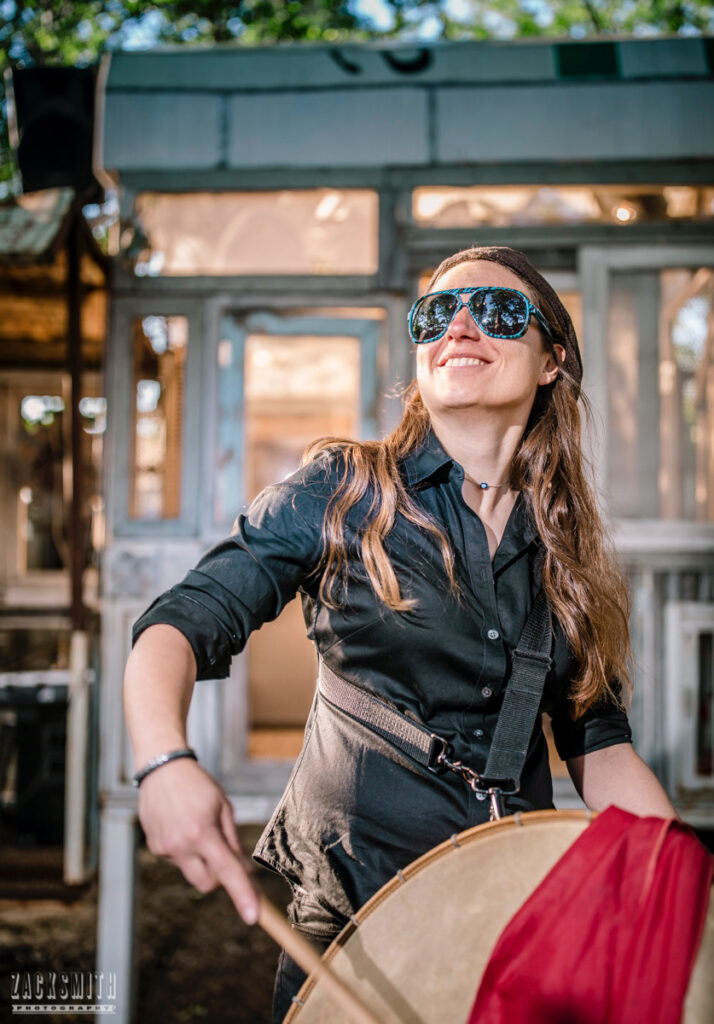
MAKING MONEY/APPLE BARREL GIG
Interviewer: Was it [Frenchmen] important for making money reasons? Was it an important part of your living, a big chunk of your living? Or was it important for other reasons?
Boyanna Trayanova: So really, the time when I was playing the most down there, that was not my money gig. I had another gig that was my money gig.
Int: So you were playing four or five nights a week down there and it still wasn’t a big chunk of dough.
BT: I was playing like, you know, five days a week at this touristy restaurant on the river that was paying me $25 a set, you know, and the tips were very little because people were there trying to eat and we were getting an hourly wage. And then I go on Frenchmen, it was mostly percent of the bar and tips. I mean, sometimes we had good nights. I would play down there on Fridays or Saturdays with Mike Sklar at the Apple Barrel and it was a trio and he would hustle the shit out of the tip bucket. Sometimes I would play with Coco Robicheaux down there too. We always did great. That was a hard gig because it started at 11. Ah! I can’t even believe I used to do that shit.
Int: Oh wow, yeah.
BT: I mean, I used to do worse on Bourbon St, actually. Play down there till 5 AM. God, never again. I’m too old for that, man. But yeah, the Apple Barrel, we’d play down there till at least 3. The whole point of that gig was like, you keep playing— be the last man standing. When all the other clubs close down, everyone goes to the Apple Barrel. And you make all your money then.
Int: Right.
BT: And you make no tips because everybody spent all their money already, of course! So you really gotta hustle that tip bucket in the beginning of the night. Anyway, getting maybe off topic here —
Int: No, this is the topic.
BEST WAY TO GET PAID / DRINK HUSTLES
Int: I mean, obviously this ties into the discussion about tipping and what’s the best pay structure. What’s the best [pay structure]?
BT: Down there? Well, the best way to get paid, so like, your pay comes from percent of the bar plus tips, unless you’re playing with some of these top notch clubs. Like Snug, that’s ticket sales. That’s fucking amazing, you know? Or like DBA. They charge a cover. Actually at one point the [Spotted] Cat was charging a cover too, but that was maybe short-lived, on the weekends, charging five bucks or something…. It was only on weekends.
Int: Yeah I remember that.
BT: So yeah, what’s the best way to get paid? Well if you’re not playing at a place that charges a cover, which is very few of those places, you gotta hustle drink sales, which I have moral conflicts with. I stopped drinking after Katrina. So, I don’t drink but I have to pretend like I do to be like “Hey, everybody pour a shot! Cheers! Cheers!”. That’s horribly annoying, you know?
Int: Yeah.
BT: Feels like you’re selling yourself for nothing.
Int: This is also not the first conversation we’ve had about—
BT: Fake drinking?
Int: Yeah. And where do you hide the drinks, the shots, you haven’t drunk?
BT: Well John Lisi’s trick was you have some tea, you know, and you pour that in a shot glass and it looks like whiskey and you’re like “Ahhh,, heyyy!” Go to the bartender [before the gig] like “Yo, I don’t drink,” here’s my thermos of tea, pour me one of these”
Int: And then charge them for seven shots of Jameson. That’s smart!
BT: Yeah. I mean, i never did this, but John Lisi did. That was his hustle.
Int: Fascinating. He might be somebody to talk to. I remember seeing him when I moved to town in 2007..
BT: Yeah, he played at Negril twice a week, Sundays and Tuesdays.
Int Interesting. Also, people have told us about getting [audience members] to buy a round of drinks for the band, because that’s a way to up the bar tab.
BT: My hustle is, I’ll order a drink and just give this to someone– “ I don’t want this.”
Int: See, I would always give it to the drummer. I would take a sip and hand it off
WORST/BEST GIGS
Int: Ok, best and worst gigs… ever.
Int: On Frenchmen.
BT: So, I think there’s two categories. There’s like, worst gig over time, average worst paying gig and single worst paying gig.
Int: Yeah.
BT: So my single worst paying gig was Negril. I don’t remember what fucking year. It was one of these— like I used to do the Wednesdays, like I was telling you, before Dominick had it. That’s part of the reason I gave it up because it was like “ahh”.
Int: This would have been pre 2013, I’m guessing.
BT: I guess, yeah, way before I think, That was probably 2009-2010ish. Maybe 2011, I have no fucking idea. 2008 even. Any of those windows.
Int: Post Katrina, pre 2013? Good enough. And not One Love Brass Band, because you said that didn’t start until 2012.
BT: No, this was I was doing a Wednesday gig at Negril with the funk band with some Japanese cats Seizo Shibayama and Kensuke. Don’t remember his last name, sadly). who is still around. He’s a fucking badass. He plays with like… I don’t even know who the fuck he plays with anymore. And this dude Kenzai who went back to Japan. But they were just like, sick, sick, sick, sick players. And I had that Wednesday gig for about six months. I just wanted to play with those cats. [But that one] was the worst single gig. the thing about percent of the bar and tip pay is that if you have a particularly slow night because no one’s out, you make no money. So that was the single worst pay situation. That was one of those nights; tt was stupid cold outside. No one wants to go to Frenchmen, because on Frenchmen you just bar hop.
Int: It’s an outdoor activity.
BT: You’re not really going to see one band. Yeah, it’s an outdoor activity. You’re walking around mostly. Maybe you’re hanging out on the benches in front of the Apple Barrel, you’re socializing, you’re like “Oh who’s playing? Oh cool, it’s my friend Boyanna. Let me drop by and see what’s up” and drop a little in the tip bucket and leave. So this particular night was frozen and there’s like no clientele. We played, you know, however long we fucking played. I don’t know, three hours? Something ridiculously unreasonable. It was like, a four piece band with tips and 20% of the bar. Which, also, the 20% is dubious because—
Intr: That’s a good word.
BT: I’m not getting a full…report from the cash register what you actually rang. It’s what the bartender says I rang. You know, are they telling me the truth here?
Int: Maybe.
BT: That’s another reason I let that Wednesday go because the bartender was just like, screwing us and stealing. Yeah. So this particular night there probably wasn’t enough to steal, but that’s just an aside as we’re discussing this topic. Yeah, so %20 of the bar when it’s zero is zero! Twenty percent of zero is zero, so we made six dollars each.
Int: Oof, you win. That’s a new record from everybody I’ve talked to. I’m sorry.
BT: Yeah, I’m number one! In worst paid! That’s an amazing honor!
Int: Alright, best gig ever on Frenchmen?
BT: I don’t even remember a figure, but it was during Jazz Fest. There was like— It’s not one particular gig that stands out It was probably a combination of several gigs that stands out. During Jazz Fest people are just, like, generous. One was with… one was at the Spotted Cat with— what was his name? Either Monty Banks or Andy Forrest? I don’t remember. Maybe Andy Forrest. Maybe Monty Banks. I don’t know, maybe both. I don’t know. One was with Kenny Holiday— he’s dead now. The BMC of all places. You wouldn’t think you’d make gigs there but we made a killing somehow. It was during Jazz Fest, that’s how. I mean, it was like… over 200 hundred. I don’t remember the exact figures. Must be have two sixty something— It was good. I mean, it should be so much more.
Int: Right, it should be.
BT: But there’s also, like, the best good feeling.
Int: That’s the best one! Those are the best stories, the good feelings ones.
SMOKING BAN
Int: When did the Apple Barrel ban smoking?
BT: It was after the ownership change.
Int: But before the city ban?
BT: Yup.
Int: Because I remember I got to town in 2014 and there was no smoking on Frenchmen, even though the ban was a year later.
BT: Yeah, so Liz would never ban smoking but then I guess there’s an ownership change and [they managed it.]
Int: We want our musicians to breathe.
BT: Yeah, thank you. But also at one point I just had to stop taking gigs at the Apple Barrel. You know, I played there four nights a week and I was just the go-to drummer to call. It was me and Tom Chute. Oh, you gotta gig at the Apple Barrel and you need a drummer? Who you gonna call?”. Me or Tom Chute. People just call me because of that. Then eventually I just had to stop taking gigs there because I didn’t want to play there anymore, and eventually people stopped calling me. You know how that works.
‘NORMAL’ PAY LEVELS
Int: Alright, ok, so going back to normal pay levels. So a totally unremarkable night of money, there’s levels in that. There’s “oh this was worth putting on pants for but kinda like, meh whatever”. And then there’s “ok, this was a good night of work”. You know, what were those levels?
BT: Ok, I mean, a hundred bucks is good. I would like to be making that, but that was kinda rare, especially the gigs I was playing. I wasn’t playing d.b.a or Snug— I would occasionally — especially not d.b.a. on a weekend. I wasn’t playing there.
Int: Everybody I’ve talked to says one hundred bucks. I know it’s a round number and it’s somehow stuck in people’s heads, I think, from a generation ago. It’s so, so consistent.
BT: It’s sad also.
Int: Yeah. Cause one hundred bucks for three hours of work, plus travel, plus whatever—
BT: Plus if you’re a drummer, you’ve got to bring you gear and set it up and then take it down and then bring it in your house and ahhh. It’s too much work! And find parking. Now you gotta a parking ticket and you gotta pay that!
Int: Yeah.
NEXT SPOT / ST. CLAUDE
Int: Alright, so Frenchmen has obviously had an arc over time. Where’s the next spot?
BT: If I knew. Well, nowhere right now. I thought it would be St. Claude and I was working hard to make that happen, but then there was a little bit of a gentrification situation going on. And it was starting to hit— how am I gonna phrase this – you know that ‘creative incubator’ point? Or right before that. What I remember Frenchmen in the 90s being, St. Claude was starting to hit that. And then the gentrification wave— tsunami, let’s call it a tsunami— It just came and washed over everything and it kinda never really fully materialized. It was just about to get there.
Int: That area became drowned in Airbnbs and stuff—
BT: That sorta stuff. And Siberia sold. I think that’s the crucial moment Of when like, “this didn’t work out”. Because Siberia was my jam! they had a Thursday Balkan night, that was my jam.
Int: Oh I forgot about that! My working theory is that St. Claude never coalesced like Frenchmen partly because of traffic. Like it’s [physically] too big of a street to be a cohesive ecosystem.
BT: Yeah, it’s too big. With Frenchmen you can just like, wobble drunkenly in the street and you wouldn’t get hit by a car, but you can’t do that on St. Claude.
Int: One thing that I worry about, is just technology and how that’s changed. If somewhere like Frenchmen dies, the spirit moves elsewhere that’s the same vibe and shit. But I also wonder if that can grow up in the world we live in now. Talking to Jonathan Freilich, talking about like, you’re hanging out there. You’re not on your phone. [But] Now our culture’s so focused on, “oh something hip is happening, let’s take a picture of ourselves there and then on to the next thing.”
BT: “Let’s video it! Let’s facebook-live it!”
Int: When I’m out on St. Claude it’s not as touristy for sure. But it’s also a lot of young, pointedly hip transplants. Not that I’m not a transplant.
BT: Yeah. I find it was really creative in the late 90s, you know? People were doing really cool fucking shit. And it was just getting there, in St. Claude before Siberia sold. I don’t want it to be secret. I just want locals to go. I think that’s a key component here: You need locals to support the scene. You know? It can’t be [only] supported by tourism. I think it’s really important for locals to support the scene because like, tourists want to hear a certain type of thing that makes it so that you’re not making art, you know? Now you’re just commodifying it for the tourists. Now you’re just pandering. That’s the word I’m looking for. You’re playing… you know, touristic crap, that they want to hear. Where like, I wanna be makin’ art. You know? So we moved it to St. Claude and that was sort of working, but then the whole gentrification wave hit, the Beauty Supply got sold, Gene’s Po-Boys got sold, Siberia got sold… It all happened in one summer. I guess that was 2019 because I was on tour for like four months and before I left everything was fine,
PLAYING UNDERAGE
BT: I moved here when I was 14. Well, I moved to America when I was nine, but we lived in Durham for four or five years. My mom got a job at Duke. Then she got a job at Tulane. ’94 is when I came here. No, wait, that’s when Mom came here. I came in ’95 because I finished out middle school up there and then came here for high school. Went to Ben Franklin High School. Somehow I did not go to NOCCA because I was a punk teenager. My parents mentioned it to me, but they didn’t really push because they were science people, not arts people. They should have pushed me but they didn’t. I was a punk teenager. I was like, “I like punk rock. I don’t like jazz.” That’s a big mistake [laughter] If I could do anything over again, I would go to NOCCA.
Being an underage musician. I was playing with this band, and I was obviously the youngest member. Everyone else was like 30ish, except teenage me I was like, sixteen! We played at the Acadian Brewery, which is not, on Frenchmen, it was on Carrolton. I was really fucking young, let’s just stress this! Playing in a brewery.
[laughter]
It was fun. We played at Checkpoints a lot actually. They didn’t really care because I’m walking in with some drums. They’re not checking my fucking ID. I’m walking straight to the stage. I’m not hanging out at the bar. I look young now–imagine 16-year-old me! But yeah, this particular night, the guy that normally would get the pay had forgotten his ID or something. You got to give them your ID for them to give you your money. I’d just gotten my driver’s license, and I’m like, “Oh, here. Here’s my ID.” They’re like, “We don’t want to look at that. No, dude, you’re 16. We don’t want this to be on the record. You’re five years too young to be in here!”
[laughter]
Oh my God. I played in all kind of places when I was way too young. The Dream Palace, which is now the Blue Nile. Upstairs, which was called the Reality Grill. I mean, it was great when I was 16 and getting paid to play music. It was just like, “Sweet. I’m rich.”
Int: What was the take home pay?
BT: I have no idea but it was a lot of money to me as a high schooler. *whispering excitedly* ….gonna buy some weed…..
[laughter]
DRAGON’S DEN
BT: I’m remembering more things. The Dragon’s Den. The Dragon Den was a great place to play. I don’t know what year it was. Must have been the very early 2000s. 2000/2001-ish. This is more about the money thing. It was also a really great arts incubator there. It was a great place to play because they would let you charge a cover. They would also give you 20%, which doesn’t even exist now. Cover and 20% of the bar and the food–and they’d feed you. That’s awesome. It was like a… Thai restaurant at the time? Cafe Siam. Maybe the only thing that sucked about it was the stairs. …if you’re a drummer. Oh my God.
Int: The stairs turned.
BT: It was horrible trying to log your giant hardware bag that weighs 50 pounds. Oh no! And you’re 5 foot, 3″, and small? [laughter] But that was great. That was a great place to play, and that was always amazing. We did great.
Int Who was in there, was it locals coming to see you?
BT: Yes, it was locals, yeah. It must have been. I was playing there with this poet guy. He was a spoken-word poet. He had this band.
Int: What was his name?
BT: Karama Sadaka. He does not live here anymore.We had a weekly gig at the Audubon Hotel on St. Charles and we would occasionally get booked at The Dragons Den also. We always made a killing, I don’t remember, what the actual figures were but I remember it was great. And I’m sure I played there with tons of other people as well; that’s just one that sticks in my mind. The people coming to see him were definitely locals. You know, just doing spoken word with a … somewhat improvised backing band. Had this killer sax player, Earl Brown I think he’s still around.
WHO TO INTERVIEW
Int: You know what? Hadn’t even literally occurred to me and this makes me feel really dumb is that some people that we maybe would want to interview don’t live here anymore.
BT: I’m sure you talked to Jonathan Freilich. He still lives here, and he was around then. Alex McMurray… Glenn Hartman… Although Glen doesn’t play down there anymore. Jonathan does. Is Alex still…?
Int: Jonathan gave a lot of good stuff, especially. I have a long interview with him. He was great. He told us those wild stories about Washboard Lissa.
BT: Trying to think of people you should talk to. Ken Swartz. S-W-A-R-T-Z. He played at the Apple Barrel every Tuesday 2008-ish.
Int: Apple Barrel’s an interesting little ecosystem in its own right.
BT: I’m thinking obviously Dominick Grillo. He’s held that Wednesday down for a really long time. Is Meschiya good to talk to?
Int: I should put her on the list too among the many people.
BT: Aurora would be awesome.
Int: I think she’s on the list that we made. Who was playing here? Like who was playing when you started? Like that’s the question.
BT: Daaaarby. Washboard Chaz. Talk to Washboard Chaz.
Int: Yes. I have an interview with Washboard Chaz and Alex McMurray together [on the site]
BT: You could talk to Walter “Wolfman” eventually. He plays at DBA every Wednesday, but that was somewhat of a recent thing. He’s almost 80 now. Jim Singleton played at Snug
Int: We’re talking to him tomorrow.
BT: Awesome. Talk to Aaron Wilkinson.
